 Aja Drain
In conjunction with its first Code Purple air quality alert in decades, D.C. was advising residents to shelter indoors — a refrain all too familiar after the COVID pandemic. But not everyone has the luxury of having a place to shelter, with many homeless residents feeling the brunt of the hazardous air.
“This morning, I woke up with my tongue was like an ashtray,” says Lucifer Potter, an unhoused resident of D.C. for over 20 years. Potter is not alone; 4,922 individuals were found to be experiencing homelessness in D.C. during a count in January, the first time in years that homelessness has increased in the District.
With air quality that bad, pollution can have detrimental impacts on your health, especially for unhoused residents. The smoke particles are small enough that they’re able to enter your bloodstream. They can also cause burning eyes, throat and lung irritation, and runny nose, according to the EPA.
“People experiencing homelessness have a lot of the same medical conditions that people in the housed community have, but often more severe and at younger ages,” says Dr. Catherine Crossland, director of homeless outreach and development at Unity Health Care. For example, lung conditions like asthma and emphysema are exacerbated. Unhoused people are also already overly exposed to air pollution, especially people living under underpasses, Will Reid of Food Not Bombs told WAMU/DCist.
“I’ve noticed the past few days my breathing is more labored, but I’m out here, so there’s a lot of us out here,” says Patricia, who only gave her first name. Patricia is from Florida, but has been in D.C. for a little over a week. They were able to get access to an inhaler and are hoping to find shelter later this evening.

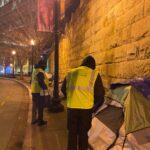
Local organizations serving homeless residents worked within their networks to support people across the city. Unity Health Care has some clinical spaces at low-barrier shelters and other service centers for people in need. Outreach staff at organizations like Miriam’s Kitchen, Pathways to Housing, and Food Not Bombs DC were out and about providing masks and information to connect residents to shelters.
Local mutual aid group Remora House is taking donations for masks and also shared advice on how to help unhoused neighbors during severe air quality, such as providing money or gift cards to help someone shelter in a cafe.
https://twitter.com/RemoraHouse_DC/status/1666555952030425096
In response to poor air conditions, D.C. government and partner agency outreach teams urge unsheltered residents to seek relief from poor outdoor air quality, according to a press release from the Mayor’s office. The Department of Human Services advises unhoused individuals to call the Shelter Hotline (202) 399-7093 for transportation for unsheltered residents. Low-barrier shelters are still open 24 hours, while other shelters and service centers were open at varying hours:
https://twitter.com/CMRobertWhiteDC/status/1666834015431663625
In addition to shelters, the District also recommends its recreation centers to unhoused residents. It also distributed masks Thursday.
“Workers that work in the field are equipped with masks to be able to allow individuals who choose not to come into shelter, to be able to stay healthy,” City Administrator Kevin Donahue said at a press conference Thursday. “And then we check in with those human service agencies twice a day to be able to see other adjustments that we have to make to make sure everyone’s doing something.”
But distributing resources and information has grown difficult for support organizations with homeless encampment clearings dispersing unhoused communities from large downtown areas like McPherson Square to smaller residential areas like Deanwood.
“Instead of having, you know, a dozen people in one encampment, you have 12 people in 12 different spots, which means that they’re harder to get in touch with,”says Jesse Rabinowitz, who works at Miriam’s Kitchen.
But this may not be the last time D.C. has to deal with poor air quality, and questions remain regarding infrastructure to help support unhoused groups. There have also been predictions that D.C. could face a shelter shortage this year, with two shelters closing and the end of the PEP-V program.
“We know that if everyone currently staying outside went to a shelter tonight, the system would not have the capacity to accommodate everyone and most people,” Rabinowitz says. He adds that many people do make the rational decision to stay outside of a shelter, like living in tents for protection against the elements, but those options are being removed by the city government.
“I’ve been moved like 18 times,” says Potter, who would normally go inside to get some fresh air but has been banned from multiple buildings in D.C.
“This is just today’s crisis; the crisis itself is homelessness,” says President and CEO of Pathways to Housing Christy Respress. “Whether it’s COVID, the wildfires now, climate change, extreme weather, as long as we have people living outside without housing, we are just continuing this conversation, running from one crisis to the next and putting Band-Aids on the problem.”
It’s a problem that residents like Patricia are experiencing firsthand.
“It’s rough for all the homeless people,” Patricia says. “They try to help us as quickly as possible, that for some there’s like a waiting list…to wait up to a year out in the streets or in shelters is what I was told.”
Advocates across the board say that the long-term solution to preventing risk from hazardous air and future crises for unhoused populations is investing in housing.
Jenny Gathright, Colleen Grablick, and Morgan Baskin contributed reporting.