Margaret Barthel
Loudoun County is renaming roads that previously bore the names of Confederate generals, enslavers, and segregationists, participating in a region-wide trend seeking to remove names and symbols honoring the area’s racist past.
The county says it has completed the process of switching out street signs and changing addresses for Jeb Stuart Road, which runs through the village of Philomont, southwest of Leesburg. The road, previously named for J.E.B. Stuart, the Confederate Army general , is now called Philomont Road — a change for the 57 homes and businesses along the road that include the name in their addresses, according to county records.
The Board of Supervisors originally approved renaming the road in November 2021, estimating the cost of replacing the signs at $4,200.
And there are more name changes on the immediate horizon. In and around the town of Round Hill, west of Purcellville on Rt. 7, a number of streets that previously honored Confederate generals will get new names — most of them references to the natural world — at the beginning of August.
- Early Avenue will become Earlybird Avenue
- Hampton Road will become Cinnamon Fern Road
- Jackson Avenue will become Honeybee Avenue
- Lee Drive will become Turtle Hill Drive
- Longstreet Avenue will become Piper Run Avenue
- Pickett Road will become Broken Arrow Road
Last year, homeowners on Mosby Court, a road entirely within the Round Hill town lines, successfully pushed back against proposals to rename their street, which also bears the name of a Confederate military leader. The town council voted against pursuing a name change for the street.
Fort Johnson Road, west of Leesburg along Rt. 7, is also undergoing the renaming process (it’s named after a nearby historical fort that bears the name of Joseph E. Johnston, another Confederate general), but the process won’t be complete until later in 2023.
By September, the county anticipates completing a much larger and more expensive renaming task: changing the signage and addresses for its sections of Route 7 and Route 50. Route 7 is a major east-west arterial road currently named for former Virginia governor and U.S. senator Harry Byrd, an architect of the commonwealth’s “Massive Resistance” response to school desegregation that shut down public schools rather than integrating them. The highway will now be called Leesburg Pike, which formalizes a historic name for the route that is already its official name in adjoining Fairfax County. In Purcellville, the highway will also bear the secondary name “Billy Pierce Memorial Pike,” after an African-American choreographer born in the town.
Route 50’s current signs say John Mosby Highway, after an officer in Stuart’s Confederate cavalry. Also a major east-west state highway that connects the Chantilly area to Winchester, Route 50 will soon be called Little River Turnpike, a historic name for the road. Fairfax County leaders voted in 2022 to rename Route 50, which had previously been referred to as Lee-Jackson Memorial Highway, to simply “Route 50.”
There are about 350 addresses along Route 7 and 300 along Route 50 that will be affected by the renaming, according to documents prepared for the Board of Supervisors by county staff. The board voted in December 2021 to move forward with the renaming process for both highways. At the time, staff estimated the cost for the signage changes at upwards of $600,000.
The county has a website with updates on the renaming process and resources for businesses and residents impacted by the changes. A program to support businesses through the name changes is expected to launch next month.
The changes in Loudoun follow a raft of similar actions across Northern Virginia, a trend which gained momentum in the wake of public protests against police brutality and racism in the summer of 2020. Local officials across the region have found a host of names honoring Confederate leaders, many of which were named at the turn of the 20th century, as the myth of the “Lost Cause” took hold. (This narrative sought to portray the Civil War as a dispute over states’ rights, not slavery, and to make Confederate soldiers into gallant military heroes, not traitors to the United States.)
Now, years later, those decisions in Loudoun and elsewhere are finally replacing street signs and changing school and place names. The process is involved, often requiring historical research into the original name, public feedback on new ones, and more. With many major roads crossing jurisdictions and including portions of state highways, county officials have had to seek approval from state legislators and the Commonwealth Transportation Board to move forward with a desired name change.
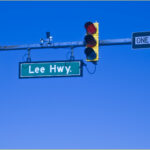
Arlington created a new county logo, which used to depict Arlington House, Robert E. Lee’s home. The county also renamed Lee Highway Langston Boulevard, after Virginia’s first Black congressman (Fairfax County also got rid of the name “Lee Highway,” instead choosing to call the road simply “Route 29,” after its state highway designation). In Arlington and Alexandria, the road formerly named Jefferson Davis Highway after the president of the Confederacy is now called Richmond Highway.
Alexandria’s City Council approved a plan to speed up renaming streets in January, directing the city to budget for renaming three streets per year. (Alexandria has more than 40 streets with Confederate names).
In Fairfax, county leaders also chose to rename Lee District, one of the county’s magisterial districts, after a review of the historical origins of the names. Lee District became Franconia District in December 2022. A report in 2020 found more than 150 place names in Fairfax County with confirmed Confederate origins.