Jacob Fenston
It’s been a nail-biting three months for zookeepers at the Smithsonian’s National Zoo, waiting to see if Nikita would give birth to tiger cubs. Now, as what would be her due date approaches, it’s clear the 11-year-old Amur tiger is not pregnant, zoo staff say.
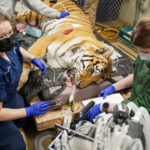
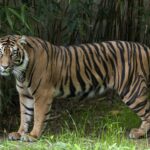
In early March, zoo staff performed an artificial insemination procedure on the 300 lb. cat — hoping to have Amur tiger cubs at the zoo for the first time since 1948. Amur tigers, also known as Siberian tigers, are the largest wild cats in the world, and they don’t easily breed in captivity. (There have been cubs of the smaller Sumatran tiger subspecies more recently).
Zookeepers had hoped to give the endangered Amur tiger population a boost, breeding Nikita with 7-year-old male Metis, neither of whom have ever had cubs before.
Zoos help keep tigers and other endangered animals from going extinct by making sure there is a sustainable, genetically diverse captive population of the animals. This is a sort of insurance policy in case wild populations are ever wiped out.
The zoo tried natural breeding with Nikita, even swapping out male Amur tigers. When that didn’t work, they turned to artificial insemination — something that has rarely been tried successfully with the large animals.
Amur tigers have a gestation period of about 11o days. As Nikita reaches that mark, it’s clear she is not going to have cubs, says Craig Saffoe, curator of large carnivores at the zoo. For one thing, she hasn’t gained any weight.
“She actually dropped a little bit of weight,” Saffoe says.
This will likely be the last attempt at cubs for Nikita. At age 11, she’s considered a middle-aged cat.
“The likelihood that she conceives is just getting lower every day,” Saffoe explains.
Instead of trying to artificially inseminate Nikita again, the focus will be on breeding the potential dad, Metis, with a younger female — either sending him to another zoo to breed, or swapping Nikita with younger animal from elsewhere.
“The potential dad, he’s still got good genes and he’s still a very, very valuable animal,” Saffoe says.
He says even though Nikita did not conceive, the artificial insemination procedure was still worthwhile, and with lessons for how to proceed next time.
“The science is moving forward, and every time we move that needle forward, we move conservation efforts forward,” say Saffoe.