Morgan Baskin
Late last November, Taniya Rogers was living in her car. Even when other neighbors in her Langdon apartment building began trickling back in – after a gas leak documented the day before Thanksgiving sent several of them packing – Rogers couldn’t stomach returning.
That’s because the cockroaches in her apartment had grown so thick that they began falling off the ceiling onto her kids, she says – she even found them in their beds when she’d pull their blankets back to sleep at night. So for two months, the 32-year-old slept with her two preschool-aged sons in their car, in the parking lot of their apartment complex at 1511 Franklin Street NE.
“I was very scared,” Rogers says. “I was nervous about the building blowing up.”
Fifty-eight-year-old Tappi Small, meanwhile, heard her carbon monoxide alarm ring on Nov. 23. When she called maintenance about it, Small says the responder told her to shut off the alarm with the back end of a broom. She did, but she says she almost immediately started experiencing chest pains and difficulty breathing. By the time she called 911 and paramedics arrived, she recalls, “They said if I didn’t call them and get out of here, I’d have been dead on Thanksgiving.”
A report from Washington Gas shows that her stove was leaking carbon monoxide at 300 parts per million – those levels are high enough to result in death, according to the U.S. Consumer Product Safety Commission.
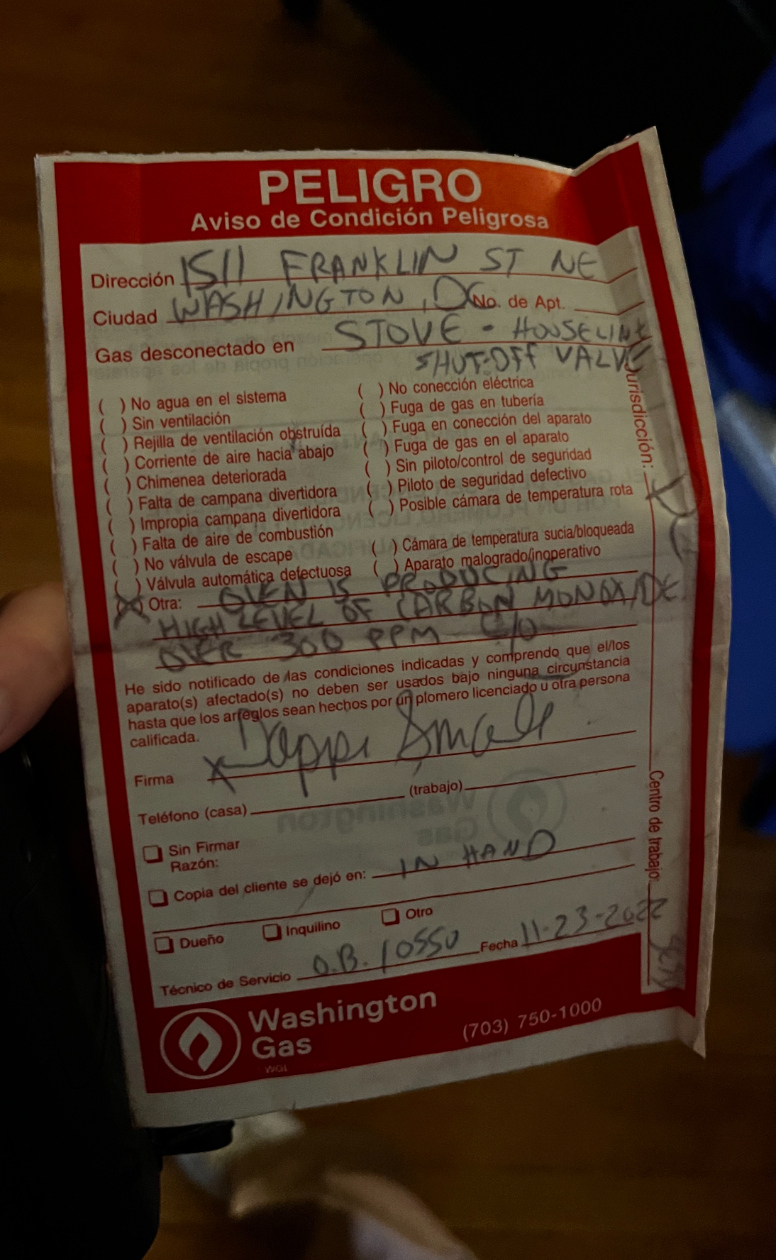 During DCist/WAMU’s visit in late May to the rent-stabilized building, the basement still reeked of gas. Washington Gas has been back to the building at least three times this spring, records show, with one hazardous conditions notice from May 27 saying that the technician found “multiple leaks on houseline of apartment building.”
In the time since conditions issues crescendoed last fall, the building owner, Brookland Investments I LLC, has sued to evict at least 13 of the building’s 18 households over nonpayment of rent. Three of those tenants tell DCist/WAMU that they’re intentionally withholding rent until the owner and property manager make serious repairs to the building. But Brookland Investments isn’t just trying to collect back rent – it’s trying to repossess some of those tenants’ apartments.
An attorney for Brookland Investments didn’t comment on why the company is seeking repossession.
A handful of those eviction cases have closed, with tenants either ordered out of their apartments or entered into settlement agreements. Others, like those involving Rogers and Shanta Rodriguez, president of the building’s tenant association, are ongoing. Rodriguez is scheduled for a mediation session with the plaintiff this fall, and has requested a jury trial.
While D.C. offers some of the country’s most progressive pro-renter protections, those have natural limitations, and the tenants of 1511 Franklin are brushing up against that ceiling. They’re ultimately asking one question: should tenants have to pay to live in a building where they say their safety is at risk?
Case law in D.C. supports the notion that tenants have the right to withhold rent if their building owner hasn’t sufficiently addressed housing code violations, and the District government recognizes renters’ right to strike. Tenants may also petition to receive a rent reduction if they can show that their living conditions violate the city’s housing code. And as a Covid-era moratorium on filing evictions kept renters in their homes across the city, rent strikes proliferated, giving tenants leverage to demand better housing conditions without the looming threat of being ousted from their homes.
One tenant advocacy group, Stomp Out Slumlords, helped organize at least 22 such strikes, DCist/WAMU reported in March. Some of those resulted in significant wins for tenants, with property owners writing off thousands in back rent.
But tenants still take a risk when they strike, even more so now that the eviction moratorium has expired. While data from D.C.’s Office of the Tenant Advocate indicates that evictions haven’t yet reached pre-pandemic levels, they are still occurring in droves – there were 754 scheduled evictions in fiscal year 2022, 346 of them carried out.
The business entity suing to evict Rodriguez and her neighbors is affiliated with NOVO Properties, the company that manages resident services at 1511 Franklin and more than 2,000 other housing units across the D.C. area. Those apartments run the gamut from older, rent-stabilized buildings to modern apartments that rent at market rate.
“In October 2022 the building owner was notified of a potential gas leak. The owner immediately conducted a building-wide pressure test. Some gas stove lines were found to be corroded and were replaced,” Aaron Sokolow, an attorney representing Brookland Investments in its eviction cases, wrote in an email to DCist/WAMU, along with invoices for gas line repair work.
 One invoice, dated Oct. 31, noted that the building’s contractor found gas leaks in two units, and that corrosion would require them to replace 50 feet of gas lines in crawl space spanning five apartments. Sokolow also said that the building owner “contracts with a monthly pest control service to exterminate in the common areas, outside the building and inside resident apartments on a rotating basis and upon request.” Sokolow didn’t respond to a question clarifying whether the work was ultimately carried out.
Rodriguez maintains that neither NOVO nor Brookland Investments has communicated with tenants about the gas issues, and that ongoing issues with gas leaks indicate that more repair work needs to be done.
For her part, Rodriguez is not sentimental: the 12-year resident of 1511 Franklin St. is an encyclopedia of dates, records, and photographs. She and her neighbors have lived with the issues plaguing their building for so long that she barely registers the smell of natural gas perfuming her halls.
In May, wearing a pastel Golden Girls T-shirt and a pair of oversized sunglasses, she marched from one floor to another, from the front porch to the parking lot and basement, identifying rat nests and unsealed windows and exposed wiring that runs directly into the dirt at her feet.
“We live in fear,” she says simply. Just a week before, a judge ordered that beginning in January, Rodriguez’ rent be reduced by about $200 per month.
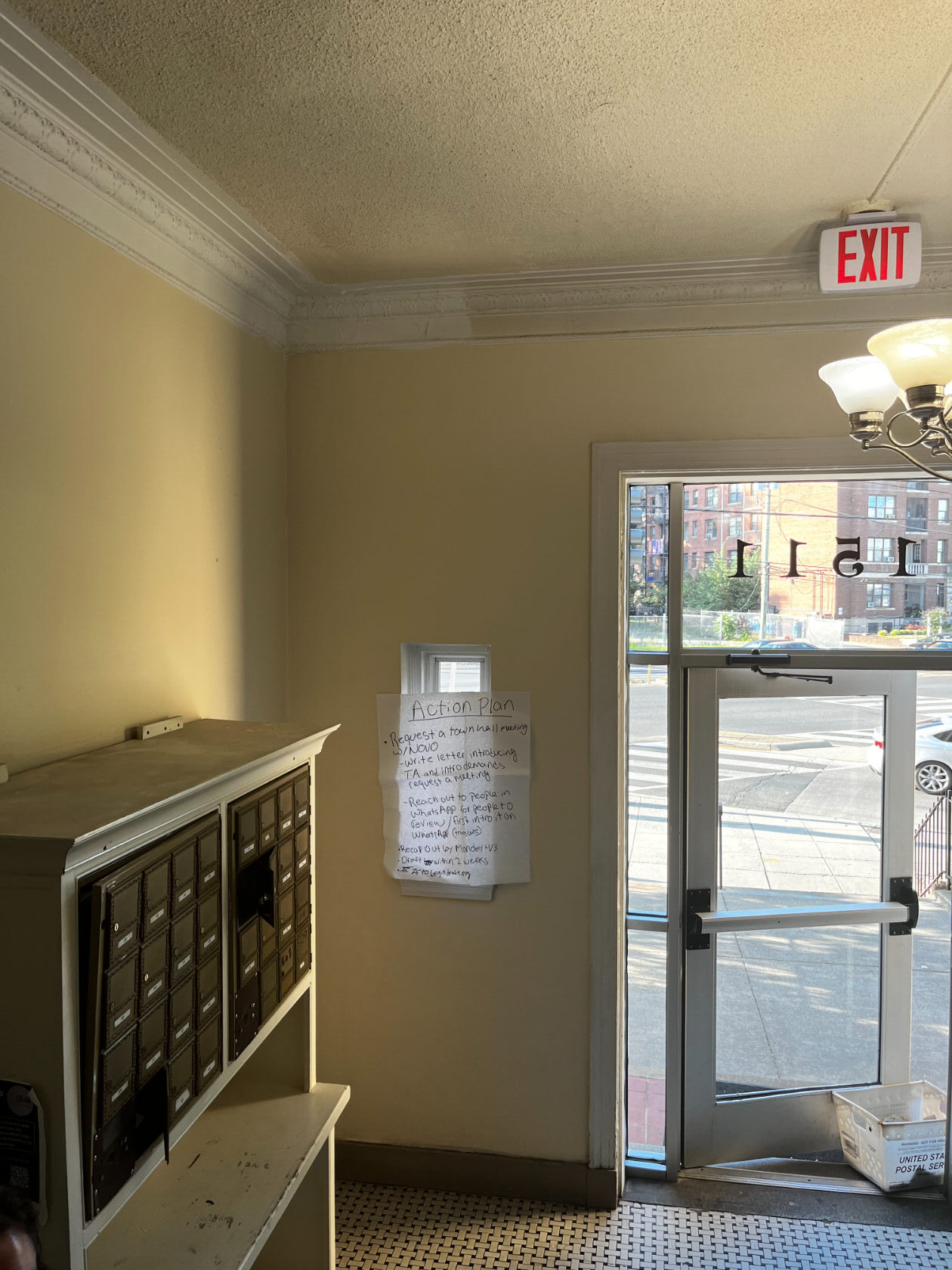
But these women say they have no interest in leaving the building: they’re organizing to protect a found community, one that watches each others’ kids, organizes potlucks, and advocates on behalf of each other. Shortly before that evening’s tenant association meeting, as people began to trickle into folding chairs arranged in a crescent along boxes of pizza in the building’s foyer, Rogers paused in the stairwell.
She remembers moving into the building several years ago with her partner, who has since passed away, thinking about how charming it was from the outside, dreaming about their future together. As the years progressed and life got harder, she was struck by an organizer’s sign hanging inside the elevator, asking whether the reader had to choose between feeding their kids or putting gas in the car. She remembers feeling seen, and motivated to action – that at a time when rent is more expensive than ever, she and her neighbors shouldn’t have to spend so much money on a home that doesn’t feel safe to them.
“We’re just letting people know what their rights are and that they have a chance to make things right,” Rogers says, “from what has been wrong to them for so long.”