Martin Austermuhle
It’s often said that people are more likely to change their behavior when they know they’re being watched. Now D.C. wants to see if that’s actually true with dangerous drivers.
The city is starting a year-long pilot program where it will send targeted letters and text messages to almost 100,000 drivers who have received a large number of speeding and red-light tickets from the city’s network of traffic cameras, with the hope that those direct and somewhat stern missives will change their driving habits for the better.
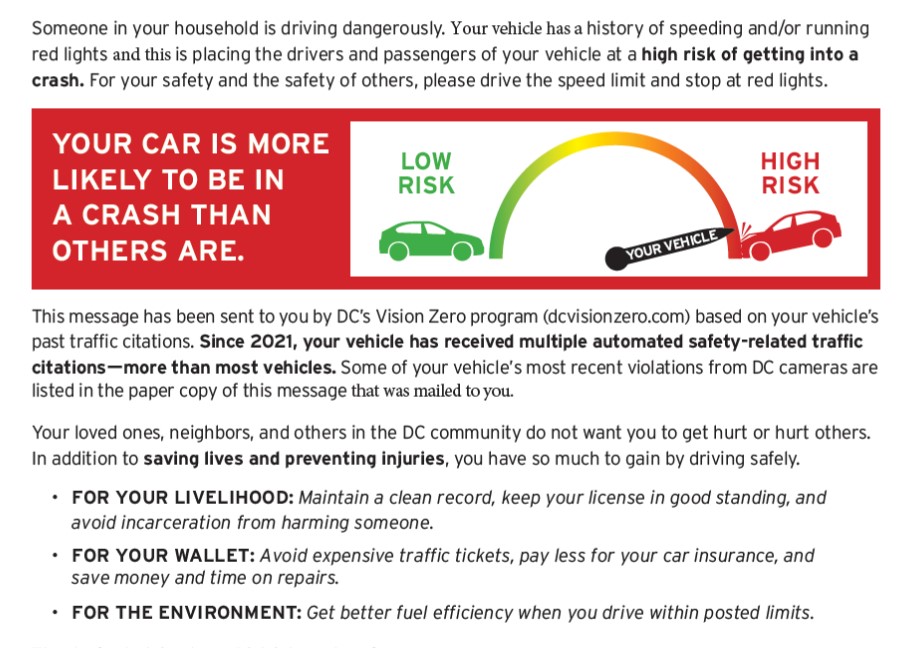
“Someone in your household is driving dangerously. Your vehicle has a history of speeding and/or running red lights and this is placing the drivers and passengers or your vehicle at a high risk of getting into a crash,” reads the letter that will be sent out to select drivers in D.C., Maryland, and Virginia, with shorter variations used for text messages. “For your safety and the safety of others, please drive the speed limit and stop at red lights.”
“YOUR CAR IS MORE LIKELY TO BE IN A CRASH THAN OTHERS ARE,” adds the letter, next to a graphic of what looks like a meter assessing crash risk with the pointer pointing at “High Risk” and an image of a car crashing.
The initiative comes from The Lab @ D.C., the city’s in-house research arm that since 2017 has been running experiments and researching best practices on everything from how to simplify government forms to whether body-worn cameras actually change police behaviors. D.C. officials say the new pilot program ties into the city’s broader goals under the Vision Zero initiative, which seeks to eliminate roadway deaths and injuries.
“We are trying to do everything we can and use all the tools and data that we have to be able to eliminate traffic fatalities and reduce dangerous driving in the District. So this is one way and a new way to use the data that we have in the government to be able to try something out to lower the number of crashes,” says Sam Quinney, The Lab’s director. “The goal here is not to be punitive. This is not an attempt to shame drivers. What we’re trying to do is make them aware of their risk. Like a lot of things, most drivers tend to think they are safer, or that a citation here or there isn’t a big deal, when in fact they are putting themselves at higher risk and putting the community at higher risk.”
The letters and text messages will include both finger-wagging reminders about how speeding and running red lights is dangerous, but also more personal appeals to describe the impacts of those actions. “Your loved ones, neighbors, and others in the D.C. community do not want you to get hurt or hurt others,” reads the letter, which will cite examples of how safe driving is better for a person’s livelihood (“Avoid incarceration for hurting someone”), their wallet (“Avoid expensive traffic tickets”), and for the environment (“Get better fuel efficiency when you drive within posted limits”).
According to data The Lab has already collected and analyzed, twice as many vehicles that get tickets from driving more than 20 miles per hour over the posted limit have been involved in a crash, and three times as many with red-light violations have similarly crashed.
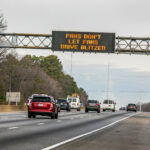
Research conducted in Virginia has found that non-traditional messages on highway or road signs have been shown to be more effective at getting drivers to change their habits. “Messages about distracted driving, messages that include humor, and messages that use word play and rhymes rank high among multiple measures of effectiveness,” concluded a 2020 research paper from academics at Virginia Tech.
While D.C.’s pilot program will feature more traditional messaging, Quinney says one of the benefits is that the letters and text messages will be directly targeted at specific drivers, and not rely on highway signs that might not be seen by the most dangerous roadway users. He says that once the year-long pilot concludes, The Lab will assess whether the messages helped reduce crashes and tickets.
The initiative comes amidst ongoing criticism about D.C.’s progress on its Vision Zero initiative, which had initially pledged to eliminate roadway deaths by 2024. Instead, there were 35 deaths last year, down slightly from the 41 in 2021, a 14-year high. A recent report from the D.C. Auditor found that the Vision Zero program lacked oversight and funding. There’s also been criticism that D.C. may be missing red flags that could be found in its own database of traffic camera tickets; the woman now charged with murder for the mid-March crash that killed three people on Rock Creek Parkway had dozens of outstanding speeding tickets worth more than $12,000 in fines, for one.
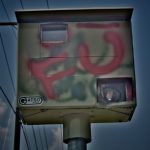
As D.C. continues expanding its network of traffic cameras, a number of efforts are underway that lawmakers and officials say could improve outcomes. Mayor Muriel Bowser created a new task force to explore whether to change the existing fines for speeding and other offenses, whether a sliding scale is needed for fines to low-income residents, and how to ensure that more non-D.C. drivers are required to pay the fines they owe. (Currently, there’s no reciprocity agreements between D.C. and Maryland and Virginia, meaning the city has few enforcement mechanisms against drivers who don’t pay their fines.) Some lawmakers have also proposed giving the traffic cameras more teeth, by allowing them to assess points against a driver’s license for violations.
D.C. officials say that while the new initiative won’t necessarily address all concerns with the city’s traffic cameras and dangerous drivers, it can at least help.
“If this intervention can make a difference, it becomes a tool in the toolbox,” said Charlie Willson, the director of the city’s Vision Zero office. “It’s a lot like preventing crashes before they occur by reminding drivers of their responsibility when they’re on the road. I think one of the appeals of it is that it’s something that you can scale up and target relatively easily and relatively cheaply, but it has the potential to influence behavior.”