 Jordan Pascale
Metro says it will run more trains than at any other point in time during its 47-year history starting today, as service and fare changes go into effect with the beginning of a new fiscal year. Bus service is also returning to pre-pandemic levels.
And while many people may remember trains running more frequently (Red Line trains ran every 2.5 minutes back in 2010, for example) Metro says it is running more service throughout the day and on weekends, instead of focusing service so heavily during peak rush hour periods. It’s the most budgeted railcar miles the system has run, thanks to the addition of six new stations on the Silver Line and the shift to running the higher levels of service all day.
Travel patterns have changed during the pandemic with fewer white-collar workers commuting during the week.
Service improvements include Orange Line trains running every 10 minutes until 9:30 p.m., and every 15 minutes after that all week. Previously they ran every 12 minutes during peak hours and 15 minutes off-peak.
Blue and Silver line riders will see trains every 12 minutes from opening until 9:30 p.m., and every 15 minutes after 9:30 p.m., seven days a week. That’s an improvement on the current 15-minute weekday frequencies during off-peak hours.
This is the tenth service improvement since last summer.
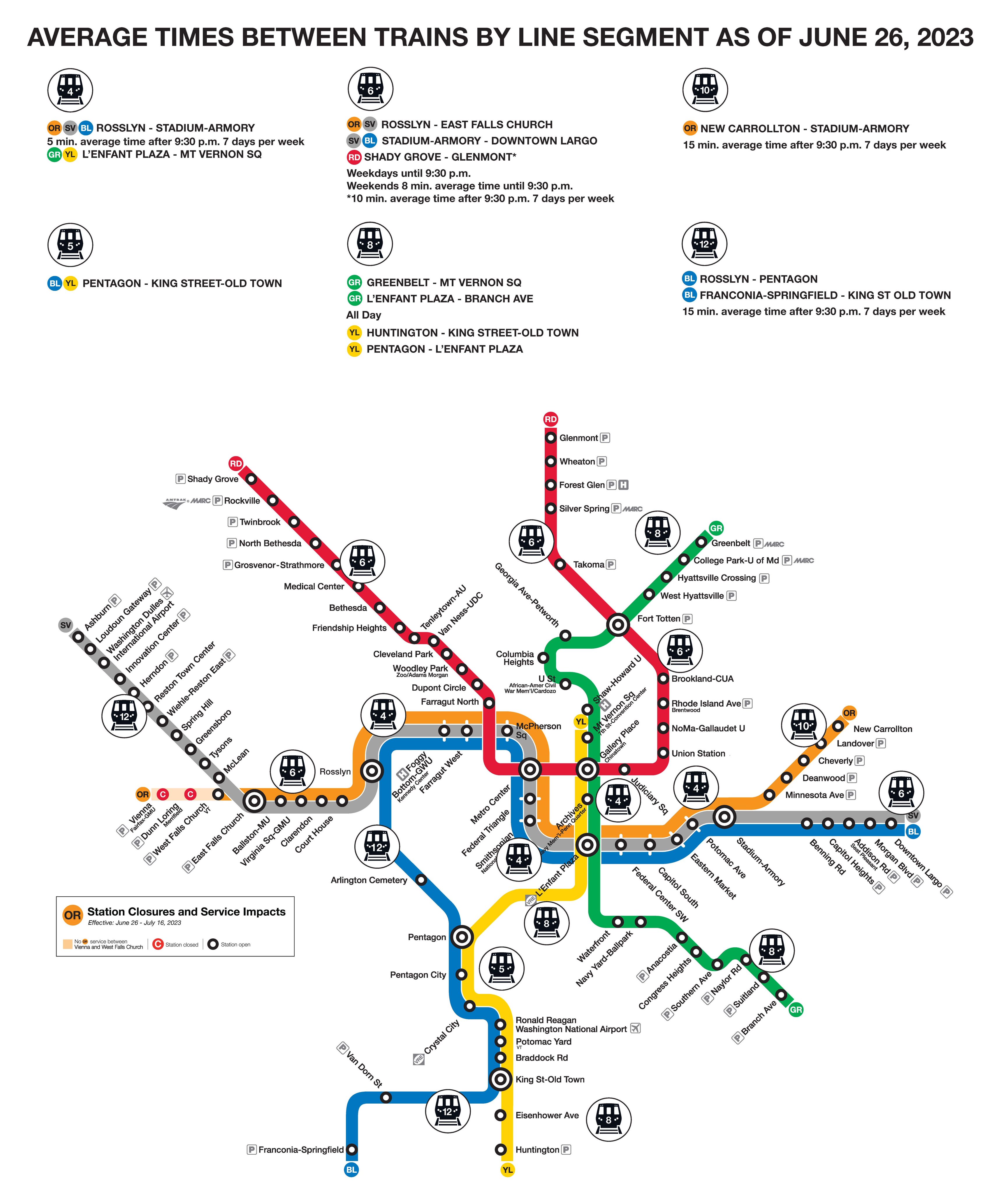
Metro still has a bit to go to reach its budgeted service levels for the fiscal year. Those service levels rely on the return of more 7000-series trains and operator availability.

So how does this news co-exist with the recent news of an upcoming $750 million financial problem, that could lead to trains every 30 minutes and closing the system after 9:30 p.m.? That problem is for the next fiscal year while this budget through June 30, 2024, is already funded.
Metrobus improvements
Metrobus service is also above pre-pandemic levels by 4% with improvements on 68 routes.
But that doesn’t mean all the pre-pandemic routes have returned. Routes like the S1, H1, 18H, and X1, which went away during the pandemic, are not back. Metro says it evaluates routes annually.
Metro has added new routes like the 16M which will expand connectivity between the Skyline neighborhood in Fairfax County, through Columbia Pike, and extend to Crystal City Metro. Arlington County officials celebrated with a ribbon cutting to celebrate the growth of Columbia Pike as a “premium transit corridor,” county officials said.
In D.C., the B2 from Anacostia to Mt. Rainier bus terminal will have a better frequency of every 12 minutes in off-peak hours.
In Maryland, the A12 route is being extended along Landover Road and Martin Luther King, Jr. Highway. A new L12 route will serve Downtown Largo and New Carrollton stations and Woodmore Towne Centre, every 20 minutes for most of the day.
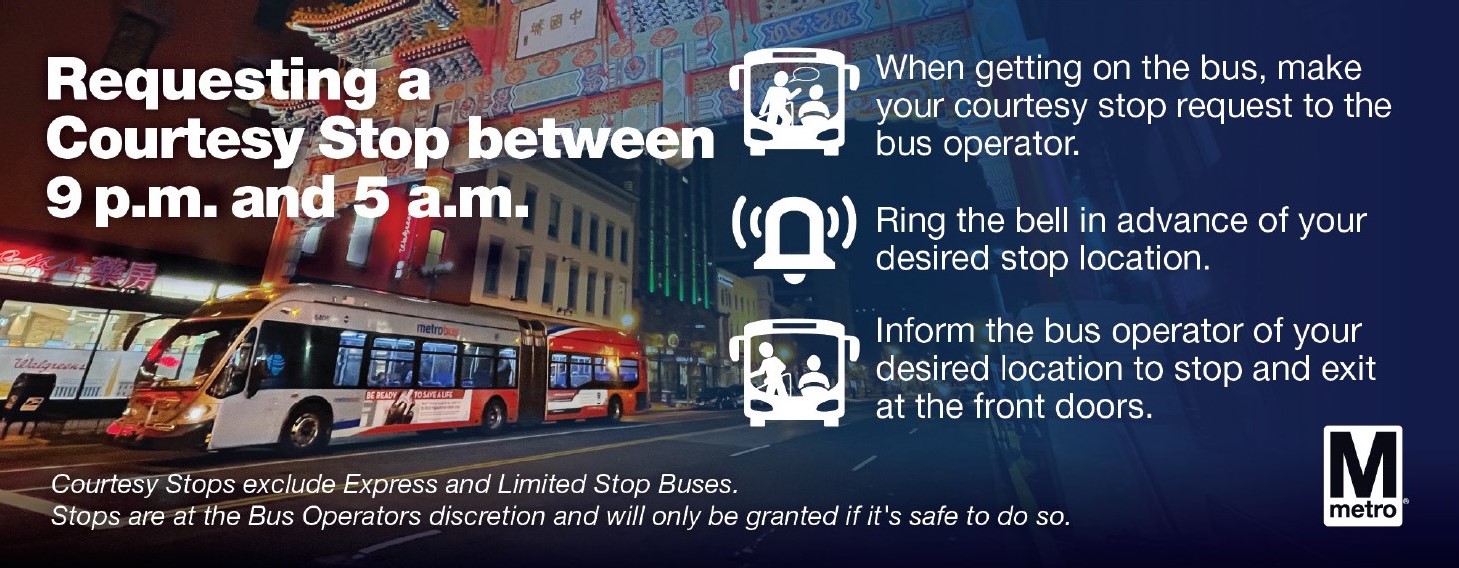
Metro also launched a new courtesy service allowing riders to get off between bus stops at night. Metro says the change “puts customer safety first during times of day when it is darkest outside.” The courtesy stops are at the discretion of the bus operator between 9 p.m. and 5 a.m. Metro said riders should make a request to the bus operator, who will let them know if they can accommodate the request. Courtesy stops will be allowed on all regular route Metro buses, but not limited and express buses, during the designated nighttime hours.
Fares changing
Metro fares are going up, but the fare structure is becoming simpler. The transit agency eliminated its peak/off-peak fare pricing that was derided by many during the pandemic, when Metro was not running peak-level service. Instead, Metrorail fares start at $2, plus 40 cents per mile and max out at $6 on weekdays before 9:30 p.m. Metro previously charged $2.25 plus a distance charge during rush hour.
Metro says the average fare is going up about 5%.
While short trips see the same or cheaper fares, long-distance off-peak hour riders would feel the brunt of the increase. A mid-day rider from Shady Grove to downtown D.C. would usually pay $3.85 but now will pay $6 no matter the time of day, a 56% increase for that time frame.
Metrorail is still $2 on weekends and after 9:30.
Metrobus fares stay at $2. MetroAccess fares were capped at $4 per trip.
Metro launched its first low-income fare program earlier this month, which allows SNAP recipients to get half-off fares.
This story previously stated Metro was raising max fares to $6.50. That was a proposal that did not end up getting voted through. The fare max remains at $6.