Jacob Fenston
There are a few things you can generally count on in D.C. around Fourth of July: muggy weather, sweaty crowds on the National Mall, and unhealthy levels of air pollution. In fact, July Fourth often brings the region’s worst air quality of the entire year — but not this year.
From 2019 through 2022, Fourth of July fireworks resulted in Code Red or Code Orange unhealthy air days for the region. In 2021, the pollution was so bad it lingered for a second day, making July 5 also an unhealthy air day.
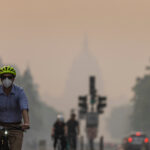
But in 2023, wildfire smoke from Canada has caused record-breaking levels of air pollution in the region, even edging into hazardous Code Purple territory. This year has already brought the most unhealthy air days due to particulate pollution of any year since 2010, and there are likely to be more such days this summer as wildfires continue to burn.
For many people in the region, dealing with the wildfire smoke has been a new experience. A summer day suddenly meant not just checking the weather before heading outside, but also checking the air quality index.
“We always want people to be thinking about air quality,” says Jennifer Desimone, the air program chief at the Metropolitan Washington Council of Governments, the group that tracks air quality in the D.C. region.
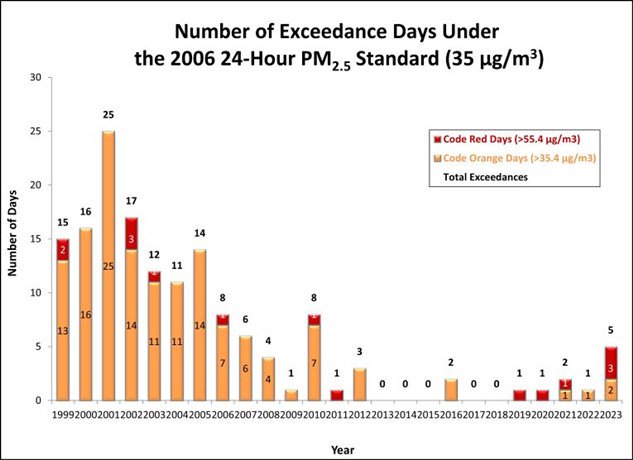
MWCOG forecasts Code Orange air quality for this Fourth of July, meaning it’s unhealthy for sensitive groups including children and people with lung or heart diseases. The group actually expects Code Orange air quality through Thursday of this week.
Desimone says that unlike wildfire smoke, pollution from fireworks can be very localized, with higher levels in the District compared to farther-out suburbs.
“When we have these large firework displays, we can see really high levels of fine particle pollution and it will typically spike up for a few hours and then drop right down,” Desimone explains.
But even short-term exposure to air pollution can be bad for you, says Susan Anenberg, chair of environmental and occupational health at George Washington University.
“For an air pollution and health scientist like me, it’s very difficult to go to see fireworks because all I can think about is the smoke that we’re exposing ourselves to,” Anenberg says.
This year, she says, fireworks pollution is layered on top of exposure to wildfire pollution.
“The fireworks smoke will just add to the the exposure that we’re all experiencing over multiple days and weeks this summer, so it just increases the pollution levels that are harming our bodies,” Anenberg says.
Fireworks pollution levels are dependent on two main factors: weather and human behavior.
“The amount of fireworks that people are putting out really varies from year to year,” says Hannah Ashenafi, associate director of the air quality division at the District Department of Energy and Environment.
In terms of weather, if it’s windy, particulate pollution from fireworks can quickly disperse into the atmosphere, improving the local air quality. Clouds can also help: with less intense sunlight, there will be less ground-level ozone pollution, which needs the bright light to form.
Ashenafi says neighborhoods around the District are impacted differently by air pollution from fireworks. In areas where the air is more polluted year-round because of industrial facilities or freeways, residents are likely to suffer more when its smoky out due to fireworks (or wildfires).
“In communities that are overburdened with air pollution, we also see people are more likely to have asthma or other heart and lung diseases. So that makes them more susceptible to seeing health impacts from the increased levels of air pollution,” Ashenafi says.
Looking ahead to a summer of possibly recurring unhealthy air, Anenberg says it’s important to make sure there are plans in place to keep everyone safe.
“One area that we really need further improvement on is ensuring that people who work outside, who have no choice but to spend their time in smoky conditions, are protected in the future,” Anenberg says.