Morgan Baskin
More than seven years after Mayor Muriel Bowser first pitched a plan to build family homeless shelters in every ward across D.C., Ward 2 is finally set to receive its own iteration.
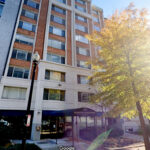
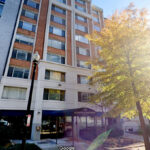
1129 New Hampshire Ave. NW, a now-vacant dorm for graduate students owned by George Washington University, is set to become a transitional housing facility for medically vulnerable adults. The school announced in 2022 it would sell the building, called the Aston, for $27.5 million.
The city has said that its Department of General Services intends to acquire the GW dorm to provide medical care to unhoused people with acute conditions – a model for transitional housing that sprouted up during the pandemic.
“This is an intervention that is very much needed in our toolbox for people experiencing homelessness,” Rachel Pierre, the interim director of D.C.’s Department of Human Services, said at a June 21 community meeting about its acquisition of the Aston.
Existing shelters in D.C. don’t currently accept mixed-gender adult families without kids, like couples or siblings trying to stay together. Instead, the city splits those groups by gender and directs them to one of the 10 “low-barrier” – or first-come, first-served – shelters it runs. Those shelters house dozens of people per room and don’t offer private bathrooms, making it difficult for people with chronic medical conditions to manage their care there.
With an upper capacity of 190 residents, the Aston could change that. Unlike low-barrier shelters, DHS’s proposed facility would house one to two people per bedroom, and provide each unit with a private bathroom. The new site will also provide medical treatment for residents with acute conditions. Barring significant construction delays, DHS says it aims to open the shelter by November.
“We have an opportunity to provide housing to people who are in desperate need of it,” says Jim Malec, chairperson of the Advisory Neighborhood Commission with jurisdiction over the site. “These are people who [DHS says] are suffering from end stage kidney failure, people who have cancer, people with ALS, and I think we should prioritize them.”
Intervention from the D.C. Council, led by Ward 2 Councilmember Brooke Pinto, initially slow-walked the project. Pinto has said she wanted more time to solicit community feedback, which has been mixed during public hearings so far – West End residents have by turns embraced and denigrated the possible shelter, and business groups have generally rallied against it.
The Department of General Services was originally scheduled to execute the sale on June 22, when the D.C. Council’s 10-day review – a period required for any contract over $10 million – lapsed. On June 21, Pinto introduced a disapproval resolution of the project, which extended the council’s review period by 35 days, giving the council until July 27 to weigh in on the contract. Chairman Phil Mendelson and At-Large Councilmember Christina Henderson co-sponsored the resolution.
Pinto since withdrew the disapproval resolution, and the contract has been automatically approved.
Opposition to the project, to the extent that it exists, has largely fallen along two lines: procedural concerns about community input, like those expressed by Pinto, and substantive ones, with some arguing that Ward 2 shouldn’t open a new shelter at all because it will degrade the character of the neighborhood.
At the June 21 public hearing about the project, tempers flared, one resident loudly declaring that diners would stop flocking to Rasika, the Michelin-starred restaurant sitting across the street from the planned shelter. Others pushed Pierre and Deputy Mayor for Health and Human Services Wayne Turnage to explain how the city government planned to mitigate noise, trash, and security concerns.
Matthew Pestronk, president of real estate development group Post Brothers Apartments, encouraged development executives operating in D.C. to lobby the District government against the acquisition, arguing in an email that there are “many reasons why this use does not fit into the immediate area in the West End of downtown.” (Also copied on the email, obtained by DCist/WAMU, was former mayor Anthony Williams.)
“The Reimagining Downtown program championed by the mayor and everyone on this email … does not contemplate uses like shelters being additive to the return of downtown when placed in an extremely high profile location,” Pestronk wrote. “It is in all of our enlightened self-interests to help the city solve the homeless problem in the most productive way possible while protecting the city’s assets.” A spokesperson for the company declined DCist/WAMU’s request for comment.
Advisory Neighborhood Commissioners also began to receive a flurry of automated emails from people urging caution in the project. “The truncated public review timeline has put the community in an unfair position,” the message read in part, according to a copy reviewed by DCist/WAMU. Fear that discontent among a vocal few would derail the whole endeavor led commissioners like Yannik Omictin to organize official support for the proposal within the ANC.
While one commissioner initially penned a competing statement that would have predicated support on more information from DHS, the nine-member commission ultimately expressed support for the shelter. On June 28, the group urged DHS to respond to a number of outstanding questions – like how it plans to transition residents out of the facility, and what kind of security it can offer – but said that, in general, it supports the development of a non-congregate shelter.
“Coming in, there was a narrative that a lot of people wanted to believe, which was that the neighborhood is staunchly opposed to a facility like this,” Omictin said. “But what we saw … was an outpouring of support from the community.”
“I think it’s a great idea to do this. My concern is that it’s done so that it’s successful,” one woman who lives in the neighborhood testified at the meeting in June. Another pointedly said: “I am happy to go to restaurants near a homeless shelter…Michelin stars and all.”
In an interview with DCist/WAMU, Turnage said of the meeting: “I’ve heard some people say ‘no, we don’t we don’t think this fits with the the tenor and tone of the neighborhood.’ And I’ve heard others who are certainly richer than I am, and who say, ‘you know, we need to find a way to help persons who are experiencing homelessness, and this project can do it in a way that does not undermine or deteriorate my neighborhood and I’ll support it.’ I will say, at the community meeting, it was almost evenly split, if not more in favor of the project than not.”
The debate is reminiscent of a similar fight that played out, albeit on a much larger scale, during Bowser’s first term in office, when she closed the noxious DC General family shelter and replaced it with smaller shelters for unhoused people in most wards across D.C. Coalitions of residents in wards 3 and 5 sued to prevent the developments from panning out, although those efforts were not ultimately successful.
But Ward 2 never got a new shelter, with officials arguing at the time that it didn’t need one because it already hosted the Patricia Handy Place for Women, a shelter for single adult women. (That shelter temporarily closed shortly after for repairs.)
The building currently in play is something of a unicorn, say Turnage and Pierre – relatively turnkey, zoned for its targeted use, and close to amenities. If the council intervenes to further delay closing or scrap the purchase altogether, it could prove difficult to find another site.
“Trying to find a building that can be readily converted to transitional housing with a minimum amount of construction and delay, in an urban area where, you know, almost every inch of land is claimed, is just very difficult,” Turnage tells DCist/WAMU. “The ward is replete with resources and amenities that could be very helpful in serving people who are experiencing homelessness as well.”
ANC 2A chair Jim Malec says he understands concerns from residents that they haven’t had significant time to weigh in on the site. But he believes it would be a misstep to sacrifice this site over smaller details.
“If we’re going to argue that we should not create a space for 200 people who need a home, I would ask, what is the moral or ethical justification for that argument?” he asks, referencing the emails he’s received about trash, security, and noise concerns.
“It’s a general overarching statement that homeless people make our community less safe. And I think that’s offensive. Because ultimately, what it says is ‘I think poor people make our community less safe,’” Malec says. “I think it’s fair to expect that DHS has a plan for how we’re going to deal with these issues, when they come up. But we can walk and chew gum at the same time. We don’t have to deny housing to people who desperately need it.”
This story was updated to reflect Ward 2 Councilmember Brooke Pinto’s withdrawal of a disapproval resolution on the sale.