Margaret Barthel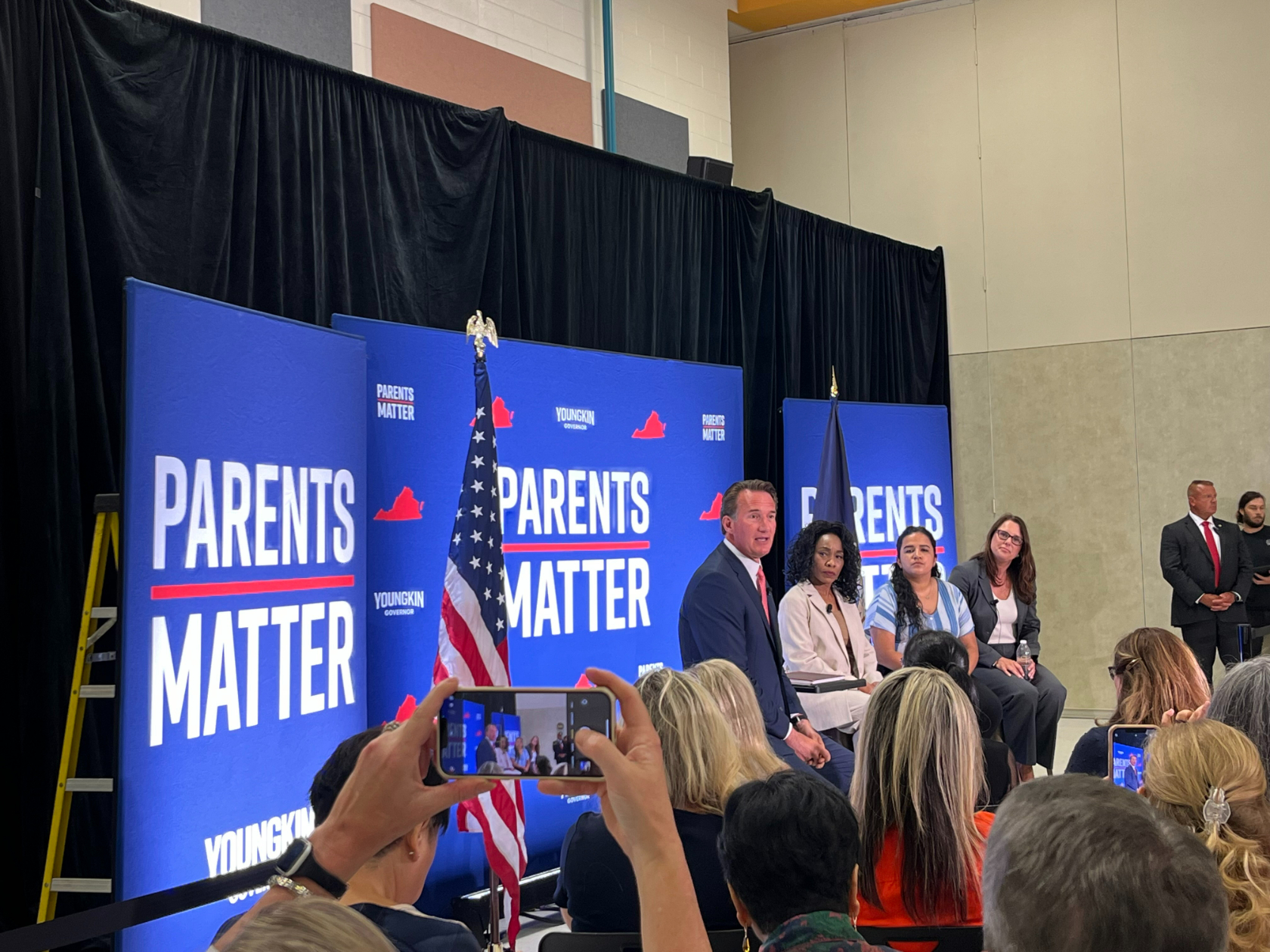
On Tuesday, Virginia Gov. Glenn Youngkin released a final version of state guidelines for public schools regarding the treatment of transgender and nonbinary students. The release sparked renewed concerns from LGBTQ+ advocates and Northern Virginia school leaders, who say they are reviewing the policies.
The guidelines require transgender and nonbinary students to use school facilities–including restrooms–and participate on sports teams according to their legal sex, not their gender identity. They also require parental consent for school staff to use names and pronouns matching students’ gender identity, and for students to participate in mental health counseling related to their gender.
“All children in Virginia deserve to have a parent engaged in their life and to be treated with dignity and respect,” Gov. Glenn Youngkin said in a statement. “The VDOE updated model policies reaffirm my administration’s continued commitment to ensure that every parent is involved in conversations regarding their child’s education, upbringing, and care.”
The Virginia Department of Education expects school boards to develop and pass their own regulations that comply with the finalized model policies.
LGBTQ advocates say policies making it harder for students to express their authentic selves at school — and preventing school staff from keeping student gender identities confidential from unsupportive families — contribute to higher rates of student absenteeism, problems with focus at school, and already-high rates of mental health problems and suicidal ideation among transgender and nonbinary youth.
There are outstanding legal questions about whether and how local school systems might comply with the model policies — and whether aspects of them are in conflict with federal civil rights law.
The document — officially called the “Model Policies On The Privacy, Dignity, And Respect For All Students and Parents In Virginia’s Public Schools” — is the Youngkin administration’s second draft of the guidelines, which it originally released last fall.
The first version, which included similar restrictions, drew condemnation from students across the state, with nearly 10,000 students participating in a walkout in protest. The Virginia Department of Education was flooded with more than 70,000 written public comments on the policy, many of them opposed to it. The agency delayed releasing a finalized version because it said it was reviewing the deluge of comments.
The Youngkin administration’s move is in stark contrast to the 2021 policies put in place during the previous administration under Gov. Ralph Northam, which required school staff to refer to students by their preferred pronouns and allowed them to use school facilities and participate in school activities according to their gender identity.
Reactions across Northern Virginia
On Wednesday, most Northern Virginia school systems said they were reviewing the new guidelines, but confirmed their current policies around student gender identity remained in place. Several school officials added their support for transgender and nonbinary students and pledged to do what they could to support those students and their families.
“I oppose any policy that infringes upon the rights of our students and threatens the safety and well-being of our LGBTQIA+ students,” said Arlington Public Schools superintendent Francisco Duran in a statement. “APS will continue to uphold our core mission and policies to ensure that every child receives equal educational access and opportunities.”
Fairfax County Public Schools, the largest school system in Virginia, said it was also reviewing the policies. Superintendent Michelle Reid pledged her commitment to maintaining “an inclusive learning environment,” for students and staff, including those who are not cisgender. In a message to families on Wednesday night, Reid emphasized that FCPS believes its current policies — which allow students to use names and pronouns matching their gender identities without parental consent — are “consistent with federal and state anti-discrimination laws.”
“Announcing that they’re moving forward with their plans to gut protections for transgender and non-binary students and their families sends a chilling message,” said Karl Frisch, a Fairfax school board member and the first openly LGBTQ person elected to local office in Virginia. “The decision is unconscionable and dangerous.”
The finalized model policies, Frisch noted, were announced just weeks after news broke that the Youngkin administration had quietly removed resources for LGBTQ students from the Virginia Department of Health website following questions about them from a conservative media outlet. The new policies also come against a national backdrop of increasingly pointed conservative attacks on access on gender-affirming care and hateful rhetoric about LGBTQ+ people.
But some in the region are calling the Youngkin administration policy a victory for parent involvement in schools.
“Parents rights are upheld and schools can no longer keep secrets from parents,” tweeted Michael Rivera, a Loudoun County parent running for an at-large seat on the county school board. “It’s time for the Loudoun County school board to start revising LCPS policies so that they follow the law and are in accordance with the current model policies from VDOE.”
The Pride Liberation Project, the group of LGBTQ+ student organizers behind the student walkout last fall, nicknamed the new policies “Don’t Be Trans” and signaled that further mass mobilizations of students against them could be on the horizon.
In a statement, the group pledged “additional actions in the near future” to oppose the guidelines.
“‘Don’t Be Trans’ would have prevented me from graduating. School was the only place where I could be myself because my household wasn’t supportive,” said Bas Rawat, a trans student organizer and recent graduate of South County High School in Fairfax, in a statement. “These guidelines will deny thousands of Virginia students the chance to be themselves.”
In an interview with DCist/WAMU, Rawat said they had come out in their senior year of high school. Though they still faced harassment from some members of their school community, the experience overall was “freeing,” they said.
“It helped me realize, ‘This is who I am,’” Rawat said, noting that would not have been possible if they had needed to ask for their parents’ permission to use the name and pronouns that match their gender identity.
Rawat called on local school boards to reject the model policies.
A survey of 34,000 LGBTQ youth, conducted by The Trevor Project, an organization dedicated to ending suicide among LGBTQ youth, found that less than a third of trans or nonbinary young people described their home life as gender-affirming. More than 250 students from 30 school systems in Virginia shared their reactions to the original version of the model policies last fall; most were trans students who said they were fearful and angry about what the policies could mean for their lives.
That fear and anger continued for some on Wednesday, as transgender and nonbinary students and their families learned about the new guidelines, according to Robert Rigby, a former Fairfax schools teacher who leads FCPS Pride, an affinity group for staff and students.
“We know from our own experience that this causes lifelong trauma,” Rigby said in an interview with DCist/WAMU. “We are looking first to send messages and to be available and make referrals to preserve lives.”
Rigby said he’d fielded about nine calls from transgender and nonbinary students on Wednesday.
“We’re getting more kids, from age 9 to 17, who are saying, ‘Can I keep existing? Please, let me exist,’” he said.
Rigby said he’d also heard from multiple parents of transgender kids who had asked him about resources for moving to Maryland. He predicted the policies would prompt LGBTQ+ staff to leave Virginia schools.
“I feel it myself,” he said. “I’m glad I got out.”
Few changes to original guidelines
Despite the public uproar last fall when the initial guidelines were released, little appears to have changed in the more controversial aspects of the new document.
The section that requires schools to use students’ legal names or nicknames associated with them clarifies that school staff may use other names if they are required for a student’s academic instruction, as in using a foreign-language name in a foreign-language class.
The new guidelines maintain the focus on school staff not withholding information, including about a student’s gender identity, from parents, but add that schools should follow Virginia law prohibiting disclosures to parents in select cases when a student may be suicidal due to parental abuse or neglect. The language that requires schools to seek parental permission before offering counseling to students related to gender is also slightly softened, with an exception for “eligible students” whose parents would not need to be notified. The guidelines do not appear to include criteria for which students would be considered “eligible.”
Both guidelines share similar language around making single-user bathrooms available to students, and allowing parents to opt-in to their students using those facilities.
Like the previous version, the finalized guidelines include a list of anti-bullying resources and direction that schools act swiftly to prevent bullying incidents.
“Every effort should be made to ensure that a transgender student wishing to change his or her means of address is treated with respect, compassion, and dignity in the classroom and school environment,” both versions assert.
The Youngkin administration believes the new model policy represents a much-needed recognition that parents should have the final say in their child’s schooling.
“These policies clarify that parents are the appropriate decision makers regarding their child’s health and wellbeing, and that students are best served when parents, teachers, and school administrators work as a team to support a child’s education,” said Virginia Secretary of Education Aimee Guidera in a statement announcing the new guidelines.
“Parents’ rights” became a rallying cry during Youngkin’s 2021 campaign for governor, and a shorthand for conservative concerns over school policies around teaching about race and handling issues of gender identity.
Equality Virginia, a statewide advocacy group for LGBTQ people, called the new policy “politically motivated” and criticized the administration for appearing not to take into account the concerns of thousands of public commenters in the new version — or consult with experts.
“Youngkin did all of this with no input from LGBTQ+ advocacy groups or subject matter experts,” said executive director Narissa Rahman, in a statement.
Outstanding legal questions
Whether and when Northern Virginia schools will implement policies aligned with the new guidelines is not yet clear.
Typically, school boards are expected to formulate their own policies that comply with the state’s guidelines within a year. But there are legal questions around whether the Youngkin administration’s model policies are themselves in compliance with Virginia code.
The state education department cites a 2020 law, passed by the Democratic-controlled legislature, that requires the department to develop “evidence-based” standards and practices around the treatment of transgender students.
The same law prompted the Northam education department to issue its 2021 model policies that largely protected transgender and nonbinary students’ ability to maintain their gender identity in school. Northern Virginia school systems mostly went along, issuing their own versions of that policy. But a 2022 analysis from Equality Now found that they were in the minority: just 13 Virginia school systems adopted a version of the Northam policy, while the rest of the state’s 133 school systems maintained that they didn’t need to update their policies, or else passed policies that outright rejected the state guidance.
Conservative activists in Northern Virginia have pointed out that if local schools said they needed to adhere to the Northam model policies, they would need to do so with the Youngkin administration’s version if they are to stay consistent.
“In 2021, the Loudoun County School Board said that it HAD to comply with the model policies. What will they say now?” tweeted Ian Prior, a Loudoun County resident and the founder of Fight For Schools, a conservative parent group. “If @LCPSOfficial doesn’t comply now, those 2021 statements will be used against it in the media, the board room, and the courtroom.”
It’s not clear what kind of penalties school divisions could face for choosing to not comply with the new model policies.
Meanwhile, the Virginia ACLU suggested in a statement that the Youngkin administration policies do not comply with the language of the original law.
“Virginia state law, found in Va. Code § 22.1-23.3.(A), gives VDOE authority to issue model policies on the treatment of transgender students that are ‘in accordance with evidence-based best practices,’” the organization said in a statement. “These new model policies fail to meet those standards.”
The ACLU said it would monitor schools’ implementation of the policies and their impact on transgender students.
Del. Marcus Simon (D-Falls Church), who put forward the original legislation in the House of Delegates, criticized the new policies in a social media post.
“The Governor has released a document full of political slogans dressed up as a model policy for the treatment of trans youth that allows dead naming & other forms of bullying by school employees themselves,” he wrote, adding that the state could instead be focused on fixing chronic underfunding in the public education system.
There are also questions about how the model policies fit in with federal court precedent in Grimm v. Gloucester County School Board, a Virginia-based case that affirmed students’ right to use bathrooms that match their gender identity instead of “alternative private” restrooms.
The Youngkin model policies state that “students shall use bathrooms that correspond to his or her sex, except to the extent that federal law otherwise requires,” with a reference to the Grimm case. The policy also pushes for schools to make single-stall bathrooms available for all students.
“If there is a decision to be made with regards to bathrooms, I think allowing a child to choose a general neutral bathroom where their dignity and their privacy can be protected is a good answer,” Youngkin said. “Each school district is going to have to work with their own decisions, but again, it’s got to start with parents.”
Youngkin spoke to members of the press at a “Parents Matter” town hall event on Tuesday afternoon in Prince William County, where he talked with local parents about his concerns about youth mental health and the effects of social media on young Virginians.
The announcement of the model policies — and the controversy over their effects on the mental health of trans and nonbinary students — came shortly afterward.
This story has been updated to include comments from the Virginia ACLU, Robert Rigby, Bas Rawat, and Michelle Reid.