Morgan Baskin
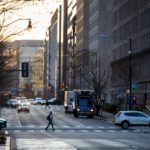
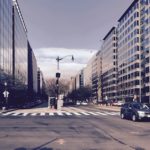
More than two years after D.C.’s public health emergency ended, the city’s downtown is still struggling to attract a daytime crowd, a new report from the area’s Business Improvement District shows.
In-person office work has reached only about 40-43% of pre-pandemic levels on an average weekday in 2022 and throughout the first few months of 2023, the report says, while new development approvals in that time reaching only 20% of pre-pandemic levels. While the businesses within the BID’s purview accounted for close to 16% of the city’s tax revenue in fiscal year 2019, that number has shrunk to just over 13% this fiscal year.
“We see that it’s going to get worse before it gets better,” says Ella Faulkner, DowntownDC BID’s vice president of planning and economic development.
Roughly 18 redevelopment projects seeking to turn unused office space into housing stalled or “appear paused” because of rising construction costs and interest rates, the report says — projects cumulatively projected to create between 4,500 and 5,000 new units of housing, with 450 to 750 of those considered “affordable.”
Gerry Widdicombe, the BID’s decades-long economic development director who recently became its CFO, says that both broader market trends and hyperlocal policies have contributed to the slump: Developers are waiting for D.C. to write regulations for its proposed Housing in Downtown Tax Abatement program, which will offer recipients financial and regulatory relief in exchange for new housing. The program’s main draw is a 20-year tax abatement; D.C.’s office of Planning and Economic Development is expected to issue a request for applications at the start of the new fiscal year this fall.
“People are going, you know, ‘If I start demolition now, does that mean I can’t apply for a tax abatement?’ So there’s a few little timing things,” Widdicombe says. Simultaneously, he adds, “some of the office building owners are recognizing that their buildings are no longer worth $600 per square foot, they’re worth somewhere between $200 to $300 per square foot.” Several office-to-residential conversion projects within the borders of the BID have now begun construction, more recent data from the group show, including 1111 20th St. NW, 1425 New York Ave. NW, and 1010 Vermont Ave. NW.
Updates to the Housing in Downtown program are among the many carrots Mayor Muriel Bowser is leveraging to developers, in an attempt to address a budget shortfall squeezing the city’s coffers. D.C.’s Chief Financial Officer estimated in February that the city could endure a $464 million revenue decline in the next three years, due to shrinking property tax revenue from office buildings downtown. Compounding uncertainty about potential losses in transit and tax revenue is the fate of federal office workers, who comprise a quarter of the city’s employees.
To some criticism from residents who work in affordable housing development, Bowser proposed exempting HID-approved projects from a landmark tenant protection that gives renters the first right of offer to buy their building or negotiate a buyout should it go for sale. HID-approved projects would also not have to comply with First Source hiring rules for construction work — a guideline stipulating that D.C. residents see priority in hiring on projects receiving public funding. And in April, D.C.’s Zoning Commission declined to expand the city’s inclusionary zoning program to downtown.
The DowntownDC BID’s report was effusive about the program, however, estimating that full utilization of its $41 million cap in fiscal year 2028 could spur a minimum of 6,000 new housing units and $57 million in tax revenue. (Bowser has set a goal of adding 15,000 new residents to downtown D.C.)
While in-person office work and new development has yet to rebound to pre-pandemic levels, the DowntownDC BID report indicates that the area’s retail and hospitality industries are faring better, and it’s the BID’s hope that a forthcoming “action plan” to revitalize the district will help bridge the gap between consumer demand and the area’s offerings.
Hotel occupancy, “destination” restaurants, and high-end shopping are all performing at 90-130% of pre-pandemic levels, per the report. (Office-dependent cafes and restaurants are performing at 60-70% of pre-pandemic levels, a testament to how thoroughly changes in work life have upended the area’s landscape.)
An ongoing audit of downtown D.C.’s offerings — an effort involving the mayor’s office, Federal City Council, DowntownDC BID and Golden Triangle BID — aims to take stock of civic life in the area and reevaluate how D.C. spends its development resources. The groups plan to produce a document by November outlining specific recommendations and strategies for revitalizing the area, and making it more attractive to residents during the day.
“We have, throughout the city, about 26 million square feet of vacant space. [DowntownDC BID has] about 10 of that, and the Golden Triangle BID has another seven or eight,” Widdicombe says. Noting that office space accounts for 79 million square feet of the BID, and that ongoing development projects aim to convert about five million of that into housing, “there will be a fairly big shift of uses” in the coming years, he says.
For residents who’d like to weigh in on the future of downtown, the city’s Office of Planning is soliciting public feedback about its usefulness and desirability.