Jacob Fenston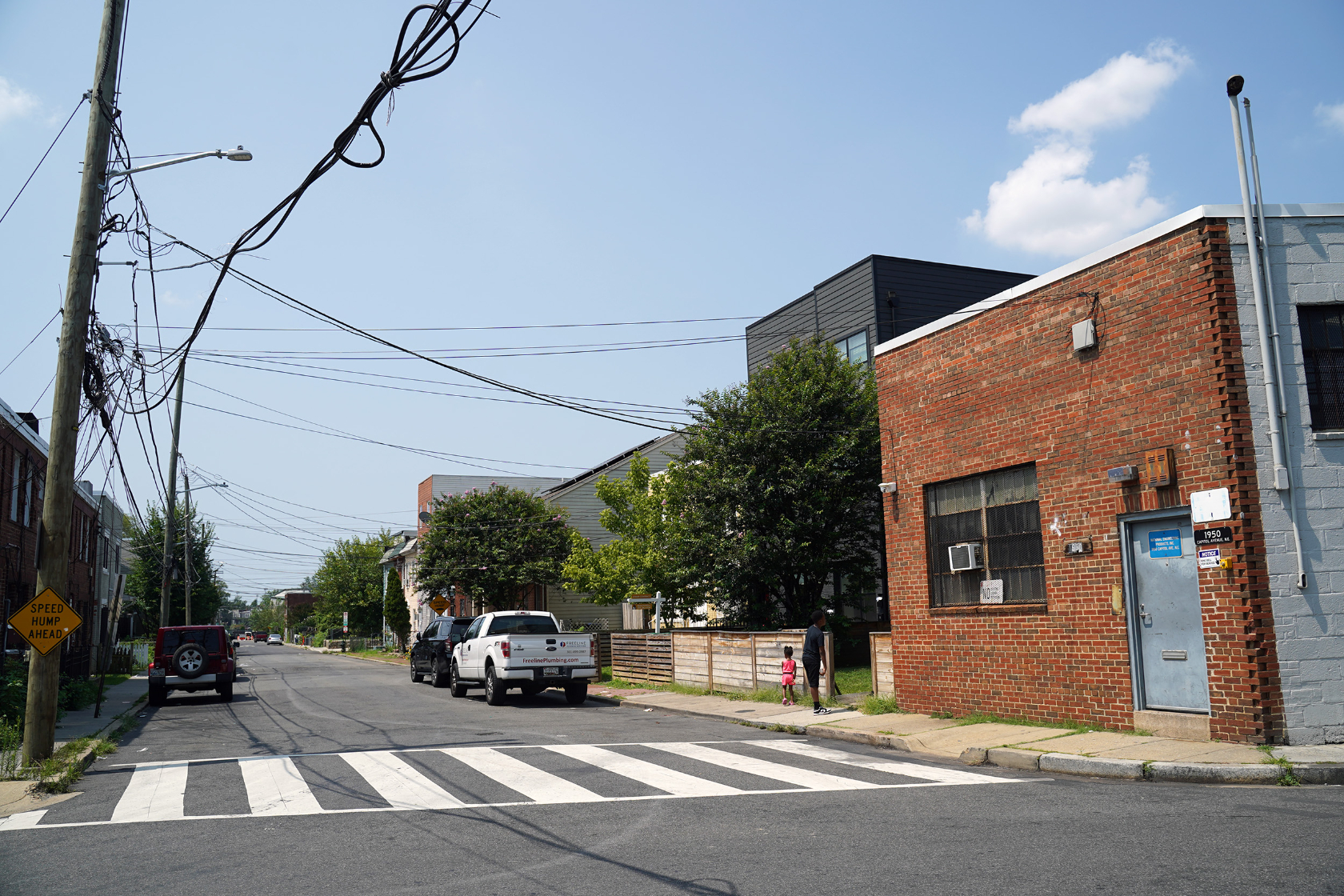
In a squat, nondescript brick building on a residential street in Northeast D.C., workers are using toxic chemicals to produce sealants for the U.S. Navy, and venting the exhaust into a densely packed residential neighborhood of row houses and apartments. The company is operating without pollution permits, and it’s been going on for the better part of a century.
“The chemicals that they produce come directly into my house,” says Shawn Scott, whose home abuts the National Engineering Products plant in Ivy City. “We share a wall.”
Scott and other residents say the 90-year-old business is poisoning people in the historically Black neighborhood and should be shut down immediately.
“I just don’t understand why they feel like it’s okay to have a chemical plant in our neighborhood and expose people to these chemicals, knowing that we can get sick from it,” Scott says.

At a rally on Wednesday, residents and activists with the nonprofit group Empower DC blocked the street outside the factory, calling for its closure. The factory has been there since before modern environmental laws, and has been operating without pollution permits — basically grandfathered in, says Parisa Norouzi, executive director of Empower DC.
“We as a society may have improved some of the environmental laws and zoning laws to disallow this type of thing next to residential homes, but grandfathered in the ones already operating and already harming communities. So we never actually fix the problem,” says Norouzi.
“To really achieve environmental justice and racial equity, we have to reverse these harmful land-use decisions,” Norouzi says.
In recent months, D.C. and federal regulators have gotten involved, conducting air testing around the factory. The testing was conducted by the District Department of Energy and Environment in July, 2022. The results, released in February, showed that the air in the neighborhood downwind of the factory had elevated levels of numerous volatile organic compounds known to cause cancer in humans, such as benzene and formaldehyde.

While the rally was taking place, the factory appeared to be in operation: there was a strong smell in the air around the building, like burning rubber, a pipe was discharging liquid from the back of the building into an empty lot, and a window air conditioning unit was rattling away. However, nobody answered the door when this reporter buzzed. The company also did not respond to a voicemail requesting comment.
Norouzi says the government response has been frustrating — too slow and too narrowly focused bringing the business into compliance with air quality laws. But under today’s zoning laws, Norouzi points out, the chemical plant would never be allowed to be located so close to homes.
“Testing is good, it’s good to know what’s going on. However, we don’t want just compliance. We want this to be rectified, which means shut it down, clean up the site, turn it into something beneficial.”
Many neighbors say they don’t sit on their porches due to the smell from the factory. Scott, who lives right next door, worries about her young kids growing up so close to the factory.
“There’s actually a vent right next to my son’s window, you can see it, it’s right equal to his window,” Scott says.
She says her youngest children, who were born in the house next to the NEP factory, have learning disabilities, while her older kids, who were born before she moved into the house, don’t.
“I’m just wondering if the chemical plant has anything to do with that situation,” Scott says. She says she’d like to move, but doesn’t feel she can afford someplace else in the District right now.
“I feel defeated,” she says.
One lifelong resident of Ivy City, Chester Harrison, says nobody knew what was going on inside the nearly windowless building when he was growing up in the 1980s.
“Me growing up as a child in Ivy City, I used to play behind NEP, like we used to play in the barrels. We would use old fire pits to make our club houses back there,” Harrison says.
“I didn’t find that out until about a year ago,” says Harrison’s mother, Brenda Ingram, who moved to Ivy City in 1965. “Building been here forever. I never knew what it was.”

Organizers are hoping to put pressure on city officials to take action against the company. They also want to put pressure on the company itself. At the rally, residents signed a petition calling for the shutdown of the business, and a large card for NEP’s owner, Gail Peterson.
“Instead of ‘get well soon’ it says ‘do well soon,’ because we hope she will do well by this community soon,” explains Norouzi. Norouzi says the owner lives in a wealthy Maryland suburb just north of D.C.
According to NEP’s website, company ownership has been passed down through several generations of the same family.
“The people who own it don’t want it near their house,” says Harrison. “Why would y’all put it inside a residential neighborhood? It’s a bad cause and it’s in a bad spot,” he says.