Margaret Barthel
The neighborhood off of Mount Vernon Ave in Alexandria is a mix of old brick garden-style apartments, new or renovated single-family homes, and the odd duplex. As we walk around, it’s the golden hour, and there’s an end-of-the-day hush: a few cars passing by, and a couple of big shady trees rustling in a light breeze.
“You can like, take a nap in the middle of the road and probably be fine,” says Luca Gattoni-Celli, the founder of the YIMBYs of Northern Virginia. “There’s birds, there’s trees, there’s kids and yoga mats and dogs and all that good stuff. You can walk to the grocery store. It’s extremely desirable.”
“And that comes with a lot of demand,” adds fellow YIMBY Peter Sutherland.
It’s an undeniably nice place, which makes it ripe for questions like: what underlying urban policy makes it so nice, exactly? Gattoni-Celli and Sutherland, unsurprisingly, have plenty of thoughts about that — and about why Del Ray is so expensive as a result.
“But it only comes with demand because we made it illegal in most places,” Gattoni-Celli replies. “We could have this in a lot more places, but we lack imagination.”
“This” is the unique combination of different housing types — garden apartments, townhomes, triplexes, single-family homes, accessory dwelling units — that you can find all over Del Ray, within walking distance of the Braddock Road metro station. It’s also the kind of housing mix Gattoni-Celli, Sutherland, and the YIMBYs of Northern Virginia — the acronym stands for “Yes in my backyard” — are in the process of trying to replicate across the region. In fact, they hope to create a regional movement.
What they want is for elected officials to change zoning codes to allow for more types of housing and more density in a region where homes are hard to find and harder to afford. They say failing to build more housing will constrain economic growth, accelerate the hollowing out of the local middle class, plunge the region further into a housing shortage, and could force younger people to leave.
Gattoni-Celli and Sutherland see Del Ray as an example of what could be — maybe plus a new mixed-use residential development in place of the Metro station parking lot, in their ideal vision.
They also see it as a place depending on its past for its vitality. Like many places in the Northern Virginia suburbs, some of the denser housing types in Del Ray would not be allowed under current zoning, as Gattoni-Celli points out. Much of the neighborhood, except for areas along its main corridors, is zoned exclusively for single-family homes or, in one area, single-family homes or duplexes. They believe lifting those restrictions — many of which have racist roots — would enhance the neighborhood, bringing more foot traffic to beloved local businesses and allowing more people access to jobs in D.C. and Northern Virginia’s booming commercial sector.
“If we don’t want to grow, we’ve made a mistake in terms of attracting a ton of great jobs to the region,” as Sutherland puts it.
But not everyone agrees that more density is a good idea, in Del Ray or across Northern Virginia, particularly established homeowners worried about what changes could mean for the neighborhoods they’ve invested so much in. Last year, the Alexandria planning commission delayed a plan to allow developers to build higher buildings if they included affordable housing after Del Ray residents raised concerns what it would do to the scale and character of the neighborhood. A grassroots group called Save Del Ray organized against the plan and has also opposed other mixed-use developments in the area.
Those debates are likely to get more heated as Alexandria considers its Zoning For Housing initiative, a study of nine different policy levers the city could pull to add more housing and undo the exclusionary zoning of the past.
Traditionally, older established homeowners are the residents who reliably show up at public meetings and press elected officials to reject new development. They’re also more likely to vote in local elections than renters or younger people. Local YIMBYs want ultimately to upend that trend: to turn out younger people and renters for public meetings and local elections in numbers large enough that elected officials pay attention.

A major win in Arlington
Gattoni-Celli, a 33-year old Alexandria resident who lives in a townhome with his wife and kids, started the YIMBYs of NoVA as a Facebook group in August 2021. He became interested in urbanism and housing supply issues (the YIMBY movement itself originated in California, which is deep in a housing shortage), and was moved by the death of Jim Pagels, a local cycling advocate killed on his bike in D.C. He began growing the group’s membership slowly, sometimes even reaching out to individual people in other Facebook groups who’d made pro-urbanism comments.
But they didn’t have much time to build the group online. In April 2022, Arlington County released its draft ‘missing middle’ policy, a proposed rewrite of the county’s zoning code ending single-family zoning and opening up about 70% of the county’s residential areas to small multi-unit buildings.
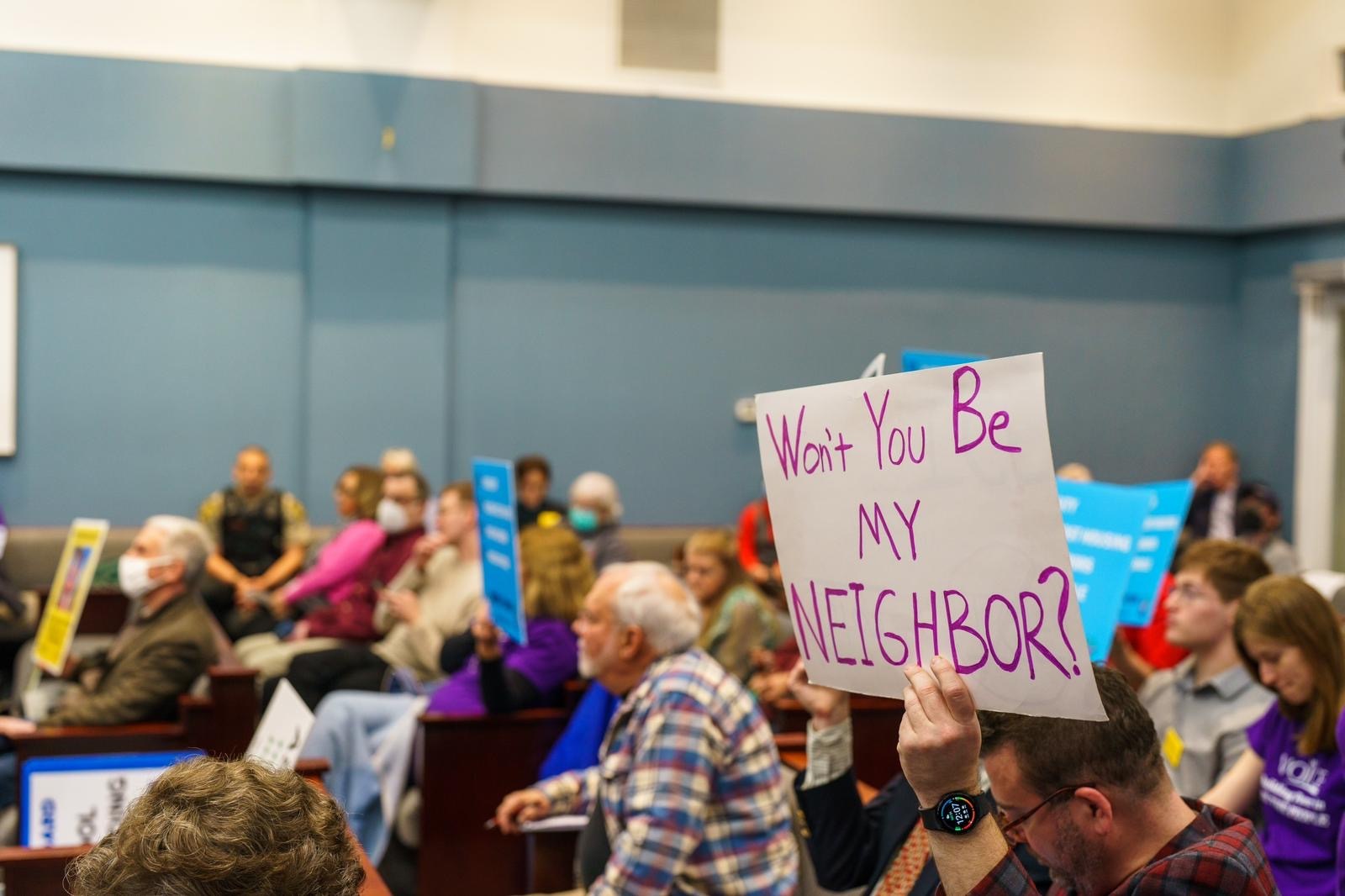
The YIMBYs scrambled to get themselves organized to push for the policy, which is named after the “missing” housing types, those between large high-rise apartment buildings and single-family homes. Along with the local NAACP chapter and the interfaith social justice organization VOICE, they led the coalition supporting the plan, mobilizing hundreds of residents to give public comments at meetings.
That focus on the bread-and-butter problem of turning people out for the cause is what was most exciting to Jane Green, a housing advocate who joined the YIMBYs early on and became its president.
“What I love about it is it’s people who are willing to go to public meetings,” she says.
Green, who lives in an Arlington apartment building with her children and spouse, led the group’s organizing effort. She knows exactly what goes into coaxing younger people and renters previously disconnected from local government into testifying. Green and the YIMBYs hosted information sessions about the complicated ins and outs of the zoning ordinance change to try to give people confidence weighing in on the dense policy. They workshopped public comments, helping residents hone in on what they wanted to say. They worked to make testifying easier day-of by monitoring the speaker list and contacting people when it was almost their turn at the mic. And they tried to make the meeting slog a little more lively.
“We have fun with each other, but the actual activity of listening and participating in a five-hour long meeting is not something that I can call enjoyable,” Sutherland jokes, comparing the YIMBY parts of his life to an episode of Parks and Recreation. (His day job is in transportation policy.)
“They brought an energy, they brought a focus, they brought new voices,” says Alice Hogan, a consultant with Alliance for Housing Solutions, an Arlington-based nonprofit that has been advocating for ‘missing middle’ homes as one way to help make homes in Arlington more affordable.
Hogan, Green and other advocates believe the unity of the coalition was what ultimately led to its success. In March, the Arlington County Board passed a version of the policy — with some compromises — unanimously, making Arlington one of the first localities in the country to end single-family zoning.
Hogan notes that housing supply reforms like ‘missing middle’ zoning and other policies pushed by the YIMBYs are only part of the solution to Northern Virginia’s housing shortage. In Arlington, ‘missing middle’ projects are capped at less than 60 per year, a drop in the bucket compared to the hundreds of thousands of units of housing, particularly affordable housing, advocates say the D.C. area needs.
“It’s an important and symbolic and opportunity-creating tool,” Hogan says. “But it is tiny by comparison.”
Hogan and other advocates hope creating more housing through changes in zoning will dovetail with other policies, like community land trusts or more traditional developer incentives. Taken together, the various tools are aimed at alleviating pressure on Arlington’s existing housing stock and ultimately creating more affordable housing options.
“When there’s more [supply], there’s less competition and hopefully everyone has a place to live. So supply is crucial,” Hogan says.
The missing middle fight was also the YIMBYs’ first real world engagement with the opposition. Public hearings before the County Board and the Planning Commission became hours-long back-and-forth debates between the pro-missing middle coalition and several groups, including an alliance of local civic associations. Opponents characterized the proposal as a rushed handout to local developers that would overwhelm local infrastructure, decimate the county’s tree canopy, and ultimately not ease home prices. Some public commenters also called the YIMBY group a shill for developers (the group says they are an all-volunteer organization with no ties to developers).
The Arlington Civic Federation approved a resolution suggesting the County Board had gone astray from the consensus-driven “Arlington Way” of the past and was ignoring the will of residents in favor of runaway density. A report included with the resolution specifically called out Gattoni-Celli, an Alexandria resident, for his involvement in an Arlington community debate.
The report argued YIMBYs gave “cover” to the county board to approve projects despite a lack of consensus in the community. For their part, YIMBYs freely admit to doing exactly what they’ve been accused of: lobbying public officials and showing up in force at public meetings to give the same officials a reason to vote in favor of more housing supply. That’s just how the game is played, Gattoni-Celli thinks.
“We’re aggressive, and we’re playing to win,” he says. “It’s not just like hugs and high fives. It’s like we’re going to figure out a way to defeat the people who disagree with us.”
‘You have to have staying power’
With the ‘missing middle’ fight over in Arlington, the fledgling YIMBYs are eyeing new places to take their tactics. Alexandria’s Zoning for Housing initiative is on their immediate horizon, though they admit to some “target confusion” with the number of different directions the city is exploring to create more homes. They also turned out for the city council’s recent Duke St. transitway vote to approve a bus rapid transit line and other streetscape changes along the major corridor.
Then there’s Fairfax County, which the YIMBYs talk about in slightly hushed tones, both because of the size of the D.C. region’s largest jurisdiction and because large swaths of it represent the kind of car-centric suburban sprawl they abhor.
“The county’s GDP is comparable to that of entire states,” Gattoni-Celli wrote in a recent op-ed about Fairfax on urbanist website Greater Greater Washington. “And exclusionary housing policy limits access to all of that opportunity, while fueling sprawl across our region.”
“The scale of the endeavor is enormous,” says Aaron Wilkowitz, who leads the YIMBYs’ efforts in Fairfax. The group also expects to face stiffer opposition there, so in the short term, Wilkowitz’s focus is on building their Fairfax membership list and getting involved in more bite-sized pushes for transit-oriented development. For example, the YIMBYs showed up at a planning commission meeting — which ran until 2 a.m. — to support reducing parking requirements for new developments. Nearly three-quarters of the speakers at the hearing were in support of the idea, and most came through the YIMBY organizing effort.
Some long-time activists are relieved to see a newly energized younger generation picking up the torch. Stewart Schwartz, the executive director of the Coalition for Smarter Growth, which advocates for transit-oriented development, has worked with the YIMBYs on some of their early Alexandria organizing. He’s been pushing for smart-growth policy since the 1990s.
“They’ve been absolutely critical to that because there is a generational change,” Schwartz says. “Many of the people who founded our organization or volunteered with us over the years are headed to their second retirement. They retired from their day jobs and now they’re retiring from activism.”
Schwartz believes the stakes for the YIMBYs and their partners are high, with building housing near transit a key way for the region to cut down its greenhouse gas emissions and also keep vital young talent in the area.
One thing the YIMBYs believe they have in their favor is the fact that housing challenges affect nearly everyone in Northern Virginia, particularly younger people and renters. Most of the leaders of the group have their own personal connection to the issue: Gattoni-Celli lives in a townhouse, which he was only able to afford with help from his father. Peter Sutherland, who married recently, is ten months into a discouraging search for a home to buy in Alexandria. Wilkowitz moved to Fairfax County after he married and realized he couldn’t afford a home in Arlington, where he had been living. And Jane Green likes the ease and community of apartment life, and just wants renters like her to have a seat at the table in policy discussions.
“The twenties or thirties used to be called the prime of life,” Gattoni-Celli says. “And now it’s become an extremely vulnerable time of life, even if you make lots and lots of money.”
The YIMBYs see their work as tapping into the anxiety and fear of navigating Northern Virginia’s impossible housing market for buyers and renters alike, and offering people a way to feel a sense of agency.
But the real question is whether they can channel those frustrations into not just single public debates, but a sustainable movement capable of tackling the decades of housing policy that they disagree with — and fast.
“You have to have staying power in this business to be able to shape the change that we’ve all shaped,” says Schwartz.
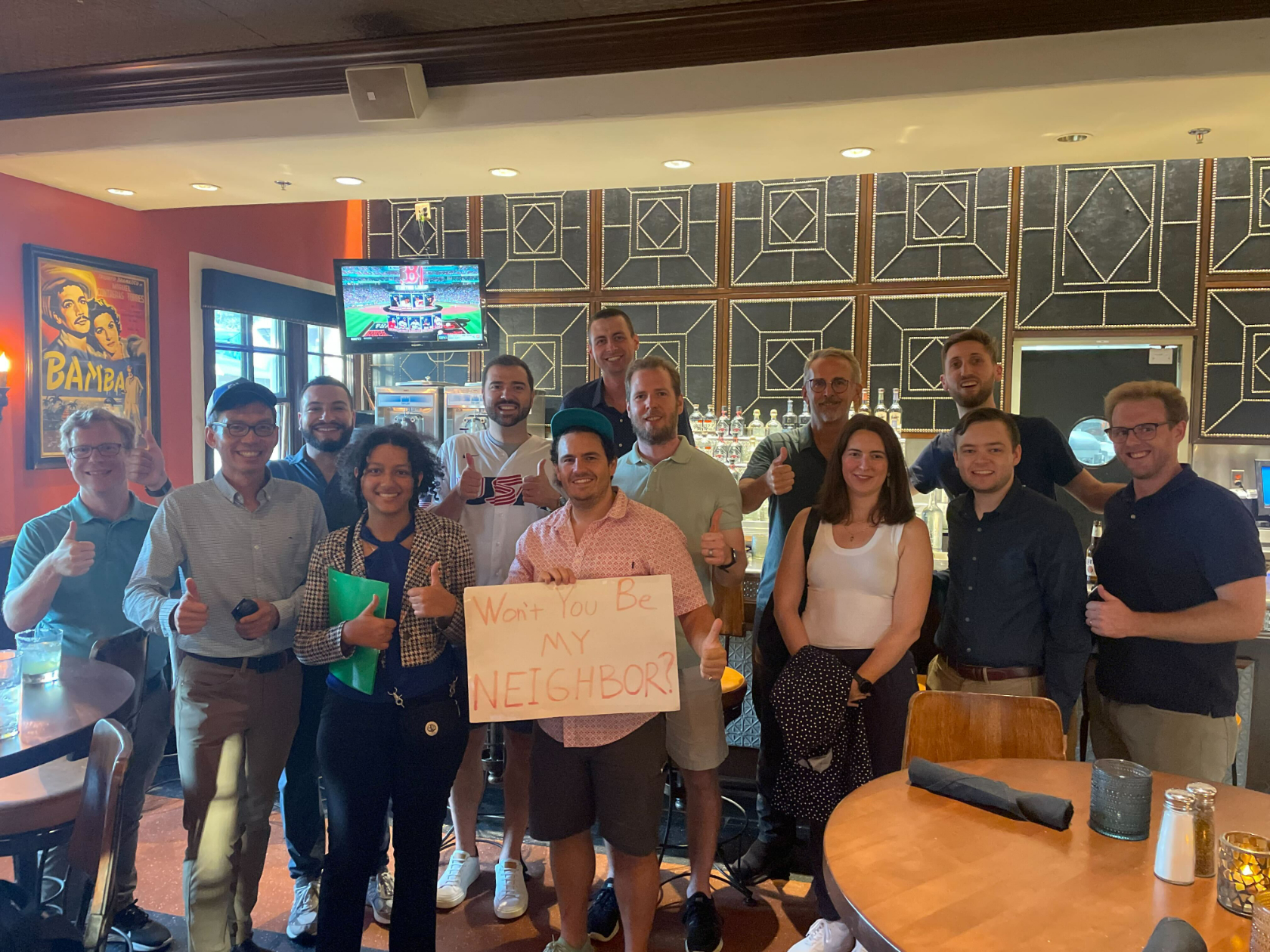
One way to do that is to offer more than politics and public meetings. The YIMBYs host social events to create a sense of community around the cause. In Fairfax, about a dozen people showed up to a YIMBY happy hour before the parking proposal meeting, including Sara Alemayehu, a George Mason University student. She’d been on the group’s email list and was excited to meet new people. When she saw that she could also attend the parking meeting afterwards, she was all in.
“I basically clicked ‘yes’ to the RSVP, and I was like ‘Oh, I can also sign up to be a speaker,’” she told WAMU/DCist at the event. “That’s basically how that really started. I feel like I’m going to be joining them for quite a while.”
For Green and other group leaders, all of it — the public meetings, the email list, the social events, the outreach to renters — is driving toward one overarching goal: getting decisionmakers to take them seriously.
“I feel like when we speak at meetings, the county board doesn’t see us as a voting bloc. You know, they just see one person,” Green explains. “And when an older homeowner-looking person speaks at a county board meeting, the board members see an entire voting bloc of people,” despite the fact that Arlington’s population is majority-renter.
She was disappointed that higher-density precincts in Arlington had lower turnout rates than single-family home neighborhoods in the recent Democratic primary for two county board seats, which had a mixed result in terms of the YIMBYs’ goals: voters nominated one pro-missing middle candidate and one who had criticized the policy.
The YIMBYs’ twofold mission is ambitious. Getting younger people and renters engaged in local politics and policy is in itself a challenge; solving the decades-old and worsening housing crisis is steeper still.
“We’re deadly serious about fixing this problem and we are going to do whatever it takes to figure it out,” says Gattoni-Celli. “And whatever it takes will consist of building an organization with the capacity to solve this problem.”