Amanda Michelle Gomez
The D.C. region’s unemployment rate is improving, with at least one county seeing a 33-year low in joblessness. But digging into the numbers shows that Black Washingtonians make up a disproportionate number of those still struggling to recover from the height of the pandemic.
While the D.C. region’s unemployment stood at 2.5% in June, and the District’s overall rate was 5.1%, joblessness among Black Washingtonians is likely higher. D.C.’s average Black unemployment rate was 9.6% in 2022, while D.C.’s white unemployment rate was 1.4% — seven times higher, per an analysis of 2022 federal labor data by the DC Fiscal Policy Institute.
The District ranked as having the highest Black-white unemployment gap in the country at both the end of 2022 and again in early 2023, according to the Economic Policy Institute, a national nonprofit think tank that collected the federal data DCFPI analyzed. That nonprofit says the data underscored that “low unemployment rates do not go hand in hand with employment parity.”
The DCFPI report also points out that the city’s unemployment is geographically concentrated. In May, the unemployment rate in majority-Black wards 7 and 8 were 7.2% and 9.1%, respectively, according to city data — while unemployment in predominantly white Ward 3 was 3.6%.
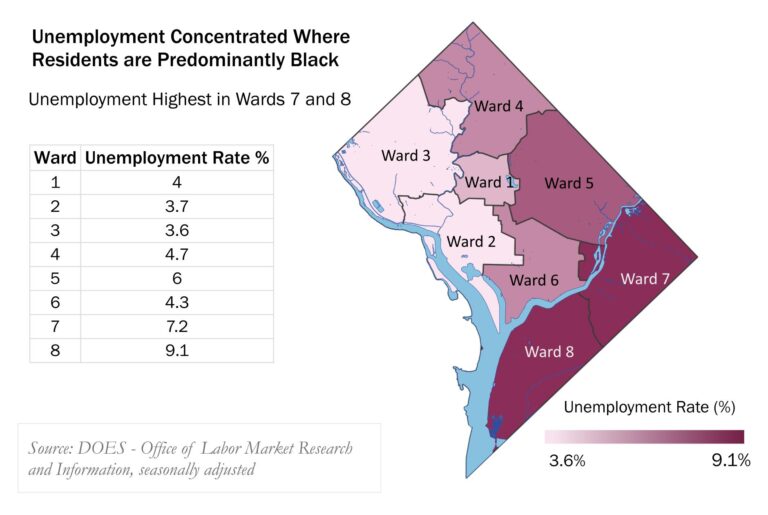
Unemployment increased to 8.5% and 11% in wards 7 and 8, respectively, in June.
“If 11% were the general unemployment rate, that would be considered a crisis and there would be a crisis response,” says Caitlin Schnur, who co-authored the DCFPI report and is the group’s deputy policy director. “The fact that there’s not is problematic. The fact that we’re seeing crisis level unemployment in Ward 8 means that leaders in the District should be responding robustly.”
Schnur says not only are Black residents chronically unemployed, but they are much more likely to experience it for long periods of time. In 2022, nearly half of all unemployed Black residents were out of work for six months or more, per the report. Black Washingtonians are also five times as likely compared to whites to be underemployed, meaning they have part-time or unstable low-wage jobs, the report found.
Yes D.C. reported an increase in jobs in June. So what’s going on?
Just because there are job openings does not mean people can access them, Schnur says. That there are higher unemployment rates in wards 7 and 8 tells Schnur that those residents might struggle to travel across town for work. Plus, Schnur says there’s a longstanding history of hiring bias and discrimination that could put Black workers at a disadvantage.
Lack of child care or stable housing also impact people’s ability to work, says Schnur. And Black residents have higher rates of homelessness or are more likely to struggle to afford child care (which is more expensive in D.C. than anywhere in the country, according to one survey) due to systematic racism.
“Black unemployment is always higher than white unemployment. And that really speaks to structural issues within the labor market that aren’t necessarily contingent on current day conditions,” says Schnur.
The report also offers solutions, among them continued support through food and housing assistance. The report also suggests funding affordable child care and free public transportation. Schnur says D.C. should also scale up and target the city’s transitional jobs program, which only serves 700 residents each year, and emphasize low-barrier employment and training programs. DCFPI is also researching the effects of a jobs guarantee program for young people, according to Schnur.