Martin Austermuhle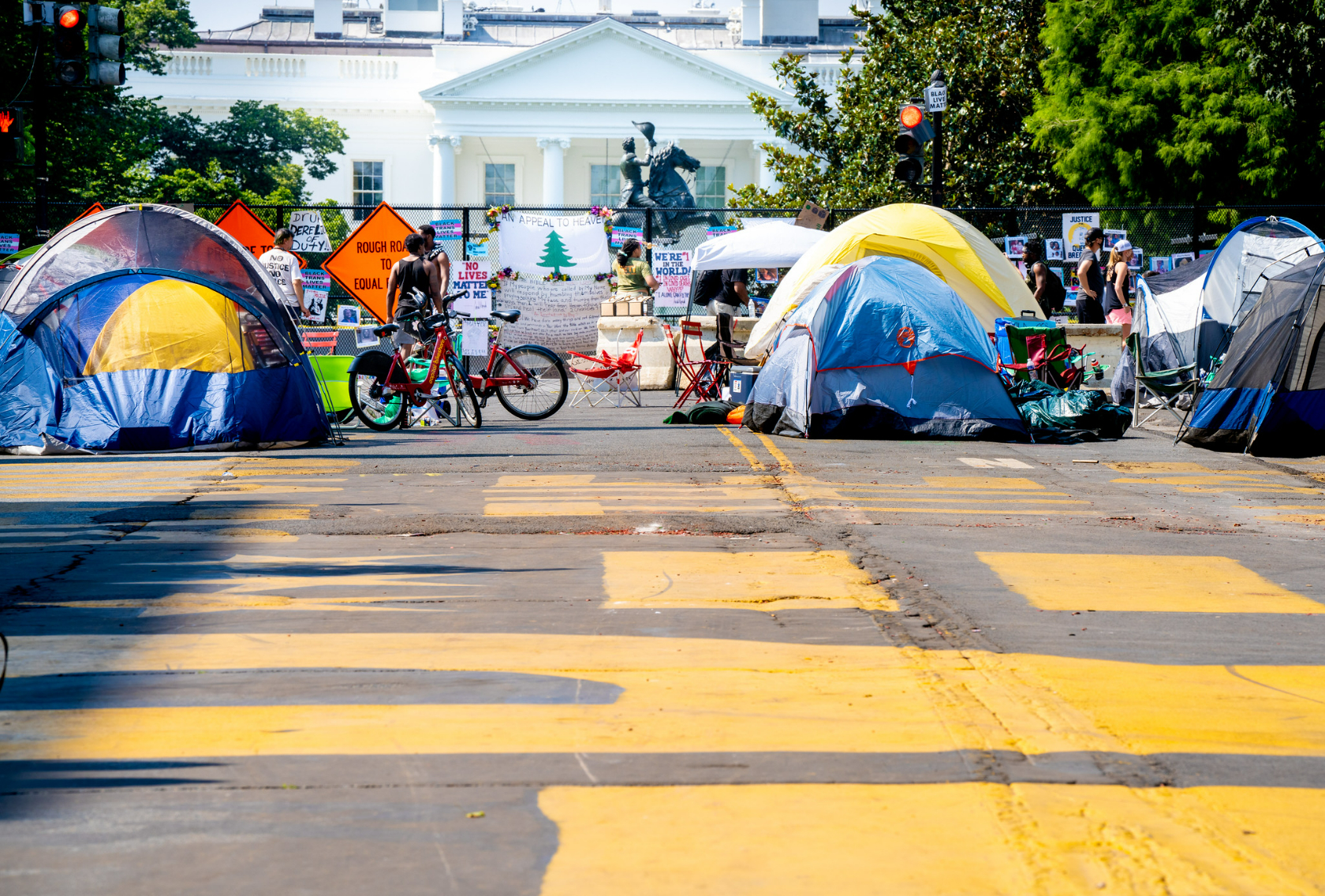
A three-judge panel from the U.S. Court of Appeals for D.C. on Tuesday allowed a case to move forward that alleges the city violated the U.S. Constitution in the summer of 2020 when police arrested two anti-abortion activists for chalking pro-life messages on the sidewalk in front of a Planned Parenthood clinic. The anti-abortion activists allege that they were arrested while racial justice protesters who wrote “Black Lives Matter” on public spaces elsewhere faced no such consequences.
In the unanimous decision, the three judges — Trump appointee Neomi Rao, Obama appointee Robert Wilkins, and Biden appointee Michelle Childs — reversed a decision by a lower court to dismiss a lawsuit that was brought by pro-life protesters in late 2020.
The judges instead found that while D.C.’s law prohibiting the defacement of public or private property is constitutional, the anti-abortion protesters can now attempt to prove that the law was unconstitutionally enforced when they were arrested in August 2020 for chalking “Black Pre-Born Lives Matter” outside the clinic in NoMa. The decision was based on allegations by the pro-life protesters and will now return to the trial court so evidence can be taken. The court did not determine whether the District’s actions were constitutional.
“The District permitted individuals expressing the ‘Black Lives Matter’ message to violate the defacement ordinance, as evidenced by the widespread painting, graffiti, and other defacement on public sidewalks, streets, and buildings, and on private property. By making no arrests, the police effectively exempted advocates of the ‘Black Lives Matter’ message from the requirements of the ordinance,” wrote Rao for the majority, citing the racial justice protests that exploded across D.C. in the wake of the police killing of George Floyd. “In contrast, the police showed up in force to the [pro-life] rally and arrested individuals who chalked ‘Black Pro-Born Lives Matter’ on the sidewalk.”
“The government may not play favorites in a public forum — permitting some messages and prohibiting others,” she added. “The District may open up its streets for painting messages to all viewpoints; and the District may later decide to enforce its defacement ordinance against all viewpoints. What the District cannot do consistent with the First Amendment is open its streets for the painting of some messages and not others.”
The District argued that it would have been impossible to enforce the city’s anti-defacement law against the large racial justice protests that were taking place, while it was much easier with the smaller anti-abortion demonstration — which had been preemptively announced to police. The three judges, though, rejected those arguments for now.
The judges did uphold the lower court’s dismissal of a claim that D.C. had purposely discriminated against the pro-life protesters, but it ordered the court to reconsider the claims of selective prosecution.
“It’s very encouraging that there was a unanimous 3-0 decision in favor of the free speech rights of pro-life students, peacefully protesting in our nation’s capital,” said Students for Life of America President Kristan Hawkins in a statement. “Viewpoint discrimination is un-American, and as the case proceeds, we look forward to learning more about how D.C. officials picked winners and losers in their enforcement. Free speech rights you’re afraid to use don’t really exist, and we will keep fighting for the rights of our students to stand up for the preborn and their mothers.”
A spokesman for D.C. Attorney General Brian Schwalb declined to comment on the ruling.
The legal fight over the arrests came around the same time that a separate group of conservative activists filed a lawsuit against D.C. over its creation of Black Lives Matter Plaza on a two-block stretch of 16th Street NW just north of the White House. The activists said that Mayor Muriel Bowser’s creation of the plaza should give them the opportunity to write their own messages on city streets, but a federal judge dismissed the lawsuit.
This post was updated to clarify the scope of the panel’s ruling.