Margaret Barthel
Some school systems in Northern Virginia say they will maintain their existing policies acknowledging transgender and nonbinary students’ gender identities, instead of bringing their practices in-line with those laid out by Gov. Glenn Youngkin.
Youngkin’s policies, developed last year and finalized in July, require transgender and nonbinary students to use school facilities according to their legal sex, and they require parental consent to use their chosen name and pronouns at school.
The Youngkin administration argues the policy is meant to show respect for parents’ role as the ultimate decision makers in how they raise their own children. But LGBTQ+ advocates say the policies amount to official bullying of a particularly vulnerable group of students, and that requiring schools to notify potentially unsupportive parents could create an unsafe home life for some trans and nonbinary students.
Fairfax County Public Schools, Virginia’s largest school system, announced on Tuesday that they would not make any changes to comply with the administration’s recommendations. The announcement came less than a week before students are set to return to classrooms.
“We have concluded our detailed legal review and determined that our current Fairfax County Public School (FCPS) policies are consistent with federal and state anti-discrimination laws as required by the new model policies,” wrote Superintendent Michelle Reid in a letter to the FCPS community. “Let me be clear that FCPS remains committed to fostering a safe, supportive, welcoming, and inclusive school environment for all students and staff, including our transgender and gender expansive students and staff.”
That means Fairfax students will continue to be allowed to use the names and pronouns consistent with their gender identity, and they will be able to use school facilities and participate on sports teams and in field trips according to their gender identity, too.
“The law requires the Virginia Department of Education to provide model policies and requires school boards to adopt policies consistent with those provided by the Department. The Fairfax County Public Schools policies diverge from VDOE model policy guidance and perpetuate a false notion that FCPS knows what’s better for a child than a child’s parent,” wrote Youngkin spokesperson Macaulay Porter in an emailed statement to DCist/WAMU. “The Fairfax County school board is expected to follow the law.”
A spokesperson for Virginia Attorney General Jason Miyares said the office expected Fairfax schools to follow the law.
Alexandria City Public Schools and Arlington Public Schools announced that they would also not change course. So has Prince William County Public Schools.
“We have reviewed the model policies and determined that our current policies and policy implementation procedures that protect the rights of our transgender students will stay as is,” wrote Arlington Superintendent Francisco Duran in a letter to the school community.
The school systems’ statements alluded to the legal questions swirling around the Youngkin administration’s model policies, which some legal experts believe run counter to federal court precedent in Grimm v. Gloucester County School Board, a Virginia-based case that affirmed students’ right to use bathrooms that match their gender identity instead of “alternative private” restrooms. The Virginia ACLU also questioned if the policies were in-line with the language of the original legislation directing the Virginia Department of Education to create model policies, which noted that such policies should be “evidence-based.”
It’s not clear yet how the Youngkin administration could penalize noncompliant school divisions, or if the matter could end up in the courts. It wouldn’t be the first time that the administration and the state’s largest school system has butted heads: In January, Miyares launched a two-part civil rights investigation into the school system’s delayed distribution of National Merit commended scholars letters, as well as the new admissions policy at an elite magnet school in Fairfax. The Youngkin administration and Northern Virginia schools also clashed in 2021 over school masking policies.
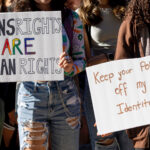
Leaders with FCPS Pride, an LGBTQ+ affinity group for staff, parents, and families in the school system, said they were pleased with the school system’s decision to not change their approach to transgender and nonbinary students. The group held a rally Tuesday night to show their support for queer youth in advance of the return to school.
“It was a beginning step. It’s not [just], ‘Oh, thank goodness. Fairfax County is going to stay with what they already had in place,’” said Davina Johnson, a retired Fairfax school counselor who is one of the leaders of the group. “It is the beginning of allowing the community to come in to have an active role in protecting and keeping our trans and binary nonbinary students safe.”
Johnson said transgender and nonbinary students she served frequently faced bullying by fellow students and ignorance or recalcitrance from other school staff on their particular needs. While she’s encouraged by the FCPS decision to maintain their policies as they are, she’d like to see the school system institute division-wide training on gender diversity and intentionally include nonbinary and transgender people and their stories in school curriculum.
Johnson criticized the Youngkin administration’s model policies for preventing school staff from doing everything they could to protect students who could be in danger at home, a dynamic she had to navigate a good deal in her time as a school counselor and one that she found “heart-wrenching.”
Johnson also said she felt the Youngkin policies could have the effect of shutting down what she called “courageous conversations” school counselors could have with students and their families to help everyone navigate their reactions to a student’s choice to come out.
“I was able to talk to families about loss, grieving, fear, embarrassment,” she said. “I gave their actions words of emotion, and then I would present different ways that they can work through it and give them that safe place to be negative or to be hurt, to be sad, to be scared.”
This story was updated after Prince William County Public Schools announced that their policies on the treatment of transgender and nonbinary students would also stay the same.