Elliot C. Williams
At the 11th annual back-to-school bash in D.C.’s Bellevue neighborhood, groups of students devour hot dogs by the dozens, and kids line up for free haircuts and face paint. An ice cream truck attracts a line that stretches all the way down Atlantic Street SW as city employees try to set up a stage for live music in the scorching August sun.
But the weather is the last concern for a group of first responders pacing up and down the block. The battery on the portable stage is malfunctioning. So, they’re stuck waiting hours for Department of Parks and Recreation workers to drive in a new Stagemobile, back it into an alleyway, and adjust it to a height that meets safety protocols.
But this anxious group of D.C. Fire and Emergency Medical Services (EMS) Department employees and volunteers aren’t just concerned about keeping everyone safe — they’re also keyed up because the stage is for them. They’re the main act this afternoon.
That’s right, these emergency responders are the ones from that viral video, in which a band plays a go-go cover of Maxwell’s 1996 neo-soul hit “Ascension” at a community event this past spring. The video has racked up 150,000 views, and that’s not counting the 236,000 plays it gained from a repost on the Washingtonian Problems Instagram account.
While their local legend grows, much is yet to be determined about the band, including their name. They’ve been performing in an official capacity for less than a year, and depending on which bandmate you ask, they’re either called Flashover or Heat Stroke. (The latter is the name one of the band’s fellow firefighters blurted out to a reporter earlier this summer — before they had settled on a favorite.)
But the band has agreed that, despite their duties to protect and serve, they will keep on cranking — the term for the nonstop beat at the heart of D.C.’s homegrown music genre. In fact, the band tells DCist/WAMU, cranking goes hand-in-hand with serving the public.

“I grew up in inner-city D.C.,” says lead vocalist Thaddeus Ellis, who retired this year from Engine 13 after 32 years of service. “So, it means a lot to give back to the young kids. Just to see them nodding their heads or their parents recognizing the songs or singing the lyrics. It’s always a good vibe.”
The bandmates’ ages range from the mid-30s to 50s, and a number of them work other jobs or pick up passion projects when they’re not on shift — including gigging with other bands. (They don’t get paid extra for their performances as Heat Stroke for city-sponsored events.)
Engine 16 firefighter Kevin Wilson, 36, has been playing percussion for over 20 years and cut his teeth by getting “called up” to play with go-go mainstays Raw Image and Junkyard Band when they needed a substitute for a show. “Those are two of my biggest accomplishments,” Wilson says. “I tell my kids that I’ve played with legendary bands.”
Some of the band members have played together since they were in their teens. They throw around terms like “brotherhood” and “family” a lot. And they tease each other like brothers, too, riffing about one member’s hidden talents or another’s solo music career that didn’t quite take off back in the day. One guy says the bandmate next to him has one responsibility: to carry the tambourines and cold water, cueing muted laughter from the group as if they’re a group of troublemakers in the back of a high school classroom.
“Most of the guys here have been playing with bands around the city forever,” says EMS-06 Captain Michael Timmons, the band’s lead keyboard player and de facto leader. “We figured, we’ve got all this talent in the fire department, why not put it together?”
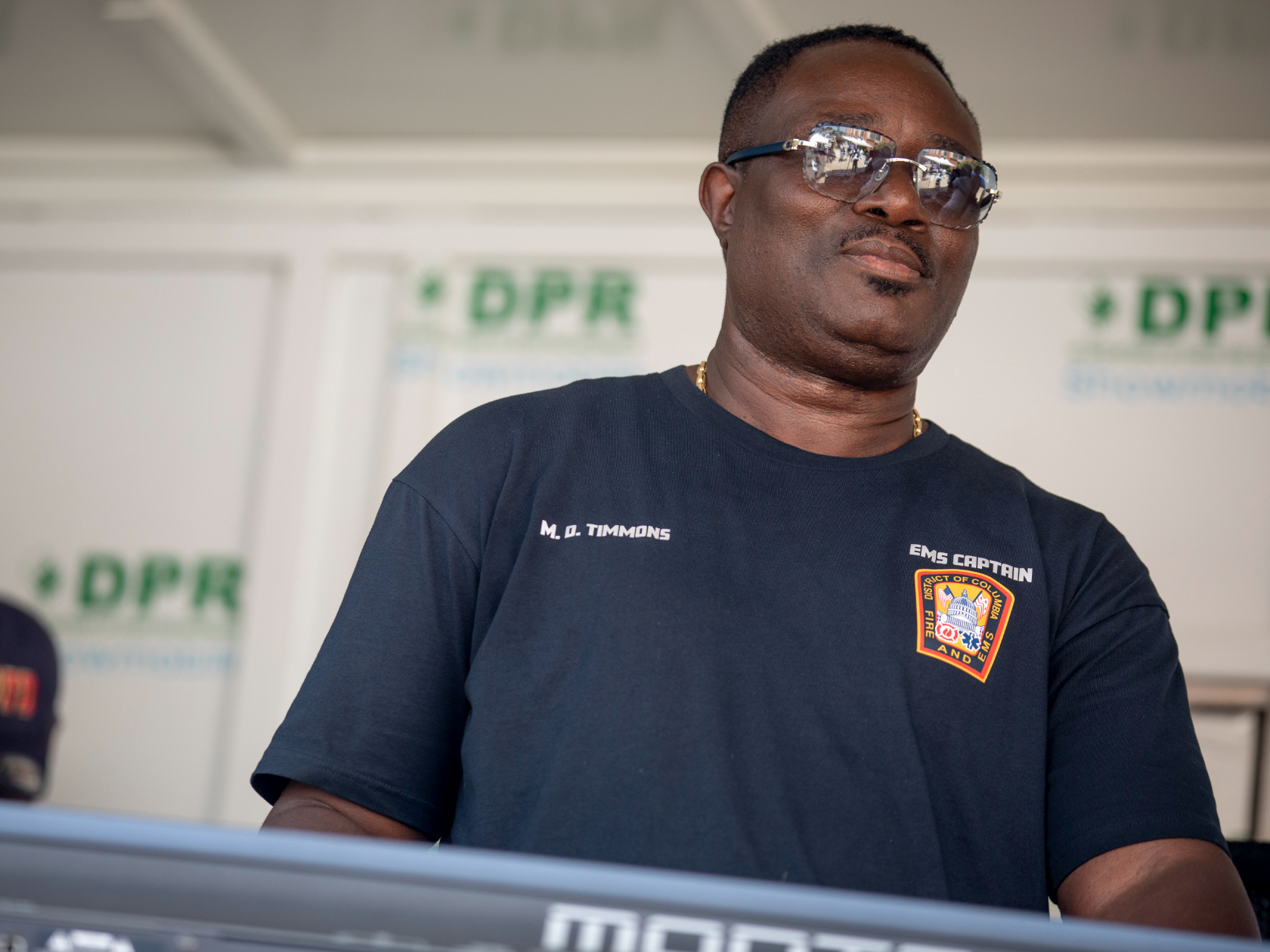


Much like their name, the band’s timeline shifts a bit depending on who’s asked, but here’s how Timmons tells it:
He and a few other musically-inclined first responders performed together in March 2022 at a memorial for the late Fire Chief Kenneth Ellerbe. Months later, Timmons called up a few more guys, and they began jamming occasionally at his house in Upper Marlboro. About six months ago, they started playing at community events sponsored by the D.C. government, often in tandem with the Side by Side band, the Metropolitan Police Department’s rock and go-go band.
Now, they’re introduced publicly as the D.C. Fire and EMS Department band and play most often for youth at Beat-the-Street events, the finale for which is on Aug. 30 at the Wharf.
It’s a lot to balance, considering they all belong to different platoons and work separate “24-on-72-off” shifts: They each spend 24 hours with their squad, prepared to jump into a burning building or provide IVs to drunk college students in the middle of the night, and then get 72 hours off the clock.
“It’s definitely a total commitment, and this is not for everyone. You have to dig down deep within yourself,” keyboardist Ronald Roundtree, a 20-year vet with Engine 2, says of being a first responder.
Do they fear for their own lives? Of course. But that’s when their training comes into play, Roundtree says. “As long as we have each other around, we’re never alone.”
This camaraderie comes in handy during their performances. If one player gets out of “the pocket,” the steady beat that provides the framework for any go-go performance, he can look to another member and jump right back in.
“That’s the unique thing about this group of musicians here,” adds Roundtree. “We haven’t been together that long. But when you hear us, you’re gonna think, ‘These guys have been together for years.’ That’s the natural instinct kicking in.”

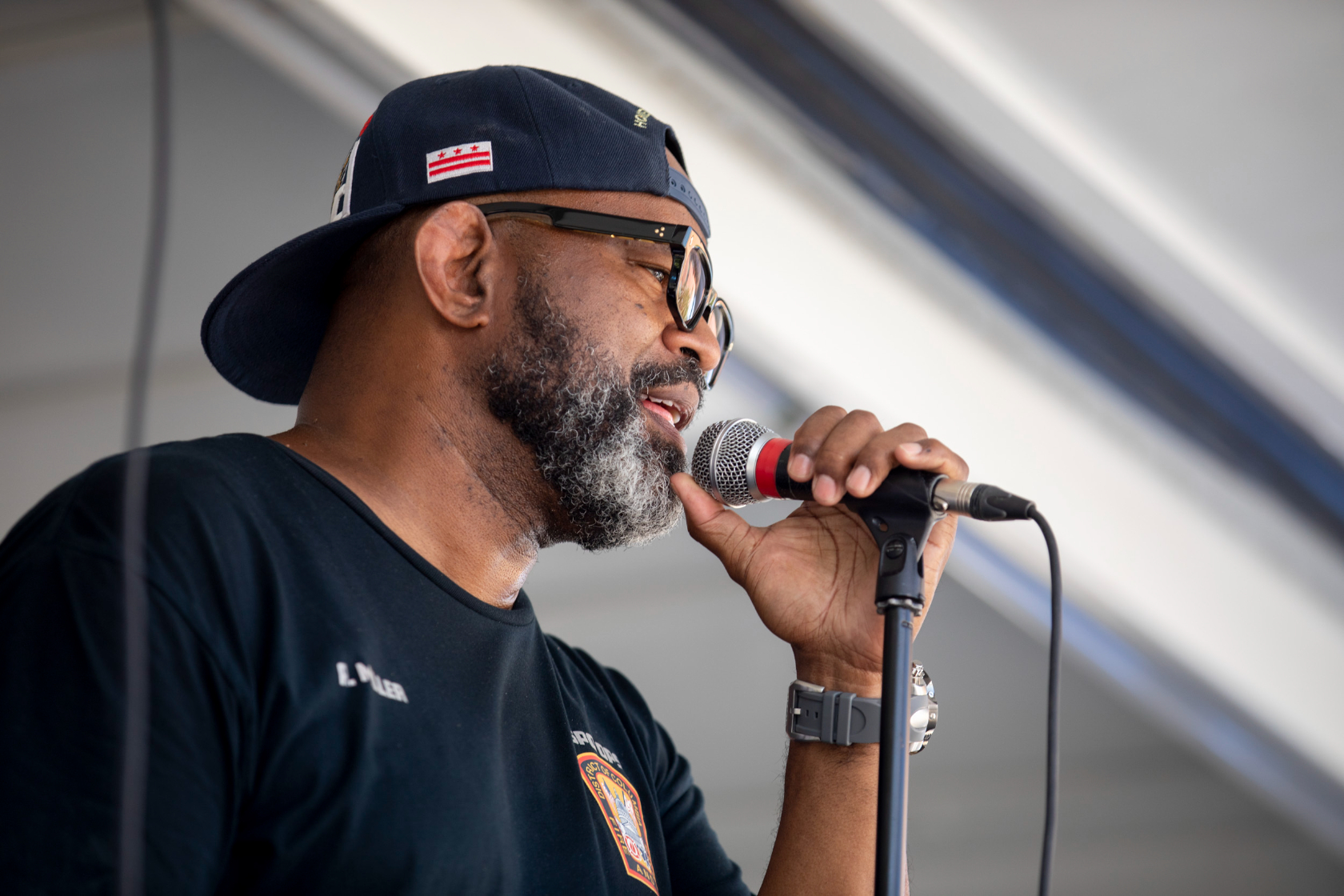

Once the stage is finally set at the back-to-school event in Bellevue, a modest crowd gathers in front. Students, teachers, officers, volunteers, and parents sway back and forth with their eyes closed, toddlers in tow, transported back to the golden age of go-go when partygoers would let loose well into the early morning hours at dance halls and nightclubs.
The band opens with their crowd-pleaser, the go-go-ified “Ascension,” and transitions seamlessly into a mashup of Anthony Hamilton’s “Best of Me” and other soul favorites. Tony Miller, of the D.C. Homeland Security and Emergency Management Agency’s special events division, serves as the band’s hype man and is responsible for the call-and-response routine that’s essential to any go-go show.
“We can stay right here all day,” Miller rap-talks into the mic, “here” being the pocket. “It ain’t gon’ hurt to move your hips, nod your head, stomp your feet, clap your hands.”
To be clear, they don’t sound like your average hobbyists who jam in a garage from time to time. They sound like pros. Could Heat Stroke catch fire?
“We’re local, but I don’t think anyone would mind if we went worldwide,” says Miller. “That’s the beauty of go-go: You can play the go-go beat with almost any genre or any type of song.”
They’ve been recording singles at a studio in Springfield, though there’s no album yet. They’re working on a web page and social media so they can share their recorded music more widely. Recently, the group shared a preview of their first single, a silky-smooth, up-tempo version of the country hit “Tennessee Whiskey,” with DCist/WAMU.
“It’s in our DNA,” says Ellis, the lead singer. “You’ll think, ‘OK, wow, these guys got some oomph to them as far as go-go,’ even though we do different genres.”
Still, as with most nascent music projects, things don’t always go as planned.
About 17 minutes into the back-to-school performance, Wilson, the veteran percussionist, stops playing the congas abruptly and yells at the others onstage, as if preventing an altercation between bandmates. The crowd blinks at each other in confusion until the cranking stops and everyone hears Wilson more clearly:
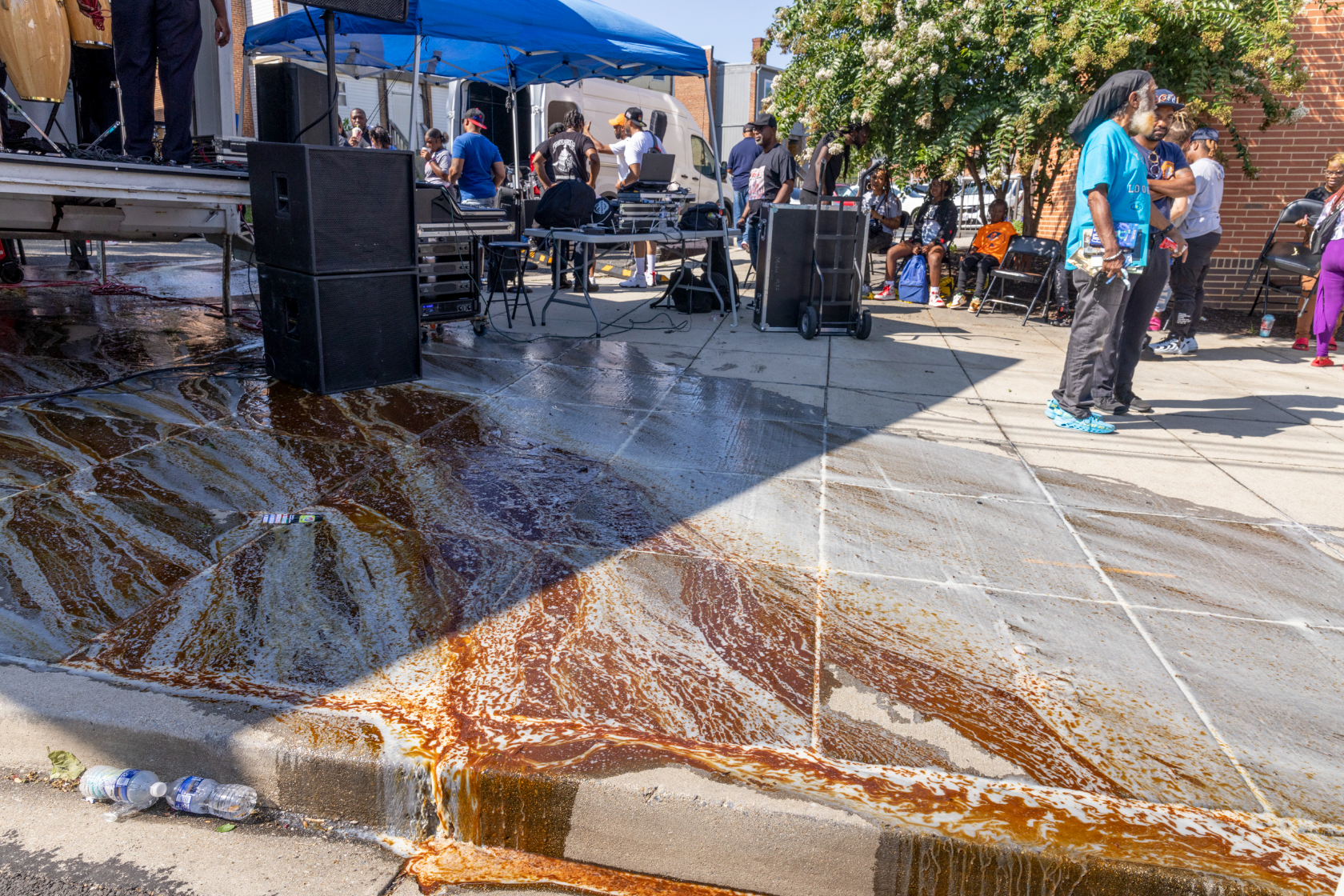
“Stop everything! Shut the power off,” he pleads with the technicians below. “There’s oil!”
Instinct kicks in. Wilson points at speakers and other equipment in front of the stage. A stream of cooking grease from a carryout spot up the alleyway flows beneath the stage.
Wilson picks up his 5-year-old daughter, Kendrix, who was on stage with him during the performance, and begins commanding people to back away, especially anyone with a cigarette. Despite the heat — from both the sun and the band’s infectious grooves — nothing catches fire.