Jacob Fenston
After years of studying and discussing the idea of launching a curbside composting program, D.C. officials finally began rolling out a pilot program this month. Roughly 9,000 households will be participating — they’ll get food scraps picked up once a week, and a bag of finished compost at the end of the program.
The pilot program was initially supposed to start in the spring. DPW began enrolling residents in April, and sent welcome packets to households that were selected in June. In late July, DPW officials told households they were aiming to launch the program by late August. At the end of last month, DPW announced the program would launch on a rolling basis, ward by ward, reaching all participants by the end of September.
Part of the delay, officials say, was getting a contract approved. DPW did not sign a contract with the companies that will do the food scrap collection until July.
“We would have hoped to have a contract awarded sooner, but we are where we’re at and we’re working really hard to meet our goals,” says Rachael Manning, zero waste program analyst with DPW.
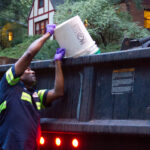
Manning says truck driver shortages have also delayed delivery of supplies needed for the program. Each household in the program will receive a 5-gallon bucket with a screw-on lid, a kitchen food scrap tote, and a package of compostable bags.
Manning says the rolling launch will allow the program to get started as materials arrive, rather than delaying the entire program until everything is ready. Households in Ward 8 were the first to get started last week. Ward 7 residents will get their buckets, totes and bags this week.
The program will collect as much as 6,000 tons of organic material over the next year — material that would otherwise end up in a local incinerator or landfill. When organic matter decomposes in a landfill, it releases methane, a potent, planet-warming greenhouse gas. That doesn’t happen when organic matter decomposes in a compost heap — carbon is sequestered in the soil, rather than being released into the atmosphere. Nationwide, landfills are the third-largest source of methane emissions.
The compost program is part of the District’s “zero waste” effort. D.C. has a goal to divert 80% of trash away from landfills and incinerators by 2032, instead composting or recycling the material. However, there is no way to get close to that goal without a robust citywide composting program and increased recycling. According to DPW, only 30% of household waste can be diverted under existing recycling programs.
D.C. lags behind other large cities and neighboring jurisdictions in terms of recycling and composting. D.C.’s citywide waste diversion rate is 16%, according to the latest DPW report; that’s compared to a 59% recycling rate in Montgomery County, a 41% rate in Prince George’s County, and a 54% rate in Arlington County.
D.C. officials have been considering a curbside composting program since at least 2017, when the city commissioned a feasibility study. That study proposed building a compost-processing facility in the District, requiring 10 to 20 acres of land. According to the study, D.C. could potentially collect between 88,000 and 148,000 tons of organic material — exceeding the current capacity of any processing facility in the region. The study envisioned DPW operating the program with its own trucks and drivers, just like curbside trash and recycling collection.
DPW decided to contract with private companies for the pilot because it would allow the program to get started more quickly. However, Manning says, DPW may take over if and when the program expands.
“It would require a big investment in staff in vehicles and we wanted to make sure that we are going the right route before we make that big investment,” Manning says.
The one-year pilot program is costing the city $4.5 million. DPW is working with two established local companies to collect and process food scraps, Compost Crew and Compost Cab. Both companies already collect food scraps from thousands of homes in the region, with residents paying for weekly collection. The companies also already have contracts with several local jurisdictions to provide government-funded or discounted collection to residents.
D.C.’s food scraps will be hauled to a processing facility in Prince George’s County to be turned into compost, a nutrient-rich soil amendment that can be used in place of chemical fertilizers.
Manning says DPW hopes to reach more households with curbside composting in the coming years. “Our goal is to offer this service in the future to any District residents that are interested,” says Manning.
Currently, the pilot program is only available to residents of single family homes or small multi-unit buildings of three or fewer units. Larger buildings are served by private trash haulers, not DPW. Currently about 10% of homes served by DPW are enrolled in the composting pilot.
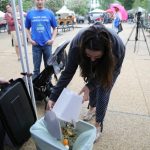
For residents who are not in the pilot program, there are 12 food scrap drop-off sites around the city.