Jacob Fenston
Just last weekend, close to 150 people were signed up for the first-ever Anacostia River splash day — the first legal swim in the river since the 1970s. Days earlier, DC Water announced the completion of a major sewer project, that drastically reduces sewage overflows into the Anacostia.
Still, even as the water is getting cleaner, the long-polluted river gets a failing grade in the latest report card assessing the waterway’s health.
“It’s a little discouraging, but you have to put it in the context,” says Christopher Williams, president and CEO of the Anacostia Watershed Society, which puts out the yearly report card.
The context is a gradual, but real, improvement over the past 30 years, Williams says.
“When we get these results and we plot them on a graph going over the decades-long period we’ve been doing these tests, the trend line still continues to go up,” he says.
In this year’s report card, the river gets a 52% grade, down 3 points from last year. The report card assesses the river in five different categories: water quality, submerged aquatic vegetation, stormwater runoff, toxics, and trash.
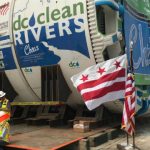
Toxics and trash both get relatively high marks (a D- and a D, respectively), reflecting ongoing efforts to remediate toxic chemicals in the river bottom and to trap trash before it makes its way into the waterway. Indeed, since the first phase of DC Water’s new Anacostia tunnel system went online in 2018, it’s captured 9,800 tons of trash, preventing it from dumping into the river — along with lots of sewage.
(By way of comparison: 9,800 tons is equivalent to roughly 1,500 Asian elephants. That’s. A. Lot. Of. Trash.)
While the cleanup of toxic chemicals is still ongoing, and a plan to dredge and cap contaminated sediment has been delayed.
In terms of water quality, the report notes that improvements have been uneven, with generally cleaner water in the lower portion of the river, especially downstream of the East Capitol Street Bridge. This is likely due to a few factors, including tides, which help flush out the lower sections of the river. Leaky sewers in Maryland are also likely to blame for high bacteria levels upstream, as is poop from wildlife.
The report highlights several challenges ahead for the river, namely climate change, which threatens to push more pollution into the water during heavy storms, and stormwater runoff, which increases as more of the watershed is developed.
On the bright side, the report highlights the return of wildlife to the watershed, including animals such as river otters, bald eagles, and osprey — and indication that the ecosystem is recovering from decades of abuse.
The real driver behind the failing grade this year, Williams says, is a precipitous drop in the amount of submerged aquatic vegetation. These native underwater grasses are a key indicator or water quality and ecosystem health, and they provide important habitat for fish and other creatures.
Submerged aquatic vegetation was entirely absent from the river for more than a decade, in the early 2000s, receiving a zero score on report cards at the time. Then, between 2013 and 2017, underwater grasses made a surprising comeback, surpassing the Anacostia Watershed Society’s goal of 20 acres coverage, and receiving a 100% score.
Now, though, there are just 3 acres of submerged aquatic vegetation. It’s not clear why this happened, Williams says. It could be related to heavy rainfall in recent years, which can overwhelm the grasses with sediment, or it could be related to cloudy spring weather, which can stunt the growth of the plants.
Williams says it’s still possible the the meet the 2025 goal of making the clean enough to swim in — but it probably won’t be every day, or everywhere in the river.
“I’m fairly optimistic that by 2025 we can have some designated swimming areas established that are swimmable on days when water quality permits,” Williams says.
As for making the river fishable, that will take longer, he says. To make fish safe to eat, toxic chemicals need to be removed from the sediment, and the timeline on that project is still several years out.