Jacob Fenston
Like any new mom, Becky Malinsky has dozens and dozens of baby photos on her phone. Unlike most new moms, the baby in question is a monkey.
“I always joke, if someone finds my phone, if I lose it, they’re like, ‘What the heck is this?!'” Malinsky says, laughing.
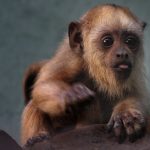
Malinksy is the primate curator at the Smithsonian’s National Zoo. The baby, Edgar, is an Allen’s swamp monkey, a species native to the forested wetlands of central Africa.
For the past month-plus, Malinksy and other zookeepers have been in the unexpected position of having to care for the baby monkey 24/7. They feed him formula in a tiny bottle, and he sleeps in a Pack ‘N Play surrounded by stuffed animals (his favorite is the stuffed ghost).

“Initially, it was holding him all the time, just like a human infant,” Malinksy says.
This was definitely not the plan when zookeepers discovered Edgar’s mom, Zawadi, was pregnant in mid-July. Zawadi was gaining weight; to confirm the pregnancy, they trained her to pause in front of an x-ray plate.
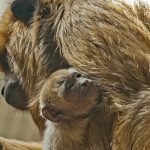
On the morning of August 21st, zoo staff were thrilled to find the baby had been born, and was alive and well. He weighed just 400 grams — the equivalent of 2.5 cups of all-purpose flour. He had a tiny, wrinkly, old-man face with gigantic ears, surrounded by a shock of white fur. Baby Allen’s swamp monkeys have whitish fur to blend in with the light-colored fur on the bellies of adult monkeys — as a baby clings to its mom’s belly, it’s camouflaged from predators.
In this case, Edgar was indeed clinging to an adult female monkey. But it was the wrong adult female monkey – Layla, the grandmother. She wasn’t producing milk, of course, so she couldn’t feed the baby. Without human intervention, little Edgar would starve.


Malinksy says they tried a few things to gently – or not so gently – encourage Zawadi’s maternal instincts. They tried putting Edgard and Zawadi alone in a smaller space.
That didn’t work.
They tried sedating the mom and putting Edgar on top of her. That seemed to work for a few hours.
“But after those few hours, unfortunately, she decided she did not want to participate in that capacity,” Malinsky says.
It’s not all that uncommon for zoos to have to hand-rear an animal. It happens in maternal neglect cases like Edgar’s, or when the mom or baby has some kind of medical issue. Here at the National Zoo in recent years, this has happened with clouded leopards, sloth bears, tigers, and cheetahs.
It’s been a huge job raising Edgar – there are about 30 zoo staffers on rotating shifts caring for him. They’ve closed the Think Tank building to the public — that’s where Allen’s swamp monkeys and orangutans are housed — and created a makeshift monkey nursery in the lobby of the building.

“It has been a very unique experience,” Malinksy says. “We have all fallen in love with this little monkey. It’s also overwhelming because we want to do the right thing for him.”
When Edgar was about three weeks old, zoo staff attempted to reintroduce him to his grandmother Layla. They’d trained her to linger by the edge of the monkey enclosure, with the idea that zookeepers could then feed Edgar through the mesh, while he clung to her.
It didn’t work. Layla now tolerated Edgar, but no longer wanted to mother him.
“As with all animals, you never know how they’re going to behave, and unfortunately Layla did not act as we thought she would,” Malinsky says. “Now we understand he probably is not ever going to be picked up and held by one of the females. And that’s okay.”
Zoo staff have had to regroup and try something new. Now, Malinsky says, they’re focused on slowly introducing Edgar to the other three swamp monkeys in the troupe, so eventually he can live with them, even if none of them acts like a parent.
“Even though we’re primate experts, we are not monkeys, and I do not know how to teach him how to be a monkey,” Malinsky says.

The only way he can learn to be a monkey is from other monkeys.
“It’s a little bit of tough love. But we know it’s what’s best for his future. Even though we are completely smitten with him — we obviously have formed this relationship with him — I deep down know I cannot provide all of his needs for him,” says Malinksy.
Malinsky says they’re taking things slow with Edgar and the introductions – so, there’s no timeline for when visitors will be able to see him regularly, or when the Think Tank will reopen to the public. But in the meantime, if you stop by the outdoor enclosure on the side of the building, you may catch a glimpse of the tiny monkey with one of his human caretakers, as they work to familiarize him with the space.