Margaret Barthel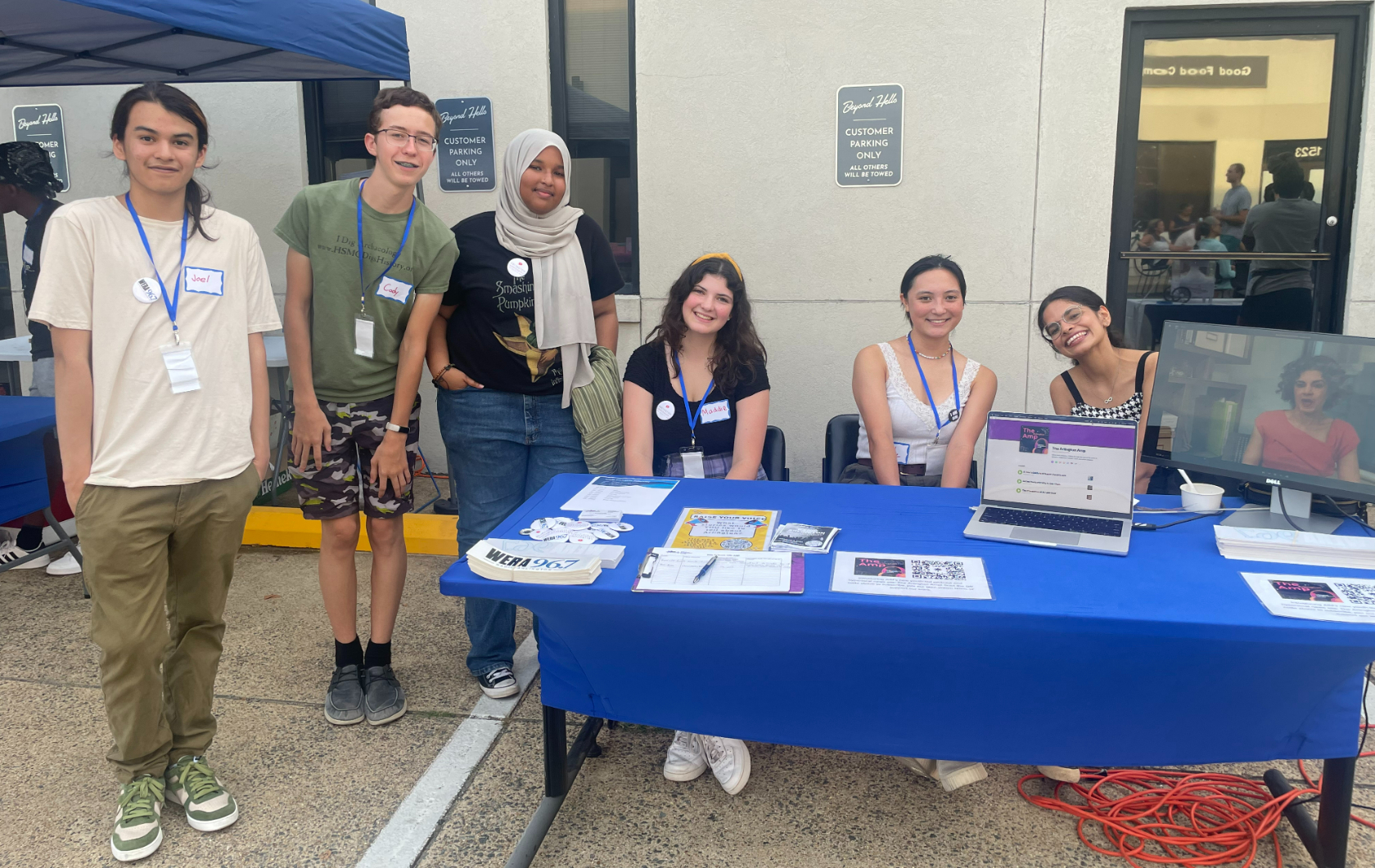
When you listen to The Arlington Amp, you’re drawn in by all kinds of compelling sounds: the traffic on Langston Boulevard, the insect peeps and rustlings of a Virginia evening, a local artist musing about her art.
But what’s maybe most compelling about this new local podcast are the voices that guide you through each interview and story. They’re by turns funny, thoughtful, wise, and emotional in navigating a wide variety of topics — and they happen to belong to a group of Arlington high school students.
“Considering the community that we live in, which is so diverse, [with] so many interesting things that are occurring, so many stories that need to be told, I thought that it was my prerogative, that it was essential that we have to share those stories, and we have to share our youth perspective on them,” says Harsidak Singh, one of the students behind The Arlington Amp.
The podcast is the final product of Arlington Independent Media’s Youth Journalism Initiative. The students spent six weeks this summer developing, reporting, scripting, and producing episodes about topics that interested them.
“What we did in fact end up with is a full season of podcast episodes, which…I’ve never been able to do in six weeks,” says Kristen Clark, who runs the program and has produced podcasts professionally. “That’s crazy. That never happens.”
Clark sees the Youth Journalism Initiative as one small way to push back against what she calls the “evisceration of local news,” a decline in community outlets over decades. Research shows connections between poor access to local news and worsening political polarization, less government transparency and more government spending, and decreasing citizen engagement.
“The lack of local storytelling in this country is ripping us apart,” she said at the showcase event. “And it’s really truly, truly, truly scary that we have lost the ability to look around at each other and talk to each other.”
Training teenagers to try to help close that gap made particular sense, she said, in a moment when so many major political debates center around young people.
“Everything from opioids to birth control to trans rights to guns, literally just name them,” she said.
In response to that lofty challenge, the Arlington Independent Media students made podcast episodes about everything from native plants to how teens can be involved in local government.
Singh, a senior at Washington and Liberty High School, produced two episodes of the podcast, one about a local artist grappling with trauma and another about a restorative justice program in Arlington. He sees the two as flip sides of the same coin: one about someone using art as a way of processing her experiences, and one about what happens when young people don’t get that chance.
The ties between mental health and restorative justice, Singh says, are especially relevant to teenagers, who are the ones experiencing juvenile detention. Policymakers examining the statistics, he says, can only understand so much.
“They don’t understand how our generation is thinking, or what issues we’re dealing with, or what the best approach would be for us and the new legal system that we might create,” he says.
Cody Finnegan tackled an entirely different — but no less topical — issue. His episode is about the debates over Plan Langston Boulevard, the county’s vision for a denser, greener, more walkable future for the major road. The plan, which would provide a blueprint for the corridor for decades to come, has drawn pushback from some residents concerned about more density and housing in the area. (Other residents are excited by the plan, eager to see the neighborhood transform into something less car-centric.)
Finnegan thinks the debate is missing the perspectives of local teens, who often rely on public transportation, bikes, scooters, and walking to get places, and who will ultimately live with the outcome of decisions made now.
“Most of the people showing up to these [community] meetings were Gen X homeowners, longtime residents, which makes sense,” he says. “But there are other perspectives to consider, and I wanted to share my perspective while respecting the people who are already involved in the conversation.”

The experience of wrestling with a controversial issue on which he himself has an opinion seems to have landed with Finnegan.
“It made me realize how much control the journalist has over the message,” he said at the showcase. “You have to be careful that you’re being ethical and you’re portraying everything in a fair way. And that’s different from not taking a position.”
Other students shared similar reflections on what they’d learned about journalism. Maddie Hawkins interviewed an Arlington County Board staffer who himself got involved in local government in high school.
Hawkins said she also learned how important it is to craft a compelling and informative narrative.
“For every minute of audio that you have, there’s another two that you don’t include,” she said.
“So it made me realize how much effort people put into making it a story and helping people process the information.”
The students also learned about the importance of journalism that serves communities by including important background and context instead of sensationalism.
“You don’t go in yelling. You don’t go in and say, ‘Breaking news! Child died by crashed minivan!’” said Shoshan Ferguson, the student behind the native plants episode. “You start with, ‘Hey, there’s a lot of accidents at this traffic stop. What’s the deal with that?’”
They also emerged from the program with a new enthusiasm for local news.
“Regular people often can’t add to that much about the national level,” Finnegan says. “I think it’s very important to have local voices, local perspectives, and for local people to have access to local reporting also so that they can be informed about the local level, because often it’s very hard to to know what’s going on even in your own community.”
Singh, who wants to follow up on his restorative justice story and perhaps take on new reporting about local public schools, agrees.
“When we bring local news to the forefront of our communities where we live, we’re essentially creating a more diverse ecosystem where all voices are heard and represented,” he says.
Clark says the Youth Journalism Initiative will continue offering free journalism training to Arlington teens this school year. Arlington public school students interested in the program can find more information here.