 Sarah Y. Kim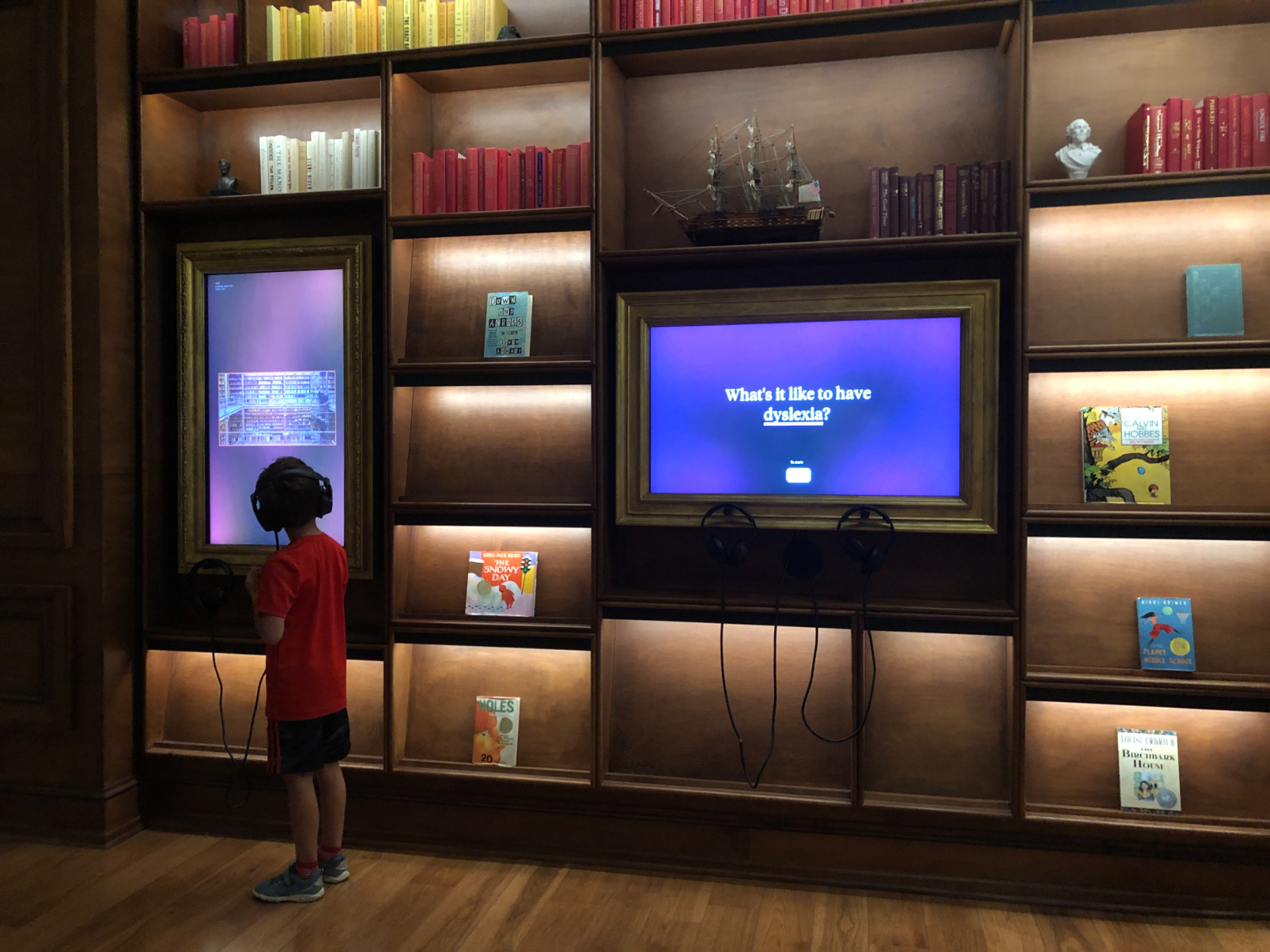
October is Dyslexia Awareness Month, and Planet Word – the D.C. museum known for its interactive exhibits about language – has a new installation, “Inside Look: Dyslexia,” that aims to “demythologize” the disability.
The museum’s founder and CEO, Ann Friedman, said she wanted Planet Word to have an exhibit that would “normalize” dyslexia in a “fun and playful but meaningful way.” About one in five people in the U.S. have it, according to the National Institute of Health.
“It’s very common,” Friedman told DCist/WAMU. “It’s not connected to intelligence. It’s just a brain difference in how you process words.”

The exhibit is in a wood-framed screen in the museum’s Schwarzman Family Library, a room that’s a bit of a booklover’s dream, with dark floor to ceiling shelves full of books lining the walls. At a table in the center, visitors can open physical books and watch them come to life in little video trailers. Open a copy of Rick Riordan’s adventure novel for kids The Lightning Thief and the Empire State Building is suddenly projected onto the table. Open a copy of Samin Nosrat’s cookbook Salt Fat Acid Heat and you see and hear salt falling through someone’s hands.
Friedman wants the museum to make books more appealing to people who might not enjoy them while making reading more accessible. Friedman hopes the exhibit can empower parents to better support their children who are struggling to read and who may not yet be diagnosed.
“Inside Look: Dyslexia” joins 20 other interactive exhibits at the museum. Visitors put on headphone sets to hear the voice-activated installation which prompts visitors to read questions or words aloud – or just tap a screen. The first question – “what’s it like to have dyslexia?” – segues into video interviews with people diagnosed with the condition.
The interviewees, many of them children, talk about their struggles at school. They talk about wanting to drop out, or wanting to get help in class but not knowing how.
“Every single time I read, I’m slow, I stumble upon the easiest words. Kids would laugh at me,” one says.
“One time, when I didn’t get my homework done because I couldn’t get it finished, the teacher made me stand up in front of the entire class and say ‘I did nothing,'”
Another described a teacher making them stand in front of the class to say ‘I did nothing’ after failing to finish their homework: “It made me very very embarrassed and I didn’t even want to go to school the next day.”
Science is central to the exhibit: visitors get a detailed breakdown of what happens to the brain when reading and how dyslexia occurs. It’s a neurobiological condition, meaning it stems from how the brain works. The museum partnered with Dr. Guinevere Eden – a professor of pediatrics at Georgetown University and the former president of the International Dyslexia Association – to produce the exhibit.
“We don’t want anyone to get a wrong answer or come away from here believing something that’s not true and not provable,” Friedman said. “We have to get everything right.”
As the exhibit explains, listening to, understanding, and speaking a language comes naturally to the vast majority of people (except in cases of hearing or neurological impairments). But the brain is not hardwired to read, and when people do learn, they are repurposing parts of the brain involved in spoken language and object recognition that were not actually designed to read.
Three parts of the brain are used when reading: for pronouncing words, identifying sounds in words, and recognizing words by sight. Brain imaging shows that when someone has dyslexia and is learning to read, they struggle because the parts of the brain that are responsible for sounding out new words and processing images aren’t activated the same way.
Jason Fujii, a Boston resident visiting D.C., came to the exhibit. He says knowing the science helps break down misconceptions.
“I had a really simplistic understanding of it,” Fujii said. He didn’t know beforehand how dyslexia affected the brain.
Friedman, who taught beginning reading for several years, said instructors should incorporate phonics into their reading lessons. Connecting the words on a page with their sounds makes reading easier for students with dyslexia. But Friedman says that’s not the standard yet across schools, even though it can benefit all students.
“The best reading instruction is reading instruction that’s good for kids with dyslexia,” she said. “If it works for them, it will work for all students.”
General admission to Planet Word is free (though the museum suggests a $15 donation on its website) and visitors can get a timed ticket. The museum also accepts walk-ins if it has the capacity.