Jacob Fenston
The 18-hole golf course in Rock Creek Park is in dire need of rehabilitation: 4 holes are completely unplayable, fairways are overgrown, and the turf has large patches of bare dirt. But a project to restore the course has some residents and environmental groups up in arms: to improve the playability of the golf course, the National Park Service wants to cut down more than 1,000 trees, clear-cutting about 8 acres.
“I always knew that there were going to have to be a couple of trees taken out here and there to reroute the golf course holes and fairways, but I really did not expect there to be 1,262 trees cut down,” says Vanessa Bertelli, a Ward 4 resident who lives near the golf course, and regularly volunteers in the park, removing invasive plants.
“If we need to remove a couple to make the golf more exciting, sure, we can talk about that. But 1,262 has to raise concerns,” Bertelli says.

NPS released an environmental assessment of the proposed golf course rehabilitation on Sept. 25, detailing the number of trees that would need to be removed under the plan. However, the assessment was not widely publicized, and went unnoticed by most residents and environmental groups. The public comment period was set to close today, but this morning NPS agreed to extend the deadline by 11 days, until Nov. 4, after public pushback, including from D.C. Delegate Eleanor Holmes Norton.
“Many of my constituents had not had an opportunity or indeed weren’t even aware of the comment period,” Norton says. While she has not taken a position herself on the golf course project, Norton says she welcomes the extension, so residents have time to read the lengthy environmental assessment and weigh in.
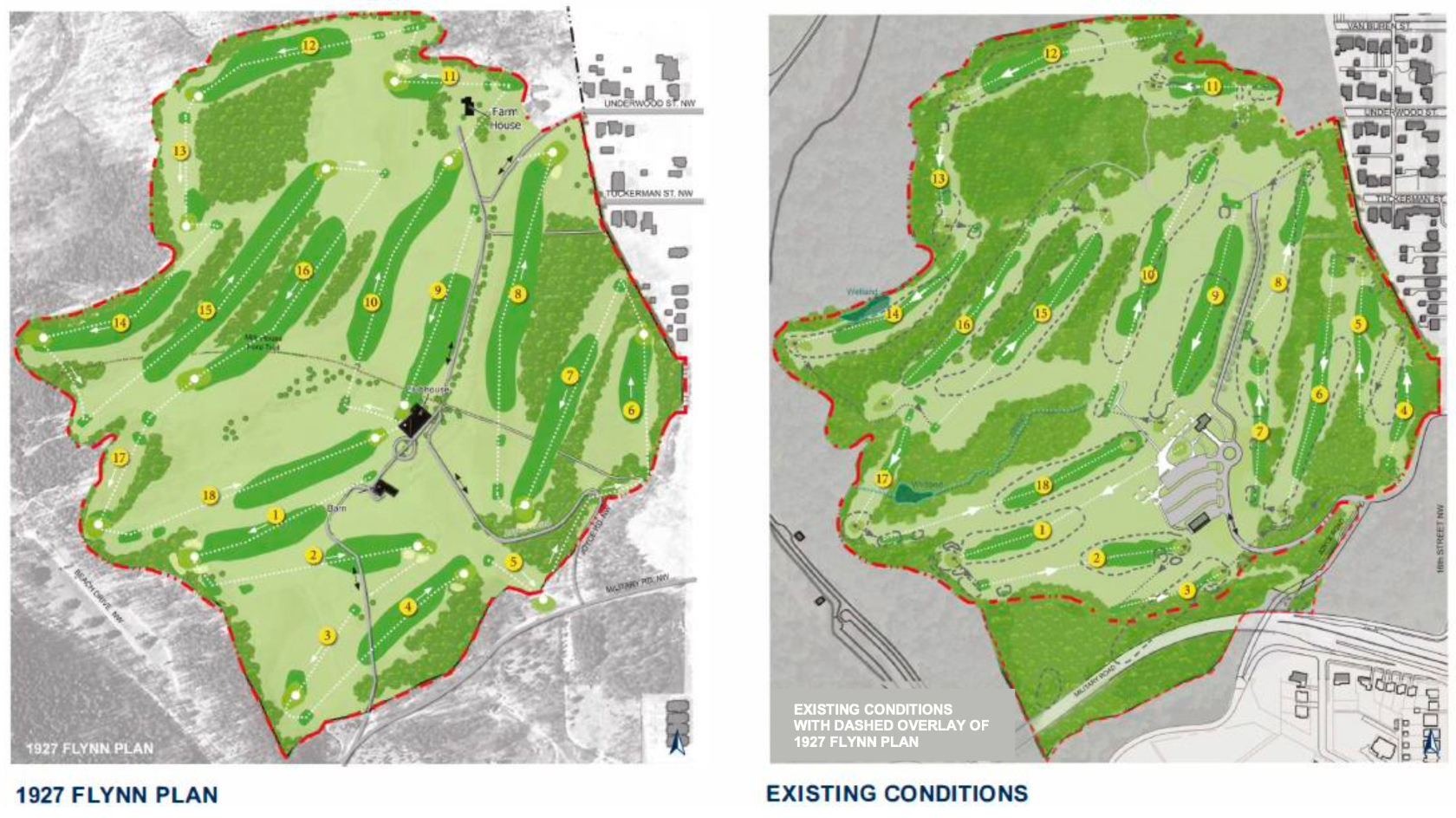
The course was designed in 1927 by the well-known golf course architect William Flynn. Flynn designed the course in a “parklands style,” incorporating stands of trees amidst the fairways, on gently sloping terrain. Flynn’s plan included more open, grassy space for golfing than what exists today. Over the decades, some of the golf course was overtaken by encroaching vegetation, and a large section on the south end was lopped off to build Military Road.
The property is “a largely intact example of a course designed during the period referred to as the Golden Age of golf course architecture,” according to an NPS press release about the comment period extension. The golf course is listed on the National Register of Historic Places it is part of the Rock Creek Park Historic District.
In 2020, a newly formed nonprofit called the National Links Trust won a 50-year lease to operate the golf course. The group proposed the rehabilitation project as a way to “address deferred maintenance, increase playability, broaden course appeal to the local community, and achieve financial stability” for the golf course. Under the plan, the old 18-hole course would be split into two 9-hole courses, with a new driving range. The project would also include a new clubhouse, golf cart building, picnic pavilion, and maintenance building.
The National Links Trust executive director was unavailable for comment for this story.
Within the golf course, there are five wooded tree stands. NPS conducted a survey of these stands in early 2022, cataloguing the trees and assessing the health of the stands. The health of the wooded areas ranges from good to poor, according to the assessment, with some areas characterized by a diversity of native tree species, while others are mostly invasive species.
A total of 2,571 trees were surveyed on the golf course property, according to the assessment — this includes most trees on the property, except for a northern portion which will not be directly affected by the project. The most common species surveyed are tuliptree, American beech, oak, and maple. Just about half of those trees, 49%, could be removed as part of the project. About 200 new native trees would be planted once the construction is complete. The rehabilitated course would also include about 13 new acres of pollinator meadows, native grass meadows, and other naturalized areas.
The environmental assessment notes that there are several endangered species within Rock Creek Park that could be affected by the loss of 8 acres of forest. These include the Hay’s spring amphipod, which is only found in a 2.5 mile portion of the Rock Creek watershed. While the amphipod, a tiny, shrimp-like creature, has not been found on the golf course itself, it does live nearby and could be adversely impacted by forest loss.
The loss of forest would be partially mitigated by the new meadow areas and new tree plantings, according to NPS in the assessment. The new meadows would provide important habitat for native pollinators, including butterflies and bees, according to NPS.
On Monday, the local nonprofit Casey Trees sent out an email blast opposing the tree removals in Rock Creek Park.
“We understand the importance of public recreation in Rock Creek Park,” says Kelly Collins Choi, director of policy and land conservation Casey Trees. “But there’s got to be a way to minimize the impacts regarding tree removal.”
Jeanne Braha, executive director of the nonprofit Rock Creek Conservancy, says her organization is still reviewing the environmental assessment. “I will say it’s concerning to see that many trees cut down. We know that Rock Creek’s forests are in poor condition and they need a lot of restoration work,” Braha says.
Another concern, Braha says, is that the golf course project could include construction of a well, to be used for irrigation.
“We would like to see more specifics about how it might impact groundwater, and particularly the Hay’s spring amphipod, which relies on groundwater seeps in Rock Creek Park.”
The public comment form can be found online on the NPS website.
This story was updated to add new information after NPS released a press release on the comment date extension, and to clarify that the 2,571 trees surveyed excludes some trees on the northern end of the golf course.