Jacob Fenston
The city of Alexandria will clean up toxic pollution along the Potomac waterfront as part of a settlement announced today. The agreement settles a lawsuit filed against the city by the nonprofit Potomac Riverkeeper, alleging a city-owned site has been polluting the river for decades.
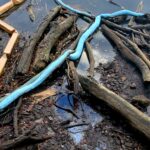
The pollution stems from the city’s long-shuttered coal gasification plant near Founders Park in Old Town. Since at least 1975, the site has been leaking coal tar, creosote and other waste into the river via storm sewers, according to the lawsuit, which was filed in May, 2022. Coal tar contains polycyclic aromatic hydrocarbons, or PAHs, according to the Environmental Protection Agency, which are considered by health agencies to be probable human carcinogens.
Under the settlement, the city agreed to install new wells that will help remove coal tar from the site, as well as a new liner inside the storm sewers to prevent coal tar from seeping into the pipes. The city also agreed clean up contaminated sediment in the river, where the storm sewer has been dumping pollution, and fund $300,000 of mussel restoration along the waterfront. The mussels will help clean up the water (they’re filter feeders, like oysters) and they will contribute to a healthy underwater ecosystem.
The city will also pay $190,000 to the riverkeeper group to cover legal fees, as part of the agreement.
Under the terms of the settlement, the city has to install the new wells within a year, and the pipe relining must be completed by March, 2025. Cleanup of contaminated sediment must begin by July, 2026, following further testing and planning.
“We’re really pleased because it really gets at the heart of trying to fix the source of pollution and eliminate this discharge to the river,” says Potomac Riverkeeper Dean Naujoks.
Emily Baker, deputy city manager of the city, says she’s also pleased with the settlement. “A lot of the work in here is improvements that we have been planning to do, and we have come to agreement with the riverkeeper in terms of accelerating some of that work and continuing with the improvements over time,” Baker says.
The coal gasification plant operated between 1851 and 1946, turning coal into gas that could be used to heat and light homes. This was a common practice around the country, before the advent of electricity. It was also highly polluting, contaminating the air, soil, groundwater, and nearby waterways.
The current pollution problem started when part of the site was redeveloped in the 1970s. Townhouses and offices went up, and a storm drainage system was installed. According to the lawsuit, that storm sewer system picks up legacy contamination from the gas plant and ferries it into the river, dumping toxic chemicals into the Potomac, along with stormwater.
Naujoks says his organization first became concerned about the pollution in 2016, and approached the city about it.
“When we got involved, these oily sheens were basically discharging out of the pipe almost every single day, or certainly after a rain event,” Naujoks says. “We started raising concerns about, are they going to address the contamination from the former gasworks site that the city owned, and the pipe that they installed that actually created that source of pollution?”
The city has taken numerous steps over the past two decades to fix the pollution problem, including installing floating booms in the river, and relining storm sewer pipes in 2006. But those measures were insufficient to fix it.
“We have been working to clean up this legacy site since since 2000, and we have invested a lot of money — over $12 million in the last 20 years — to clean it up,” says Baker.
As for why they pollution is still happening: “Nobody’s more frustrated about that than we are here at the city,” Baker says.
Baker says the city has budgeted $11 million to complete the remediation projects.
The settlement is still subject to final approval. The EPA and U.S. Justice Department now have 45 days to review and comment on the agreement, which then heads to a judge for final approval.