Amanda Michelle Gomez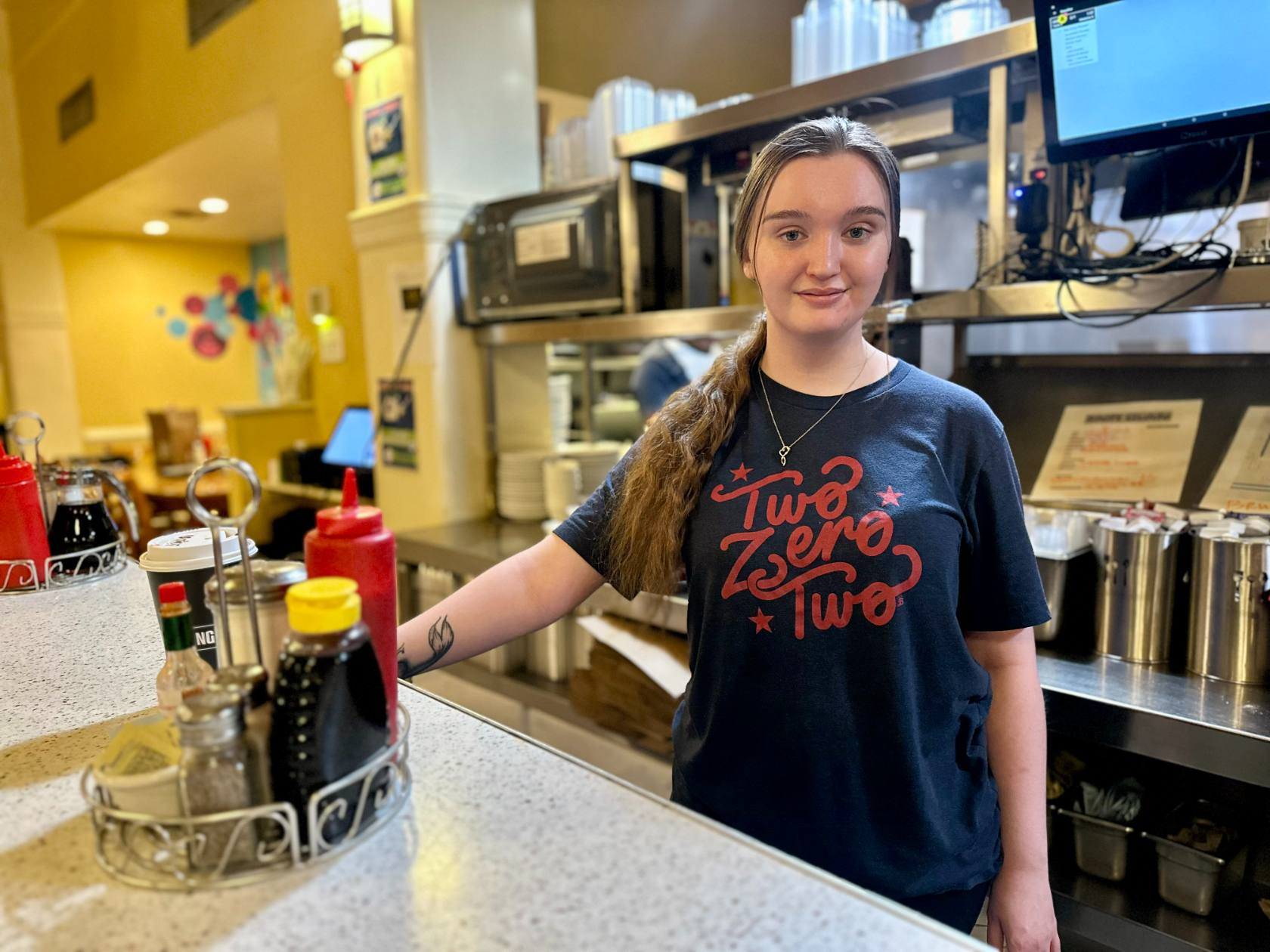
Madi Kennedy says she earns more money now than she ever has.
Kennedy is a server at The Diner on 18th Street NW, where she earns $8 per hour, plus tips. Both her hourly wage and tips have increased over the last few months, she says.
Kennedy was used to earning just over $2 per hour and hustling for tips when she worked at restaurants in Philadelphia. When she moved to the District over the summer and started working at the diner, Kennedy was pleased to be making $6 per hour — the city’s tipped minimum wage at the time — plus enough in gratuity to afford to live in her new city.
Then, shortly after she started, her boss unexpectedly raised her hourly wage to $8.
“It was actually a really nice surprise,” Kennedy tells DCist/WAMU.
Kennedy is one of many service industry workers impacted by the implementation of Initiative 82, the ballot measure District voters overwhelmingly approved last year that incrementally raises the hourly wages tipped workers are required to be paid. Prior to its implementation, D.C. workers were required to be paid just over $5 per hour, with their employer supplementing that if they didn’t reach the city’s minimum wage through tips. The measure gradually increases their wages over the next several years, until they reach the full minimum wage in 2027. (D.C.’s minimum wage is currently $17 an hour and increases periodically in line with inflation.)
The initiative was contentious, including within the restaurant industry. Critics warned bartenders and servers would earn less because patrons would stop tipping or they’d lose their jobs altogether because businesses would shutter, while proponents argued the two-tier wage system is confusing and inequitable — plus lacks stability.
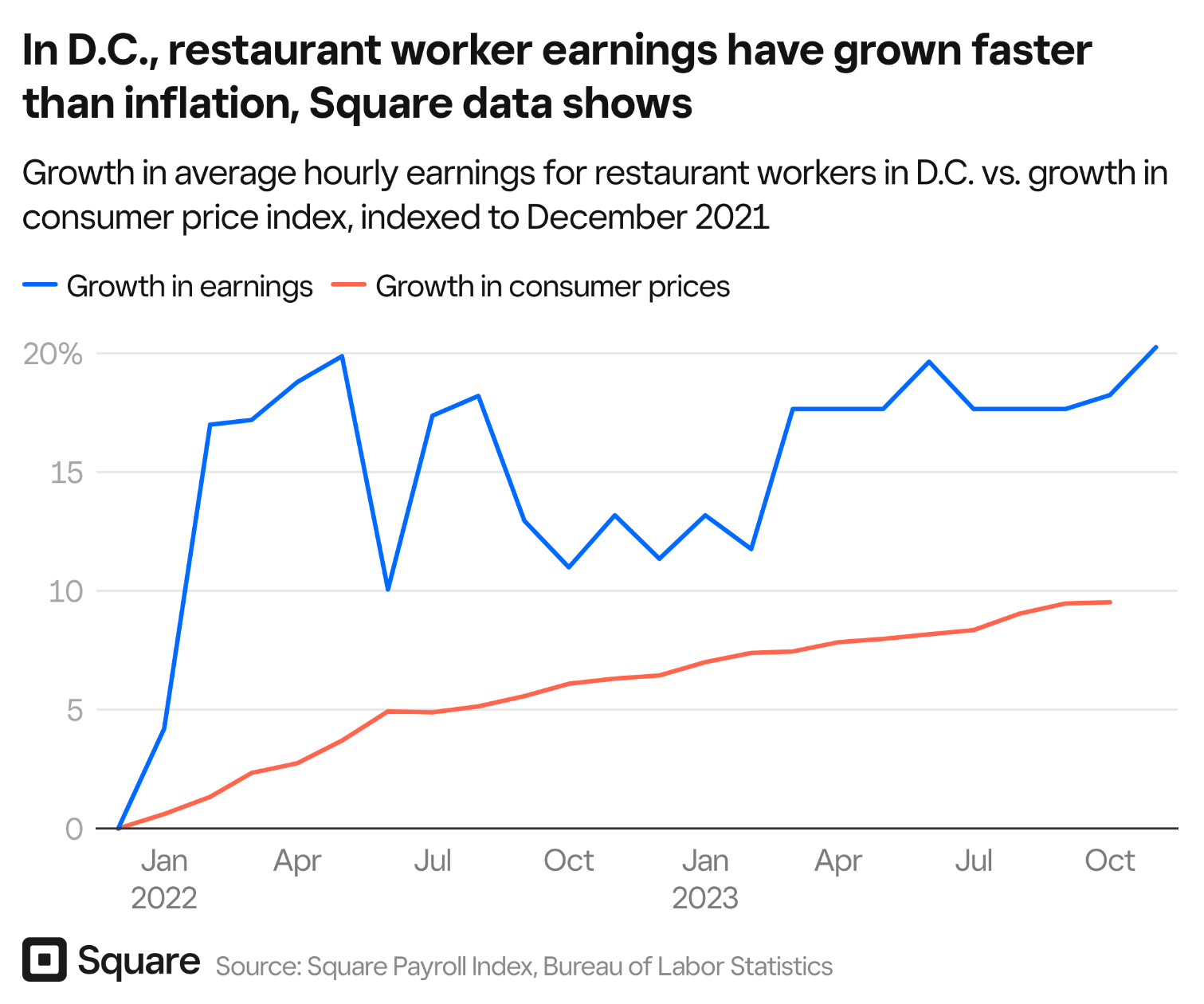
We have an incomplete picture of Initiative 82’s effects, however, the worst-case scenario – mass closures or layoffs – has not come to pass, at least thus far. The total earnings of restaurant workers appear to have increased, though not necessarily their tips. The average hourly wages and total earnings for both front-of-house and kitchen staff increased, surpassing inflation, between January 2022 and October 2023, according to Square, a popular point-of-sale system used by restaurants. However, tips appear to have gone down over that same time period, with workers making $1 per hour less in tips and overtime.
Conversations with front-of-house restaurant workers during the past month reflect the dichotomy in the Square data. Of more than a dozen workers DCist/WAMU spoke to, several said they make more money now — though the pressures of inflation and many restaurants’ new service charges mean that hasn’t been the case for everyone.
‘It’s quite comforting’
Kennedy didn’t realize her pay bump had to do with a ballot initiative, but was grateful to buy a new pair of shoes (black Vans) with the extra cash. She says she also feels more confident about making her monthly rent of $850 for the group house she lives in.
“It’s quite comforting, I’d say, to have that extra money,” Kennedy says. “So on days like Tuesdays in the afternoon, when it’s super slow, I know that I can rely on my $8 an hour and know that I’m at least getting something for my time.”
The hourly wage of Zach Slavin, a bartender at casual Adams Morgan cocktail bar Grand Duchess, also increased to $8 in accordance with Initiative 82, and his tips have stayed consistent, he says.
His higher earnings have meant he is less worried about affording rent or the health insurance that he purchases on the Obamacare marketplace — and he can afford to splurge more by patronizing a bar himself.
“I’m a little more comfortable,” Slavin says. He doesn’t want the D.C. Council to pass a bill that would speed up the timeline for when employers have to pay their tipped workers the full minimum wage — because it would also eliminate the initiative’s step increase from $8 per hour to $10 next year.
“That’s a difference of $3,000-$4,000 for full time workers who could use that increase next year,” he says.
Likewise, Marvin Sanchez, who bartends at U Street pizza spot Red Light, is making more money now because his hourly wages increased to $8 over the summer plus his tips stayed the same.
“It made a big difference,” Sanchez says — though he remains skeptical of Initiative 82 if it means people stop tipping once it’s fully implemented.
A lot of bars and restaurants across the city already pay their front-of-house staff above the tipped minimum wage of $8 an hour, including fancy bistro Primrose in Northeast and the casual restaurant Pho Viet in Northwest, workers there tell WAMU/DCist.
Thirsty Crow, a snazzy Columbia Heights sports bar, pays bartender Don $30 per hour, he says. (He declined to give his last name due to privacy concerns.) He made more than tipped minimum wage before Initiative 82, he adds. Don isn’t allowed to accept credit card tips, but he does get a cut from a 22% service charge added to all bar tabs, he says. (Thirsty Crow declined to say whether it added this service charge before or after Initiative 82.)
Even without tips, Don says he’s satisfied with his earnings. On a recent check, he made $1,800 for 32 hours of work, he says. He believes that’s comparable to what he used to earn when he made money from tips on top of a service charge, but had lower base pay.
“It’s definitely more stable,” Don says of his workplace’s payment structure.
Higher wages, fewer tips mean less overall pay
IHOP server Nick Jones says he earns less now despite the raise to his base pay.
“A lot of people don’t tip these days,” Jones tells DCist/WAMU. “I remember when I first started here, I thought I was ballin’.”
A year ago, Jones would walk out of a shift with $120 to $160 a night — but now it’s more like $80 to $110, he says. Patrons tip less generously than they used to, he says, and a few of his regulars even stopped showing up. He suspects that’s because menu prices increased. Jones says his boss explained to him that the Columbia Heights diner needed to raise prices to afford increased labor costs; the manager of the franchised restaurant confirmed that was the case.
“They’re like ‘Why do I got to pay $15 for some pancakes?’ and then they are like ‘No’ and then they leave,” he says.
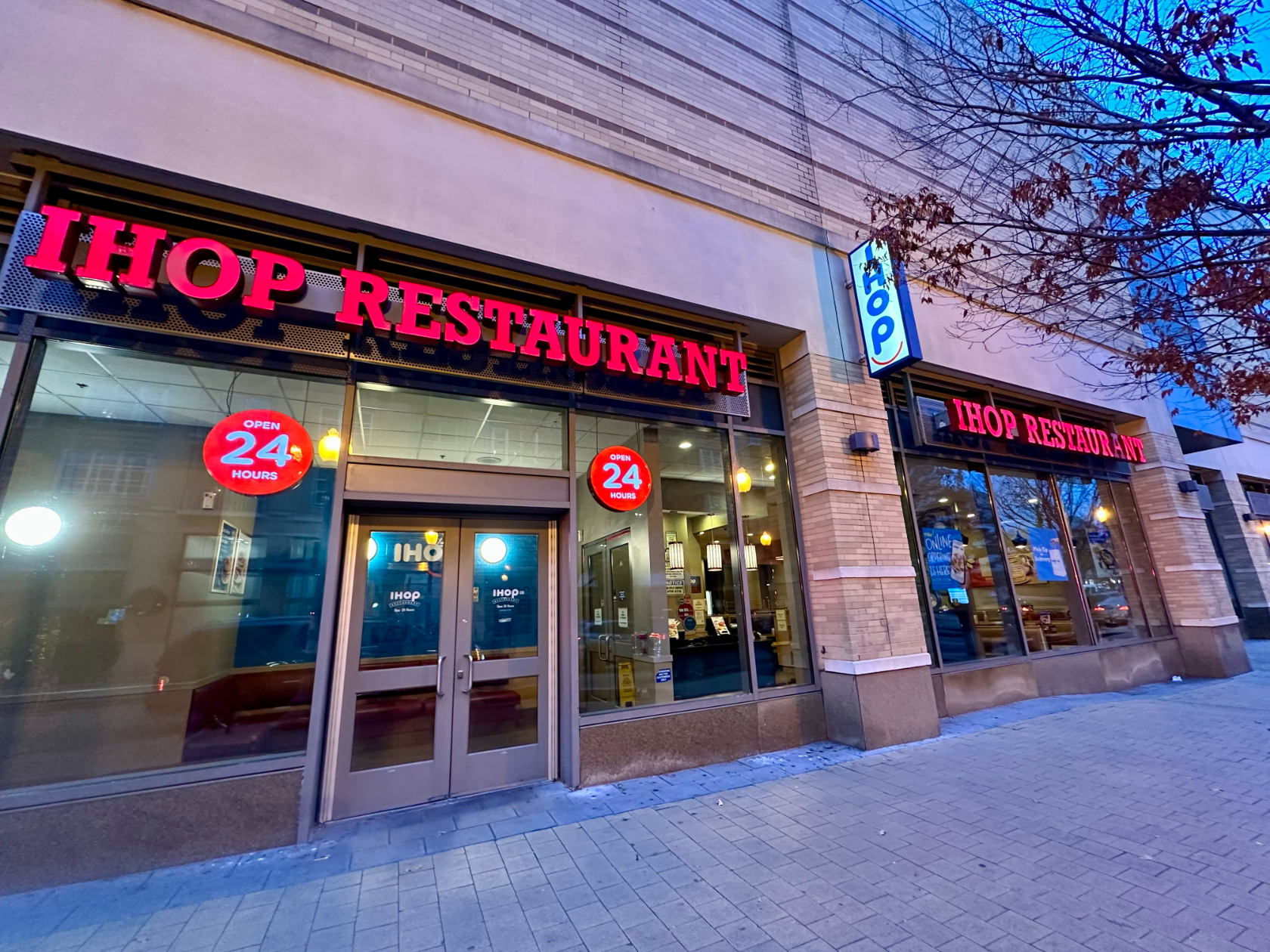
Jones says one of his regulars, an older woman who lived in the neighborhood, was direct with him and explained she wouldn’t patronize as often because her usual order, grilled steak with broccoli and mashed potatoes, increased by 50% to $24. She told him she felt bad not being able to tip him her usual $6, he says, and then one day just stopped coming in.
According to a survey of 944 D.C. area residents funded by the National Restaurant Association, which campaigned against the initiative, rising menu prices are prompting more people to stay home — 52% of those polled said they were eating at home more often now.
Jones says everything from his rent to his groceries has gotten more expensive, so he doesn’t fault Initiative 82 alone for his hard times. But he also isn’t sure how the initiative is helping either.
“I personally feel like it’s one of those gigs where you get what you put in,” he says in defense of the tipped minimum wage system.
‘Initiative 82 fee’
Maybe the most widespread impact of Initiative 82 on local bartenders and servers is that of service charges. While they were already a practice at some establishments before the initiative passed, more and more restaurant owners are adding fees as a percentage of bills to manage increased labor costs, and they can have both an emotional and practical effect on workers.
In some cases, the addition of these fees has no noticeable effect on the workers’ take-home pay, because their employer treats it like tips and gives the money directly to employees. But that’s not always the case — service fees, unlike tips, are not legally required to go to workers. Plus, the fees can make interactions with patrons awkward or even hostile, undermining the hospitality aspect of the job.
“To offset the impact of DC’s Initiative 82 on independent restaurants, a 3.5% fee has been added to your bill,” local Mexican chain Mi Vida says on its menu.
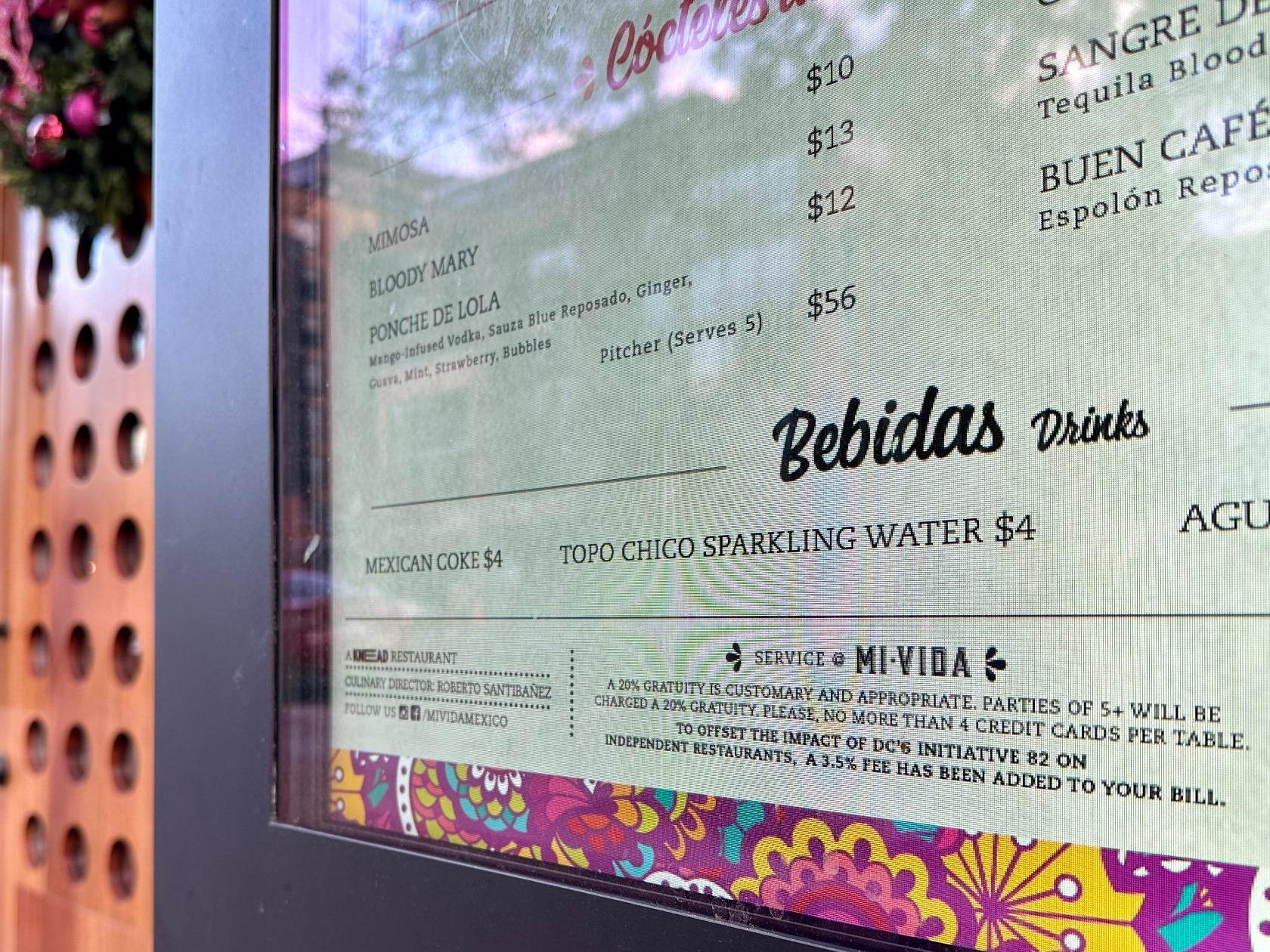
A Mi Vida server, who declined to give his name as he wasn’t given permission to speak to the press, hates having to explain the fee to patrons. Some customers are bothered by it, he says, particularly tourists who have no idea what the initiative is and don’t think they should pay for it because they aren’t D.C.voters.
“It’s annoying,” he says. “It’s another thing that I have to do.”
The server doesn’t think patrons should have to pay for the initiative either. He voted against Initiative 82 because he is happy with his pay under the tipped minimum wage system.
“We can have a decent living with the money that we make through tips,” he says. “If [we’ll be making] minimum wage, trust me, there will be no servers anymore.”
So far, the Mi Vida server says his tips haven’t been impacted by the 3.5% fee. But he worries that’ll change if his employer keeps increasing the fee as the minimum wage keeps climbing. He also says his pay stub breakdown is even more confusing now because it includes not only tips but service fees.
The fees can also complicate a worker’s decision to change jobs, says one Dew Drop Inn and Wonderland Ballroom bartender, Kate, who declined to give her last name due to privacy concerns. She trusts that her current bars, which have the same ownership, are giving the money from their service fees to her and her colleagues. But she’s not sure she could trust another employer to actually give the money to workers — which feels limiting for her professional mobility.
Bars and restaurants appear to be complying with Initiative 82, according to workers’ rights lawyer Justin Zelikovitz. He says of the thousands of pay stubs he sees per week from restaurant workers who suspect their boss of wage theft, largely due to questionable tip pooling practices, none have violated the initiative’s step increases.
As workers weigh the initiative’s impacts, groups that favor or oppose Initiative 82 are already forming their initial analyses. One from One Fair Wage (OFW), the nonprofit that helped get the initiative on the ballot, says the phasing out of tipped minimum wage has so far not negatively impacted the restaurant industry and instead restaurant jobs, wages and tips have modestly increased between November 2022 and 2023.
The Restaurant Association Metropolitan Washington, which opposed the initiative, says the OFW analysis is misleading in part because Initiative 82 did not take effect until May 2023. RAMW also says Initiative 82 is one of several factors plaguing the industry, with more D.C. restaurants closing than opening in 2023 compared to the last two years: 52 restaurants closed, compared to 48 in 2022 and 40 in 2021. There were 72 new D.C. restaurant openings this year, compared to 74 in 2022 and 77 in 2021.
Those that have recently closed have cited numerous reasons, including labor costs, but also unaffordable rent and increased crime.
Still, the tipped workers we interviewed, even the ones who’ve benefited from the change so far, are not sure what full implementation would mean for them or their industry. Kennedy of The Diner says it would be great to earn the standard minimum wage of $17 per hour, but wants to continue to make tips to get her to a livable wage.
”Tips are the main bread maker for our job,” Kennedy says.