Amanda Michelle Gomez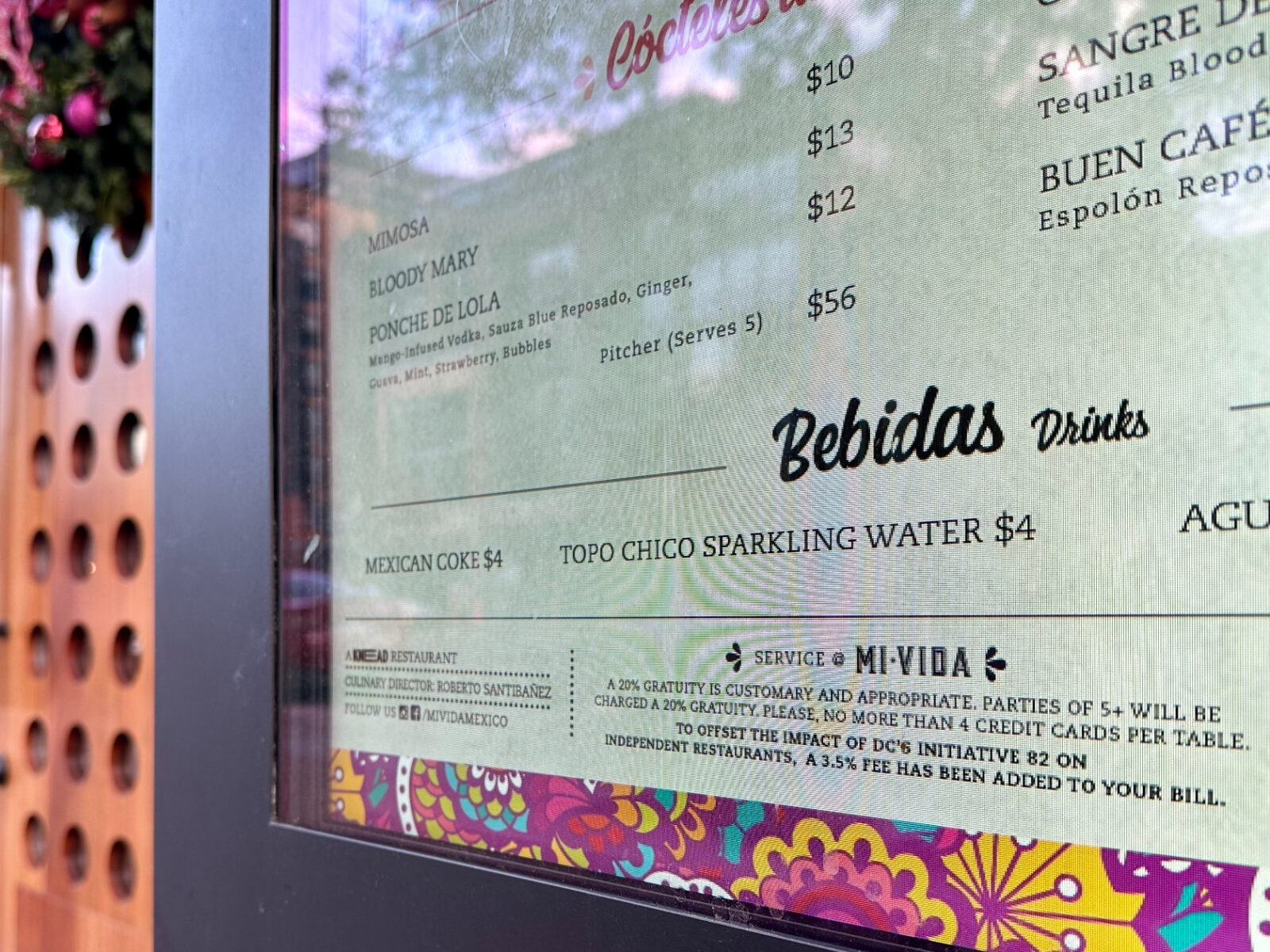
Service fees are becoming ubiquitous at D.C. restaurants, particularly after the passage of Initiative 82, which phases out the tipped minimum wage and requires restaurant owners to pay their bartenders and servers more instead of relying on tips. These fees run the gamut, with varying names and different percentages of the total bill.
Now, one D.C.-based nonprofit is taking legal action against large local chains with questionable fees in the hopes of putting an end to a practice it deems deceitful.
The nonprofit Travelers United has already filed two separate lawsuits, as first reported by Washingtonian, one against Clyde’s Restaurant Group, which operates eight local restaurants including several named Clyde’s and Old Ebbitt Grill, and another against Knead Hospitality + Design, which operates over a dozen restaurants including Mi Vida. The lawsuits both allege that the local restaurant groups are violating D.C.’s consumer protection law by misleading patrons into believing meals at their restaurants are cheaper than they actually are.
“The restaurants could simply just increase prices so that consumers knew the price of an item when ordering, but instead consumers are hit with a surcharge when presented with the final bill,” reads a complaint filed last week against Knead Hospitality + Design in D.C. Superior Court.
The restaurant groups did not respond to requests for comment.
Clyde’s restaurant group dropped its 3.75% “2023 surcharge” after the suit, according to Travelers United, and Knead also quickly dropped its 3.5% “Initiative 82” fees after the suit was filed, Washingtonian reports.
D.C.’s Office of the Attorney General weighed in on the matter last year, issuing guidance to restaurant owners on how to charge fees in a clear and transparent manner so they do not run afoul of the law. But Travelers United appears to have a more strict view of D.C.’s consumer protection law. The nonprofit believes fees are inherently deceptive and illegal under D.C. law, according to Travelers United lead counsel Lauren Wolfe. So far, Travelers United has only filed lawsuits against restaurant groups with fees well under 10% that wouldn’t likely be mistaken for automatic gratuity.
Many restaurant owners and their advocates including the Restaurant Association of Metropolitan Washington have defended fees as a necessary tool to offset high operation costs and stay in business. Raising menu prices to keep up with costs would stop patrons from coming in, many have argued.
Some patrons sympathize with restaurateurs, while others do not and are annoyed with the fees. Some patrons have even started tracking local establishments with service fees, adding them to a crowd-sourced spreadsheet or a Chrome extension, because they find their practices misleading.
Travelers United filed lawsuits with these perturbed patrons in mind. We should expect more lawsuits, Wolfe says
We caught up with Wolfe about her group’s effort to stop D.C. restaurants from adding service charges. The interview has been lightly edited for clarity and length.
Your tourist advocacy group is known for suing big hotels like Hyatt and MGM Resorts over “junk fees.” But now you’re suing local restaurant groups. Many different types of businesses charge fees, from food delivery services to concert promoters. Why target D.C. restaurants?
What we have been seeing in the last few years is a huge rise in total junk fees. We’ve obviously seen them for about a decade now in the hotel industry, and we currently have four class-action [lawsuits] going against hotel groups that are charging these junk resort fees that we think are illegal under existing law.
So what we’ve seen recently, definitely in just the last year in Washington, D.C., is that a lot of restaurants started to add essentially junk fees to their menus. Instead of just listing the price of an item on the menu, they are now listing a price, but then saying, ‘Oh, actually, there’s a mandatory extra charge’ — which is exactly what hotels do with resort fees. And you don’t really get anything for that charge. It’s just a way for restaurants to essentially lie about the advertised price, just like hotels use resort fees to lie about the advertised price of a room.
What makes these fees different than, say, when a restaurant adds gratuity automatically for a large party?
The restaurant industry — in America, in general — we have a history of gratuity. So I don’t think that anybody has a problem with adding a gratuity for service that’s actually directly going to those employees. And there’s obviously a lot of rules about how that money has to go to them. But what we’re seeing is junk fees that we have no idea where this money is going at all. We don’t know if it’s a tip. Sometimes they make it look like it’s a tax. That’s the type of fee that we want to avoid.
Your first lawsuit was against Clyde’s Restaurant Group, which operates Old Ebbitt Grill and others. The lawsuit cited a lunch among Travelers United members, who were charged a $2.10 service fee at the end of the meal. What makes the restaurant group’s fee deceptive, allegedly violating D.C.’s consumer protection law, in your view?
Clyde’s said that they did have a 2023 surcharge, and they said that essentially we’re adding this small surcharge because it’s the year 2023. And Travelers United has the position that you can’t just make up fees because it’s 2023. So whether you name the fee a 2023 surcharge or an Initiative 82 fee, it’s essentially all the same fee. You’re just making up fees that are just not making it clear to consumers what the actual price of an item is at the restaurant.
[On its menu, Clyde’s explained the rationale behind the 2023 surcharge: “Our restaurants have been operating with extraordinary increases in the cost of doing business. High inflation, rising wages and supply chain challenges have continued beyond the pandemic creating a difficult operating environment. We have reluctantly chosen to implement a separate 3.75% fee for 2023 with the hope that it can be eliminated in the future as conditions improve. We appreciate your support and understanding.”]
It feels like hundreds of restaurants have service fees. How many more lawsuits should we expect?
Well it would be great if Travelers United didn’t have to file all of these lawsuits. Not just against D.C. restaurants, but against hotels across America as well that are using deceptive fees to harm tourists and to take advantage of tourists. And so what we would love to see is for the [U.S. Federal Trade Commission]’s proposed junk fee rule to take effect. Everybody can comment on that proposal. I think the comments are up for about another week or two.
We’d love to see also national and state legislation. I think it’s possible in Washington D.C. that we could pass clarification to the existing law saying that these junk fees are illegal. We think that it is pretty clear under D.C.’s existing Consumer Protection Procedures Act that they’re already illegal, but we could always pass further clarification on the issue just like California has done. California just passed a really great general junk fees bill that essentially bans all junk fees across the state of California. And they even passed a specific resort fee bill to just further clarify that hotels can’t charge hidden and deceptive resort fees. So it’s really a great win for tourism, and we’d love to see a similar bill in Washington D.C., though existing D.C. law already is pretty clear that you can’t, say, advertise something as one price and actually charge people another.
In lieu of this type of law passing, it sounds like Travelers United might continue to pursue more legal action. I didn’t hear a No.
Yeah, we might just continue to sue larger restaurant groups that are engaging in this practice. It’s pretty clear that these deceptive fees are a violation of existing D.C. consumer protection law. When you go to the grocery store, you don’t see an item at one price and then go to checkout and it’s actually 5% more because Safeway or Giant tacked on some sort of weird fee. Because that’s not tolerated. Obviously everybody would be doing that if they could get away with it. But it’s illegal.
So yes, we will continue to sue until we see an end to this practice in Washington, D.C. It’s something that’s obviously pretty new in the city. We’ve seen it only kind of in the last year, but this is actually an increasing problem across the country. I’ve heard a lot of people in California talk about this, that they’ve been seeing these kind of fees in Los Angeles and in San Francisco. I’m originally from Michigan, and my cousin just actually saw a service fee in Holland, Michigan, on the west side of the state. So, you know, they’re popping up everywhere, where people think that they can get away with this. And I think it just shows the importance of President Biden’s initiative to ban these junk fees because nobody likes them. And it’s just essentially companies taking advantage of people who think that they can’t fight back.
D.C.’s Office of the Attorney General issued guidance to local restaurants, showing owners how to have transparent and clearly communicated service charges. Can restaurant service fees be honest? Or does Travelers United view these fees as inherently deceptive?
We do think that these fees are inherently deceptive, but I’d also like to make it clear that both of the restaurant groups that we’ve sued, we don’t think are complying with the attorney general’s guidance. The attorney general put out some pretty specific guidance that requires pretty extensive disclosure. And we don’t think that either of the restaurant groups complied with that.
[An OAG spokesperson declined to comment on its investigations into specific D.C. restaurants. The spokesperson says when the office hears concerns about service fees, they investigate and provide guidance on how to properly disclose fees to comply with the law. The OAG has so far only educated restaurateurs, and has not yet taken formal legal action over fees, the spokesperson added.]
The OAG’s guidance makes clear that so long as a restaurant owner describes a service fee accurately — says ‘this is not a tip, it’s going to pay the base wages of workers’ — and that it’s posted somewhere a price of a meal would be, it complies with the law, more or less. Travelers United appears to disagree with that premise. What would your advice to restaurants be so that they aren’t hit with a lawsuit from you?
Just to list the advertised price of an item on the menu and sell the item for that price.
… It’s not just a consumer issue, obviously. We as Travelers United are advocating for these restaurants not to take advantage of tourists to Washington, D.C. But this is obviously also a workers rights issue. Because I have heard from a lot of workers now who have also said that [patrons] think that the service fees are often a tip, and so then they’re taking the percentage out of hypothetical tips, or they’re just mad in general and not tipping. And that is the exact same thing also that we heard from hotel workers about resort fees. People were confused about resort fees. They thought it was type of a service charge. And so then hotel workers were seeing that they were getting tipped less because people thought that it was kind of a service charge. So it’s not just a consumer issue, it’s also a workers rights issue.
How are you tipped off about allegedly deceptive service fees?
I live in D.C. and I go to restaurants. So we have seen this not just from personal experience and people in Travelers United talking about it amongst each other, but … people write to us about it. We regularly follow trends that are going on, particularly in the travel industry, to see what’s happening. These fees popped up, we thought at the very beginning, at restaurants that were specifically targeting tourists. We heard some tourists say that they thought that these fees were essentially a mandatory tax, which is the exact same argument that we were hearing from people who stayed in hotels at first and were told that resort fees were like a mandatory tax. So it was like hearing the same kind of junk fee horror story just in a new industry. And we wanted to make this stop before it spread as far as the hotel resort fee, amenity fee, situation has.
You mentioned more “larger” restaurant groups could see legal action from Travelers United, does that mean smaller, one-off restaurants are not a priority for you?
It just means that we hope that the people that can afford to make a mistake can send the message to the smaller mom and pop operators to remove their fees as well. I am very aware that running a restaurant is a hard, hard business that runs on small margins, but everybody in every business needs to follow the law to run their business. My parents ran a small business, and I worked in that business my whole life. And I am aware of what it takes to run a mom and pop operation. But there’s bigger groups that should know better. And they should set an example for other restaurants in Washington, D.C.