Margaret Barthel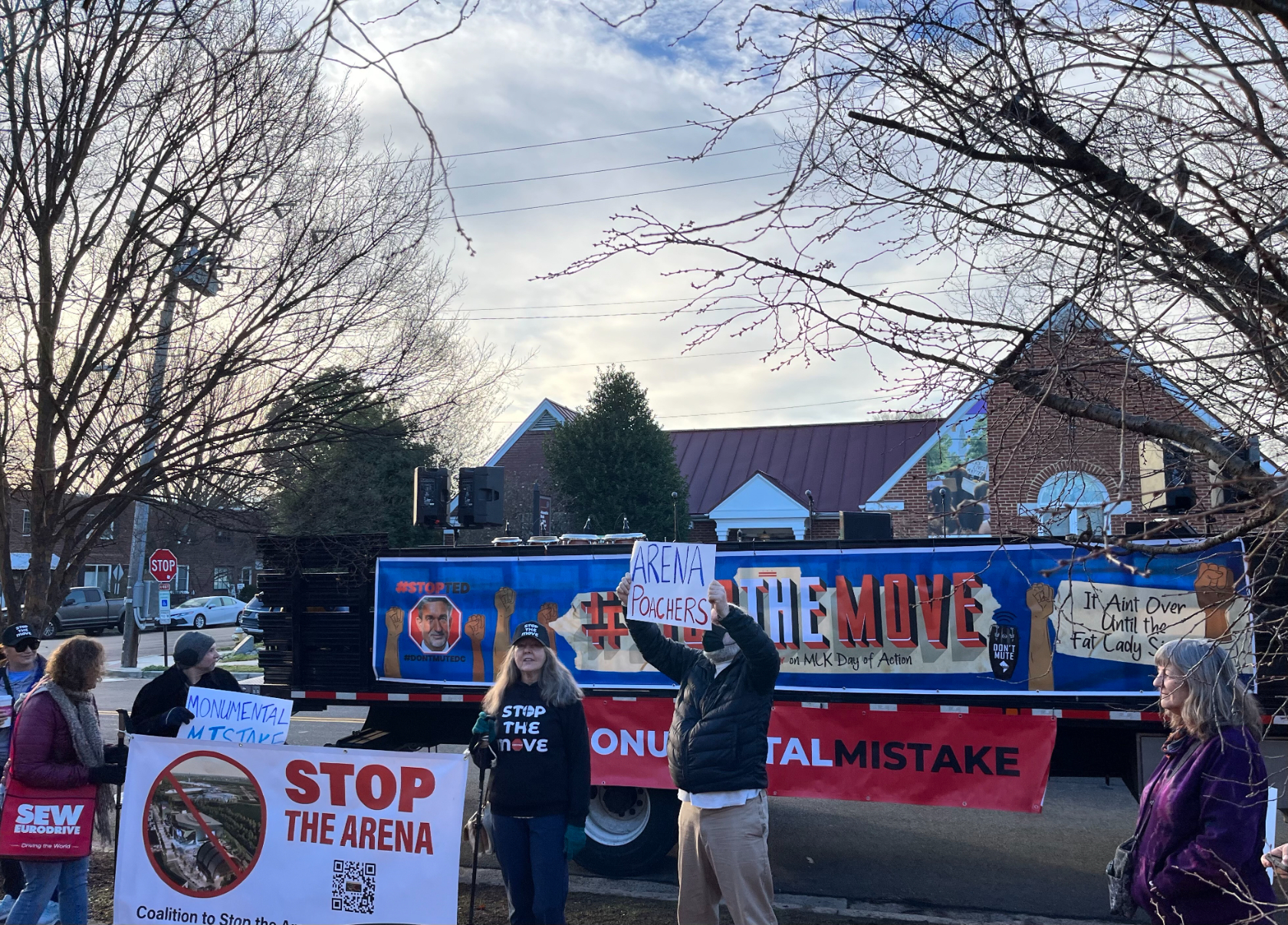
The signs at the rally outside the Charles Houston rec center in Alexandria expressed passionate opposition: “Stop the Arena,” “Monumental Mistake,” “This is a financial disaster,” “Economists agree … Stadium Subsidies are SCAMS,” and, in a particularly nerdy twist, “Meaningful Consultation Requires Information.”
If that last one conjures baffling images of management consultants on a picket line, well, that’s not far off. The gathering last weekend, hosted by the Coalition to Stop the Arena, was an opportunity for a few dozen city residents to air their concerns about the proposal to build a new sports arena and entertainment district in Potomac Yard. Namely: they haven’t seen the numbers to convince them the project makes fiscal sense.
They were joined by musician-activists with Don’t Mute D.C., the group behind the go-go truck familiar at D.C. protests.
“The bonds are on the back of the people that’s used to finance this project on this side. And the disinvestment and the broken promises will be the impact on our side,” said Cohen Cosby III, of Don’t Mute D.C.
Afterwards, the Alexandria activists lugged their signs inside for a town hall on the subject with the City Council. Cosby and the band drove around the rec center a few times as the event took place inside, go-go music blasting, prompting a cheer from attendees inside. (One organizer said the group got two noise complaints, both from Tesla drivers.)
The deal, first announced in December by Virginia Gov. Glenn Youngkin and Monumental Sports owner Ted Leonsis, would finance a sizeable sports and entertainment development in Potomac Yard. It would include a new arena for the Wizards and the Capitals, a performing arts venue, as well as practice facilities for the teams, office space for Monumental’s corporate employees, and a large underground parking garage. All that would cost a whopping $2 billion, including more than $1 billion in publicly-backed bonds that would be repaid by tax revenue generated at the site, according to top-line figures shared by Monumental and the Alexandria Economic Development Partnership. Proponents say it would bring in $5 billion in fiscal impact — including direct and indirect tax revenues minus the cost of bond payments — for the city over the construction period and 35 years of operations.
“It is not a project that is a one and done,” says Julie Coons, the president and CEO of the Northern Virginia Chamber of Commerce, which is lobbying for the project. “It’s an ongoing opportunity to create greater growth, at scale, which creates greater opportunity over time.”
But the proposal has quickly become a flashpoint in Alexandria, with hundreds of residents showing up to Zoom calls with officials and other community events. Opponents say the economic projections are overly rosy — and not in line with the scholarly consensus that sports stadiums and arenas typically fail to live up to economic development projections. Given that, some residents are frustrated that some of the data and assumptions behind the flashy numbers are not public. They’re also worried about traffic, parking, and crime.
Meanwhile, city officials are begging for everyone to keep an open mind. They note the project isn’t just an arena, but an entertainment district they hope will catalyze future commercial development and diversify the city’s sources of tax revenue, now heavily dependent on property taxes.
An official full-court press
These are opening salvos, since Alexandria leaders aren’t making any decisions about the arena project yet. The first hurdle for the proposal will be in Richmond, where lawmakers in the General Assembly will have to vote to create a sports authority that would own the arena and put forward the bonds financing the project. Those bills are awaiting hearings in House Appropriations and Senate Finance and Appropriations committees.
If the General Assembly approves that legislation — which Democratic leaders and Gov. Glenn Youngkin both see as a bargaining chip in what are likely to be protracted negotiations over stopgap funding for Metro and the state budget — the project would then go through the Alexandria land-use permitting process, culminating in a vote by the City Council.
But Alexandria leaders aren’t waiting on Richmond to move forward with a full schedule of public engagement opportunities to talk to residents about the plan.
On Saturday, residents filled the bleachers on one side of the rec center gym, sitting quietly while the City Council read and responded to questions from the public submitted on notecards.
Members of the council said they were open to the arena concept. Some were even enthusiastic, particularly when it came to possible community benefits the city might be able to wring from the ultimate project agreement, as well as new tax revenue from additional development around the arena. Several members of the Council were particularly interested in exploring whether the project could create a dedicated stream of revenue for public schools and teacher pay.
An economic anchor that could catalyze new businesses, several Councilmembers said, could help Alexandria take the pressure off of its residential taxpayers, particularly at a time when more traditional forms of commercial development, like office buildings, are in financial trouble due to hybrid work. The idea was worth exploring for that reason alone, said Councilmember Canek Aguirre.
“This is something that the council is looking at in terms of the financial health of the city that we have to take very seriously,” he said.
But he and other officials acknowledged they don’t yet have the full picture on new revenue generated from associated development, and how it might shift the city’s sources of tax revenue or any future tax cuts residents might enjoy as a result.
“We don’t have numbers on that. I wish I could share with you…what a reduction would look like,” he said. “But we frankly just don’t know that yet. Until we do, we’ll keep on asking those questions.”
Any boost to Alexandria’s coffers from Potomac Yard would not come from taxes on the actual arena, the business and sales and use taxes generated at the site, or the income taxes paid by Monumental employees. Those would be used to repay the bonds to construct the project. Also already spoken for are lease payments from Monumental, parking taxes, and the naming rights to the entertainment district.
Another key question is the plan to manage game-day foot and car traffic to the area, and how it might disrupt evening commutes. Officials said a study of the area’s transportation needs will be forthcoming soon — and they said that plan would be critical to securing their continuing support.
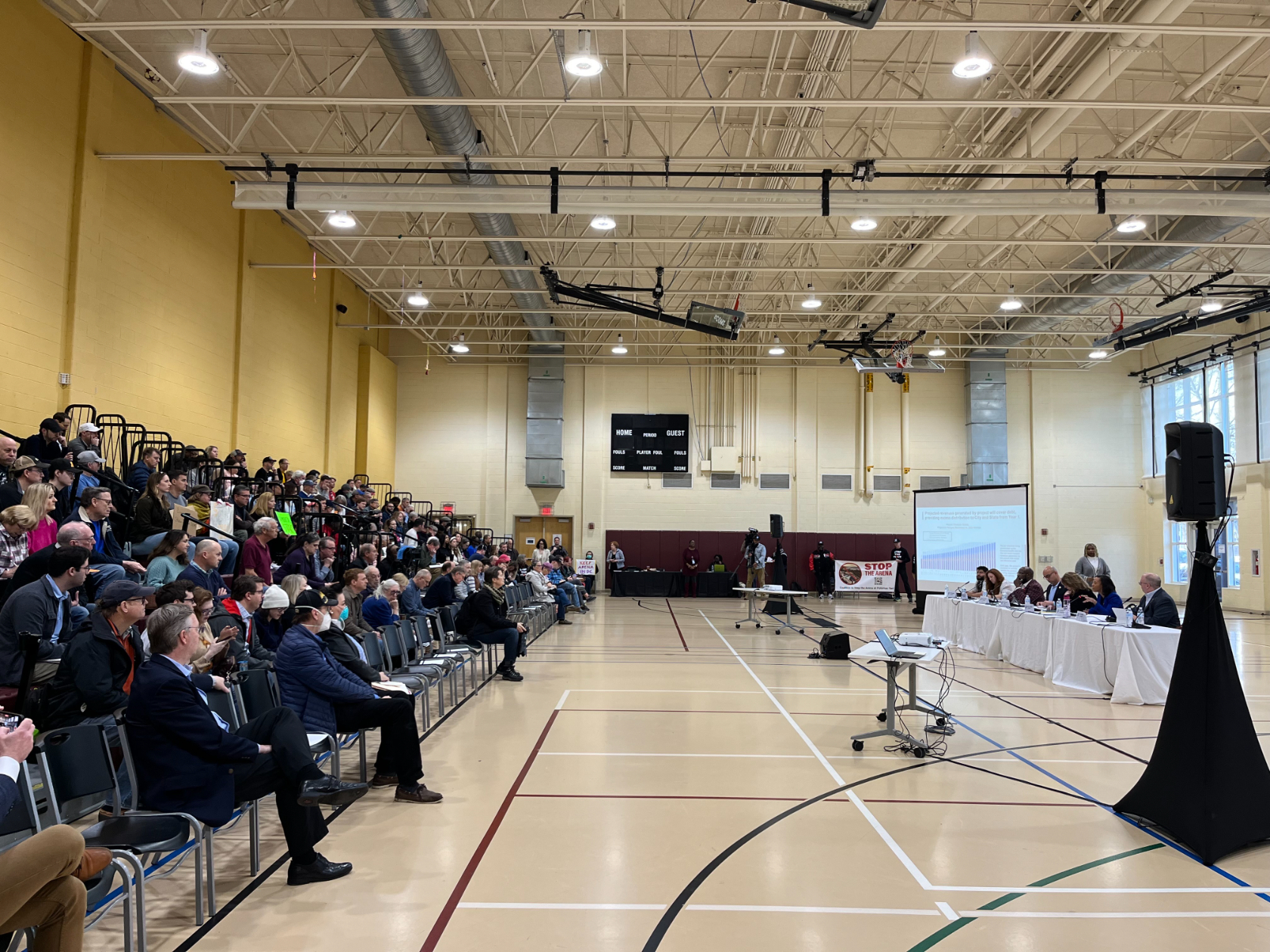
Multiple councilmembers also noted another key concern with the current deal: Alexandria’s representation on the planned sports authority, the body which would own and manage the arena property. Currently, the bills before lawmakers in Richmond allow the city to appoint three members of the nine-member board, with the rest appointed by the Virginia governor. Councilmember Kirk McPike said he’d like to see Alexandria’s proportion increased to four or even five members of the nine-member authority. Aguirre and Chapman said they’d vote against the plan if it moved forward in its current configuration.
‘This is the brainstorming phase’
Some Alexandria residents don’t feel there is enough information to decide at this stage, given the many outstanding questions about the economic development figures and the impact the arena could have on already-busy roads and the Potomac Yard Metro station.
“I think it’s very clear they’re taking it seriously, which I appreciate. But I think people are not going to be assuaged based on the information provided so far,” said Del Ray resident Aria Velz, one of the many town hall attendees who submitted questions and took notes. She said she wasn’t opposed to development in general and liked the idea of an entertainment district — but questioned publicly subsidizing a sports arena on behalf of a billionaire.
The Coalition to Stop the Arena has largely grown out of similar concerns.
“We just haven’t seen the guts of those projections. And without that, there’s no way to understand whether those projections are real,” said Dan Heng, a coalition member and Lynnhaven resident.
The Coalition is taking inspiration from a successful resident-led campaign in 1992 to prevent then-owner Jack Kent Cooke from relocating the Commanders to a new football stadium on the same site, even consulting with the leaders of that long-ago campaign for advice. Organizers are planning a lobby day in Richmond next week.
Other Alexandrians find the arena idea much more appealing. While acknowledging the open questions about traffic and finances, Tim Laderach, the former president of the Del Ray Citizens Association, says he’s “cautiously optimistic” about the project. He’s particularly heartened by promises from real estate firm JBG Smith, which owns the site, to build 500 affordable housing units as part of the larger transaction.
“This is the brainstorming stage,” he told DCist/WAMU. “This is where we need to think through what possibilities are out there before we go the next step and say, ‘Is that a realistic possibility?’”
Bill Blackburn is a partner with the HomeGrown Restaurant Group, which owns Pork Barrel BBQ, Whiskey and Oyster, Holy Cow, and a few other local restaurants in the city. He lives in Del Ray and is excited about the arena idea, which he says could bring a wide range of new opportunities for small businesses like his — not to mention the opportunity to eventually walk with his kids to their first-ever Wizards game. But he also understands his neighbors’ worries.
“There’s a large contingent of people who live in Alexandria who haven’t made up their mind yet,” he said. “And I think that’s very fair, because there are questions out there that need to be answered.”
This updated to reflect Tim Laderach’s correct title.