Margaret Barthel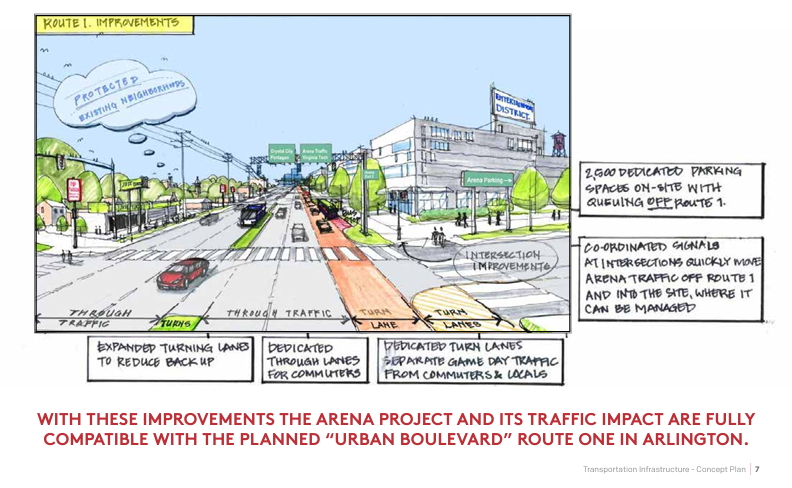
The proposed new sports arena in Potomac Yard would not dramatically change travel time estimates compared to the existing development plans in the area, as long as a series of improvements to the Metro station and area roads are undertaken. That’s according to a presentation from a consultant hired by state officials.
The report, put together by engineering and planning consulting firm Kimley-Horn, concludes that capital improvements to the Metrorail Station, bike and bus infrastructure, and intersections on Route 1 and Glebe Road would cost $135-$215 million. That’s on top of $110 million in investments currently planned for the area to accommodate dense development anticipated in city planning for the neighborhood. State officials say they would eventually sign a memorandum of agreement with the city of Alexandria to outline the state’s funding commitments for transportation projects.
On Thursday evening, Alexandria officials, state transportation experts, and a representative from Monumental Sports and Entertainment shared a presentation on the needs and some initial ideas about how to respond to them at a community listening session. (The community did most of the listening; officials took written questions, some of which they answered live. The rest will be answered and published online.)
New transportation needs and traffic volumes in an already-congested area have been key points of concern for many Alexandria residents. They’re particularly worried about Route 1, which is already plagued by gridlock, and the recently completed Potomac Yard Metro station, which just opened last year and is not large enough to accommodate game-day surges.
Officials stressed the plans are a jumping-off point for future conversations.
“These are draft documents, these are concepts, they are solutions,” said Alexandria Economic Development Partnership president Stephanie Landrum. “They will only get better with more community feedback and engagement and ideas.”
One of the reports compares the traffic and transit use under two different scenarios: a peak game-day, with fans coming to Alexandria to a sold-out game on a weekday during commuting hours; and regular morning and evening commutes without the arena, but with denser mixed-use development. The traffic portion of the analysis includes a scenario accounting for the planned redevelopment of Route 1 into an urban boulevard.
Overall, the report found that the numbers of car trips for each scenario would be similar, though the arena would account for a higher volume of inbound trips to the area, while the mixed-use development scenario would result in more outbound trips from residents living in the area. The analysis suggests the arena would lead to much higher rates of people walking and taking transit.
The models are based on two years of data around how fans currently get to Capital One arena in D.C., and where the current fan base’s home addresses are, according to Jordan Silberman, a senior vice president at Monumental Sports and Entertainment and the Capital One arena’s general manager.
Silberman said around half of fans arrive at Capital One by car, and half by public transit, walking, or biking. That breakdown, he said, has evolved post-pandemic, with more people driving now than before.
“We did the best we could with the data we have,” he said.
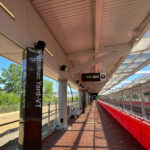
One of the biggest stumbling blocks to getting people in and out of Potomac Yard — particularly if half of fans and event attendees take transit — is the capacity of the brand new $370 million Metro station. If the current station and its service levels are left as they are now, the consulting firm Kimley Horn found that post-game passengers would experience “extreme crowding lasting 60-90 minutes.”
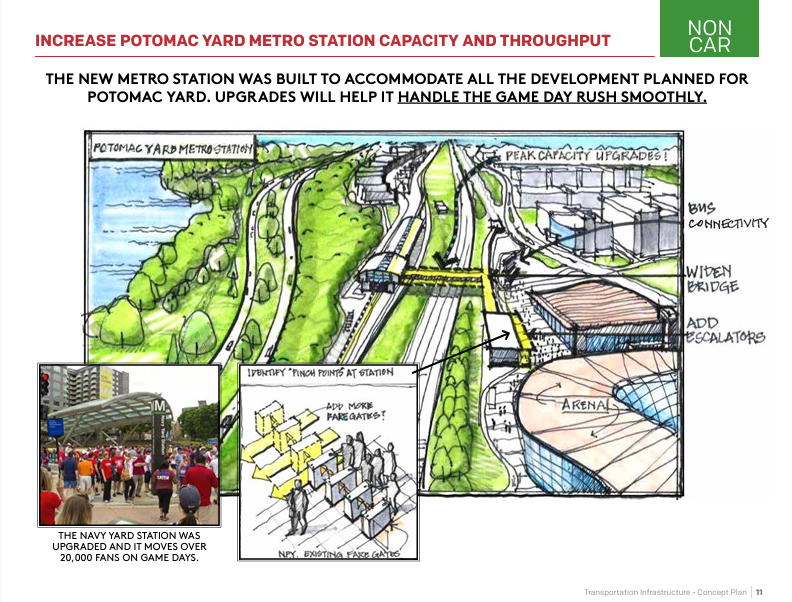
With added trains and a number of capital improvements, including new faregates, more escalators, more ticket machines, and a wider bridge over the CSX rail tracks, “the station will be able to handle anticipated passengers but will be crowded for ~30-45 minutes post game.”
Those improvements to the Metro station, plus bus and some bike and pedestrian infrastructure, are expected to cost $35-70 million, and game-day service adjustments are expected to cost $2.5-7.5 million annually.
The Kimley-Horn presentation notes that “WMATA will need to further analyze station capacity and potential physical improvements,” but does not provide further detail on what specifics that analysis would entail. It was not immediately clear to what extent Metro was involved in the initial report, but the consulting firm has previously worked on other Metro improvement projects, and used that experience in assessing the proposed upgrades at Potomac Yard.
There’s also a possibility Monumental might incentivize ticketholders to park at further-away Metro stations at Huntington and Eisenhower, which both have large parking lots, and take the train to games. Similar plans to try to get people to park in under-used parking garages in Crystal City and take a shuttle bus to the arena are also under discussion. Further-out improvements might include a bike path connecting the arena to the Mount Vernon Trail, or even a new VRE station (once the new Long Bridge project is complete).
One slide in the presentation showed a sketch of improvements for Metroway, the bus rapid transit line running south from the Pentagon, including the possibility of new dedicated lanes for the service through areas near the arena site. But on Thursday, transportation officials said that was a typo, and it should have promised only increased frequencies on Metroway, not dedicated lanes.
To mitigate the extra traffic on Route 1 and Glebe Road, transportation experts said they’d focus on making intersection improvements to ensure dedicated turn lanes for traffic going to the arena complex.
About 55% of fans who drive to the arena would come from the north, along the Route 1 corridor, according to the analysis. Another quarter of fans would come from the southern part of Route 1, up from the Huntington area and points south. About 20% would come in from the west along Glebe Road.
Officials also discussed setting up dedicated rideshare pick-up and drop-off areas (about 10% of fans are expected to arrive by rideshare).
Opponents of the arena said the plans lacked detail about protecting nearby neighborhoods from cut-through traffic.
“Longer turn lanes are not going to solve the problem of the massive new volume of people driving to Alexandria for games and events on almost every night of the year,” said the Coalition to Stop the Arena in a statement. “This plan is not going to protect the surrounding neighborhoods from the peak traffic impacts of this project. DC has multiple metro stations, multiple road access points, and many more garages.”
Alexandria transportation leaders did not specify exactly how they would prevent problems in nearby neighborhoods, but they did list some possible strategies, including residential parking permit systems, parking enforcement, traffic-calming measures like speed bumps, and traffic management during events.
This story has been updated to reflect that the state paid for the Kimley Horn analysis, and to add context about the firm’s previous work on Metro-related projects.