Jacob Fenston
Anna Mayer is a high school junior in D.C., and while she says she cares deeply about climate change, she’s never learned about it in public schools.
“I learned about the water cycle in second grade, and that was the extent of my public school climate education,” says Mayer, who attends School Without Walls, a magnet public high school in Foggy Bottom.
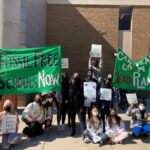
Mayer is one of the leaders of an effort to get the District to adopt a Green New Deal For Schools — making sure school facilities are more resilient and less polluting, and ensuring all students learn about the climate crisis.
“Everybody deserves to know what is going on in their world, and right now we’re not learning about it — especially something that will cause terrible consequences for the rest of our lives,” Mayer says.
Student activists succeeded in getting the D.C. State Board of Education to pass a resolution supporting these demands last month. Now they’re taking their advocacy to the D.C. Council.
“Each of us had seen around us how the climate was changing and how it seemed like people in power around us weren’t doing what they needed to do,” says Zoe Fisher, another student activist, who is also a junior at School Without Walls. “Oftentimes as youth, we were told like, ‘Oh, you’re going to grow up and change the world.’ But we know that this is not pausing for us and waiting for us to grow up. So we should start taking action now.”
Students attended several school board meetings to make their demands, prior to the resolution’s passage. Each time, they would bring more supporters to pack the meeting room; at the January meeting, there were nearly 80 supporters present.
“With this many students, they were pushing our meetings way past 10 p.m.,” says Allister Chang, the school board member representing Ward 2. “One thing I observed which I just love, is week after week, they were getting tighter and tighter around their asks, their approach, and the way that they testified and how they strung the testimonies together.”
The school board unanimously passed the resolution at its Jan. 17 meeting.
D.C. is only the second place in the U.S. where a school board has passed such a resolution, according to Adah Crandall, an organizer with the Sunrise Movement, a group that’s mobilizing young people nationwide around climate action. The first was Boulder, Co., and there are resolutions pending in several other places, including Berkeley, Ca., and Northampton, Mass. The push for a Green New Deal for Schools is alongside the movement for federal Green New Deal legislation.
“Our schools are really at the forefront of this crisis,” says Crandall. “Our schools are really in the middle of a political battleground right now, where the far right is trying to control what we learn in schools. They’re trying to ban books, prevent us from learning about the climate crisis.”
D.C. does score better than many states in terms of teaching climate change, getting a B+ according to a 2020 study by the National Center for Science Education. That’s the same grade as neighboring Maryland, and much better than Virginia’s failing grade.
In D.C., however, the school board wields little power, after the passage of a law in 2007 that transferred control of the school system directly to the mayor. The D.C. student activists say the school board resolution will give them leverage as they take their demands to lawmakers.
The Green New Deal for Schools proposal includes a set of five demands: free school lunches that are locally and sustainably grown; a comprehensive climate justice curriculum; pathways to green jobs for students; school facilities that are climate resilient and run on 100% renewable energy; and that schools should have climate disaster plans. While the Sunrise Movement provides a basic template for these demands, local students adapt them as they see fit.
“In order to keep our students safe, we need to update the plans to prepare for imminent disasters, like the smoke that we’re most definitely going to get more of that happened last year. That was pretty disastrous for a lot of students,” says Mayer. “Our school, for one, didn’t have the appropriate reaction to that. They were basically just like, ‘Don’t go outside and you’ll be fine.'”
The students say they’re now working to build up their coalition to include more students from all across the District, and they’re starting to have conversations with D.C. Council members.
“We’ll be going to many more meetings,” says Fisher. “We’ll have to bring more and more people, and maybe even keep them until 2 or 3 in the morning to show them how important this issue is.”