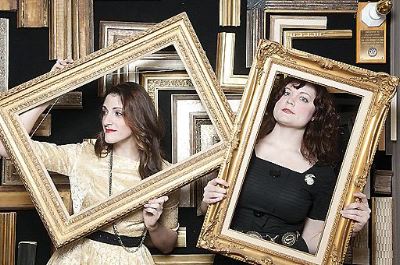
 The Sweater Set are here to impress. In addition to impressing audiences with the sheer number of instruments with which they’re more than proficient, Sara Curtin and Maureen Andary are also well versed in a number of musical styles. Within the course of our conversation, they brought up tidbits about folk, jazz, country, musical theater and indie rock. Their love of all of these styles are apparent on their most recent album Goldmine.
Goldmine‘s fourteen tracks range from the swinging gypsy jazz accordion of “The Breaker” to the light and the heartbreaking pop of “Who’s Sorry”. Yet what remains consistent are Andary and Curtin’s golden harmonies which guide the songs. They are clear students of music who appreciate how they can tweak and hone their craft for a result that’s downright impressive.
We sat down with the Sweater Set at Andary’s home where we talked about their upcoming tour with Michelle Shocked, recording kazoos, applying for grants and their appreciation for the art of costume.
See them next: Tonight at the Kennedy Center. 6:00 p.m.
Find them online: The Sweater Set
There are so many guitar cases in this house.
Maureen: There are five of us that live here. We’re all musicians and we all own multiple guitars. I own six.
Six guitars? Do you have a favorite?
Maureen: It changes, but right now this is my favorite one. It’s an Eastman Archtop. We’re bringing it on tour. We’re also bringing the Guild guitar which I have a love/hate relationship with. It’s a good guitar, but it’s the sturdy workhorse. It doesn’t have the best action, it’s not the easiest guitar to play, but it’s reliable.
Sara: We just need the different styles. We need the folk guitar and the jazz guitar.
I caught the two of you when you played Fort Reno a few summers ago. If I remember correctly, you talked about both being from musical families and having seen many brothers, parents, friends and whatnot play that stage as well.
Sara: My dad was in a band and played Fort Reno, and my brother played there also.
Maureen: And I just always dated musicians, so I had this one long-term boyfriend in high school who played there a bunch. My family wasn’t really musical, but I grew up singing with Sara in church.
Sara: My mom was our director.
Maureen: So, it’s pretty familial. And we grew up going to Fort Reno a lot. Especially Sara, because she went to school right across the street.
Sara: There was the excuse to skip school right on that stage.
Maureen: That used to be one of the only cool things to do when we were…
Sara: …skipping school.
Maureen: …under 21. Just to hang out there. That and Club Soda.
Sara: And Passport, we used to go to Passport until they shut it down.
Maureen: Oh yeah, in Van Ness. Oh, God. And there was this shitty little club called Club Soda and it was probably half the size of this room. And it wasn’t a bar, it was an all-ages club and it was a hole in the ground and you’d walk down and there were ska shows and punk shows and you would mosh in the corner because the band took up half the space.
Sara: Where was that?
Maureen: Cleveland Park. And now it’s where Atomic Billiards is, but they knocked down a wall. I used to see Ryan Holladay and Hays Holladay rock out with their ska band.
They were in a ska band?
Maureen: In high school. It was fronted by this kid, Ox. They’ve been in so many bands. They were in a jook band in college called Jiggapuss that actually got kind of big despite themselves.
I know you worked with Hays Holladay on Goldmine. It sounds like you’ve known him for awhile.
Sara: She has, I just met Hays this year.
Maureen: Well, I never knew Hays as well as I knew Ryan, but Ryan was the one who suggested to me working with Hays and I had never thought of it before. But, I knew from listening to the Epochs that they were really incredible at recording but I didn’t know that Hays was the engineer behind it all. When we were considering working with him, we were on tour in North Carolina and we downloaded a bunch of Epochs tunes so Sara could hear them.
Sara: They definitely got us through some late night drives.
How was working with Hays?
Sara: Working with Hays was great. He’s so focused.
Maureen: We would try to shoot the shit and he’d be like…
Sara: …”Okay, what’s next?” He was so focused on the project, which was great because we were on a time crunch. We only had nine days in the studio with him from start to finish. So it was time sensitive.
Maureen: It was really time sensitive because it’s fourteen tracks and some of them are simpler than others, but we really had to be super focused.
Sara: We wanted it to be really precise, so we weren’t just performing them live and being like, “Okay, cool, that was a good take.” We were really going in depth and he has such a good ear that he really went in there and he caught everything. We would stand there with him listening to one measure of a song twenty times in a row what we could do to fix about it, how we could do it, going over and doing it again…
Maureen: And he would catch things and replace them before we could even say anything. He’d be like, “Oh, I already did that.” He’s a genius.
Sara: It was so good to work with him. At times it felt like we were totally on the same page. We weren’t always on the same page but it was very easy to communicate with Hays.
Was it difficult tracking multiple instruments? Did you try to replicate some of your live performances in which you play two instruments at the same time?
Sara: On the CD we just played one at a time and just tracked over.
Maureen: Though we did try to replicate some of the things that happen live. On “Needed,” Sara plays the guitar and the Chinese finger cymbals, so at first we put the Chinese finger cymbals right on the 1, but then Sara was like, “I want it delayed…”
Sara: …how we do it live…
Maureen: …because when it’s live, it’s delayed.
Sara: So we put it a beat later to put it where it would be live. So that when we performed it live, it would also sound like the record. But those we did afterwards. I wasn’t playing the guitar and the finger cymbals at the same time. But we definitely tried to make it sound how we really sound.
Which instruments do each of you play?
Maureen: I’ve recently picked up the banjo in addition to flute and guitar and ukulele. I’m doing more glockenspiel and hand percussion. I didn’t do it on the record because it’s not my strong point gut when we do it live, I do glockenspiel and hand clapping and shakers and stuff, which is new for me. So, those are new, banjo is new. It’s clawhammer old-time banjo which is different from bluegrass, so we’ve actually started working on some material with the banjo, just to make things more complicated. Then, there’s always kazoo.
I could hear the kazoos on the record.
Maureen: Hays did such a good job.
Sara: Of the people that we’ve given the new record to, a couple people have noted how great the kazoos sound and have said, “This is the best I’ve ever heard a kazoo sound on a record.” And we’re like, “Alright!” We did two tracks of two kazoos each in an isolated booth and then in a big room. So there are four kazoos.
Maureen: But, I think the thing that really makes it is the roomy kazoo noise.
Sara: And on the record, I also play guitar and ukulele and accordion.
Maureen: And Rhodes! You played Rhodes!
Sara: There’s a Fender Rhodes on one song, on “Not at All”, and I played piano and baby piano on another song. And the glockenspiel and percussion stuff. I did a lot of the hand percussion. I think all of the hand percussion is me. The drummer brought in his own drums but I didn’t let him track the hand percussion. I was like, “No! Me! Girls! Girls can do it!”
Well, it’s your album.
Sara: Exactly. The only thing we can’t do live is the banjo on “Needed”.
Maureen: There’s banjo on the record.
Sara: And in “Needed” there’s a banjo part, and we can’t do it live because I can’t play banjo. Maureen wrote it on the ukulele.
Maureen: You’re also playing guitar.
Sara: I am playing the guitar but the banjo is more featured on the record.
Maureen: It’s nice. It’s sort of a tinny, funny sound.
Sara: But that’s the only thing we can’t do live. And of course, have ten voices. We try. We try so hard.
One thing I hadn’t noticed until I looked closely is that your album is partially funded by the DC Arts & Humanities. I don’t see a lot of albums that go after that kind of funding.
Sara: We applied for a grant.
Maureen: I researched it. I got one in 2008 for my solo album. So, every year since then I just applied for stuff and last year we got a grant from them. The grant program is called the Young Artists Program. It’s specifically the Young Emerging Artists Program and it’s for 18-30 year olds and it’s for individual artists to nurture their craft within the District of Columbia and to raise the profile of the arts community and to contribute. So, we’ve had a lot of support from the commission. This is also Sara’s second grant and it paid for the duplication, not the engineering, but that’s a big chunk.
Sara: It was really wonderful. They’ve been great.
Did it also tie into your Artist-in-Residence spot at the Strathmore?
Sara: No. They’re exclusive.
Maureen: We did explain in our proposal that we would be releasing it at the Strathmore just to show that we’d really be showcasing and getting a lot out of the money and that we had a real opportunity to share the art. That’s what they want to make sure — that it won’t just end up in boxes in your basement. They want to make sure that you’re promoting yourself, too. But, Strathmore is completely different.
Sara: We got that offer over a year ago. So, I guess maybe in March 2010? Then, the year for us started in May 2010. We had the orientation meeting then and then went through April 2011. So, we had our month of residency.
Maureen: And it’s over! We’ve been thinking about it for a year.
Sara: It really fueled our last year. We were like, “April! April! April!” And now it’s…May. No, we have a busy May/June, so that’s good.
Yeah, you’re going on tour with Michelle Shocked.
Sara: We are.
Did she contact you?
Maureen: She did. We went to Folk Alliance, which is a folk music conference for acts like us to go get booked and we did a bunch of showcases in Memphis in 2010. Michelle came to one of our showcases because word was spreading around that we were interesting.
Sara: “A must-see! A must-see at Folk Alliance.”
Maureen: Yeah, we did a good job talking ourselves up. So, Michelle came because a friend of hers recommended us and she stayed for the whole set. Actually, we were in a room…have you heard of Go Girls Music?
No.
Maureen: It’s run by this woman Madeline Sklar whose mission is to empower women musicians to represent and do well. So, Go Girls had a room that you could book and Madeline’s whole job is social entrepreneurship, social media, social networking for musicians. It was her room and Madeline was videotaping the set. Everyone’s set got videotaped and broadcasted live on the web to an international audience. So, Michelle was there and they were all excited and they took photos. It was really cool. We just loved playing there. It was so positive.
Sara: Then a year later, Michelle called us out of the blue asking us to go on tour.
Maureen: For the East Coast leg.
Sara: She did a West Coast leg in March and April and also in April went to Australia and New Zealand and now is here on the East Coast.
Maureen: And we’re going to sing backup for her for a few songs.
How long have you been working on learning those songs?
Sara: Well, we got them maybe three weeks ago.
Maureen: They’re really interesting. They’re complicated and fun.
Sara: It’s part of a new project song series she’s writing called Indelible Women. So, each song is about a different woman. There’s an Amelia Earhart song, an Audrey Hepburn song. “Ella Fitzgella” is one of the songs.
Maureen: I would say they’re sort of jazzy.
Sara: With tight harmonies.
Maureen: We’re excited to sing with her. She’s a great voice.
Sara, you lived in New York awhile, is that right?
Sara: I did. I moved after college and was there for almost four years and I moved here in January.
Are you both teaching music, now, or is the band your full-time job?
Sara: Maureen’s the teacher.
Maureen: I’ve been here for awhile. I used to live in New York, also, but that was before we had the band and Sara was still in college.
Sara: Inconveniently, we started the band long distance.
Maureen: Yeah, a year or two after I had left New York, she had moved there. I think we had just missed each other by six months. So, I’ve had a lot of time to establish myself here teaching music. And it’s very flexible. I work at Middle C and at the House of Musical Traditions, I teach group classes there for uke. I really enjoy that but it’s also really flexible, because we’re going on tour for almost four weeks and that was fine with my employer. I just got a substitute. So, my kids aren’t really gonna suffer. It’ll probably be good for them to switch it up. So, that’s what I’m doing right now, but the primary focus is just always music. I also sing at a church. I do the same job that Sara and I had when we were little, which is fun.
Sara: Since I moved here, I’ve been focusing on The Sweater Set. I moved down here in January because we had Strathmore coming up. I moved here and the next week we went into the studio with Hays. So, that was full time in January.
Maureen: Sara’s become our CEO. She’s done most of the work. She wrote the press release. Wasn’t that a great press release? She’s a great writer.
Sara: So, I’ve been working on this and I’ve been doing some freelance transcription work for clients in New York but my primary focus right now is this and May happened so fast…and now we’re going on tour! It’s like, Kennedy Center and tour! It just seemed like the CD release was yesterday.
Do you write songs together or separately?
Maureen: We write them separately but we arrange together.
Sara: We arrange together and we usually send the first demo that’s a little unfinished to each other. Like, yesterday we started a new song and Maureen sent me a demo that she made right after she finished writing it. So, that’s what we do. We usually record songs right away when we write them and then start arranging them together. But, the lyrics and things are formed. The melodies are formed.
Maureen: It’s really cool though. I feel like the instrumentation of our group is starting to influence the genre a little bit. Because the latest one I wrote is going to sound like a gypsy jazz song because Sara plays accordion. And I’m going to do it on the Archtop. With the accordion and the harmonies and the chord changes on the Archtop, what could have been a folk song is now going to sound like…”Oohm-pah!”
Sara: …an Eastern European Slavic rhythm…
Maureen: …like a tambourine on the foot and we’re going to get some ankle bells. Instrumentation does a lot for the song structure.
Sara: And the last one I wrote and arranged for us, I wrote on guitar but with Maureen playing clawhammer banjo in mind and now it’s like a pop-country tune. Sweater Set hoedown, for real.
Maureen: Maybe that will be the name of our next series. But we have too many sad songs for that.
Sara: It could be a funny, ironic title.
Are most of your songs sad songs?
Sara: I write almost exclusively sad songs. You enter different phases and you start writing differently. I think it also depends on what you’re listening to.
Maureen: Sara has an interesting thing going on with her writing because she’ll write these songs that are incredibly upbeat with really sad lyrics. Like “Fetch the Broom”.
Sara: That’s really sad.
Maureen: The lyrics are “Please fetch the broom/I’m beginning to fall apart/I fear I might end up everywhere.”
Sara: All your body is crumbling down to the ground.
Maureen: But it’s this really manic picking ukulele part and clapping and shakers and a folk kit drum set and pretty major harmonies.
Sara: I tend to write in major keys.
Maureen: People who listen would tend to be like, “This is such a happy, groovy song.” But if you look at the lyrics, it’s like, “Daaaaamn.”
Sara: We like to walk that fine line.
What have you been listening to lately?
Sara: I’ve been listening to a lot of indie rock bands.
Maureen: Yeah, I was just listening to the Deer Tick album, Black Dirt Sessions. Sara took me to that concert so I’ve been listening to that. Really enjoy that. Really enjoy the production.
Sara: Yeah, we saw them at the Black Cat not too long ago.
Maureen: And I’ve been listening to Ali Farka Toure and “In the Heart of the Moon”, which is just an instrumental guitar album. Sara turned me on to the Dirty Projectors. Bitte Orca is such a great album. James Blake! Oh my god. I sort of listen to whatever Sara listens to.
Sara: That’s what I’ve been listening to on repeat for the last month.
Maureen: I’ve been really grateful for Sara’s musical tastes, though, because I’ve been in a rut where I only listen to dead people. Everybody I listen to is dead. Billie Holiday, Ray Charles, Hank Williams…well, Mavis Staples is still alive…but I listen to Elliott Smith and Nick Drake. Dead and dead.
Sara: We do listen to a lot of Elliott Smith.
Maureen: But I do listen to Iron & Wine, who is alive. But she’s always discovering new music.
Sara: But I also equally listen to 93.9 and top 40 radio. Our musical tastes are everywhere.
Maureen: You can definitely tell with this album that Sara’s style is a lot more experimental with her songs. They’re so interesting and experimental whereas mine are classic.
Sara: But they’re cross-genre.
Maureen: They are, but they’re classic country and classic jazz. I’ve started to push the boundary with Goldmine.
Sara: “Downstream” is a very contemporary song.
Maureen: “Downstream”, Sara urged me to put it on there. I have a time change in there. It’s a sad folk song with picking and a driving bassline. Then there’s “Bathwater”, I added a part in 6/8 because I wanted the song to not just be a manic frenzy of happiness. I wanted there to be a sense of calm, peaceful serenity and I realized that changing the time signature is a device that Sara uses a lot more than me but it’s a metaphor…
Sara: It’s effective.
Maureen: It changes the whole energy of the song and it takes you into a new direction.
Sara: We also arranged that song with “Not At All” in mind. I wrote that a year and a half ago. We knew that we wanted it on the record and we wanted to produce it with drums. We wanted to produce it with instrumentation and the vocals were so important when I wrote that song, I demoed it with all the “Ha ha”s in the background. That’s just how the song went. We wanted to record it the way that it goes but didn’t know how to fit it into the album because it’s so bare and so weird, kind of and it doesn’t really match things often and easily so when you wrote “Burrito,” it was like a separate song. So you put them together in a way that allowed us to seamlessly go into “Not At All” from “Burrito”, which is just called “Bathwater”, now. It used to be “Bathwater Burrito”.
Maureen: The lyrics are “Boy in a burrito of blankets/I love the way you wake up and cook breakfast/Delicious.” That’s the whole last appendix to that song.
Sara: But, putting the album together I knew that we wanted those back-to-back production-wise and for vibe. It would be hard to have some happy song lead into “Not At All”. If you put those sad ones on there you’ve got to find a way to do it.
Whose song was “The Breaker”?
Sara: Mine. The little gypsy accordion. That was the first song I wrote on the accordion as the main instrument. Because I picked it up a year and a half ago.
It definitely stands out as a different sound.
Sara: I wanted it to fit in with Maureen’s upbeat jazz tunes but because of the lack of jazz in it, I think it doesn’t.
Maureen: It’s a jazz progression, D minor, G minor, A7. That’s jazz. But the vocal style is not jazz. But that’s why you probably categorize them as gypsy jazz.
Sara: I was feeling a little bitter that day, I guess. I also used to go to this bar around the corner from my house in Brooklyn and there was this Slavic Soul Party band and they had every Monday night. I used to go and dance for hours to this incredible Eastern European gypsy rock band. So fun. So I was channeling them for sure. I think the style came from that bar that I went to, but also the music box, I wrote the song because the music box is in that key.
Maureen: That’s a jazz song. “I Love Paris in the Springtime”.
Sara: Someone gave it to my mom in college and it was in my bedroom growing up and that’s probably the first song I ever heard. It’s probably the first melody I knew because it was in my room my whole life. So, I moved back home in January and I’d been spending a lot of time there before I moved so in the fall when I was spending a lot of time there, I came across the music box and kind of modified the melody to make it into “The Breaker”. Also, it’s plinky-plunky like a lot of our other songs.
Speaking of the press release, I couldn’t help but notice there was a line about bringing your vintage dresses on tour. Is that part of the overall experience?
Sara: Oh yeah.
Maureen: We dress consciously.
Sara: Matching. Our phone conversations before gigs are “What are you wearing? I really want to wear this dress. Do you have a belt that goes with it?” And that’s as important as, “Do you have the ukulele?”
Maureen: It’s also important because we both grew up in theater backgrounds and did a lot of musical theater as kids growing up.
Sara: We respect the art of costume.
Maureen: Costumes are a part of it! If you’re stepping onstage how could they not be?
Sara: There are lights and sound.
Maureen: And people looking at you. And it makes us feel better. It makes us perform better, I think. It’s just a whole part of the presentation. So we’re going to bring a bunch of vintage dresses. I think we’ll have at least three or four combos. And bring a sewing kit. The sides rip.
Sara: Vintage dresses, that’s the problem with them. They’re old. The fabric is old. But we’ll have a bag of shoes and our garment bag of dresses poofing out. Flying out the windows.