DCist’s daily roundup of a number of films playing this week at the AFI/Discovery Channel Silverdocs festival. Check out our previous reviews here and here.
 Credit: www.jeaniefinlay.com Copyright Jeanie Finlay 2011
Sound it Out explores the local importance of Sound It Out Records, the last remaining record store in a swath of industrialized land in Northeast England. Proprietor Tom Butchart’s savant-like knowledge and quirky charm conjures memories of John Cusack’s Rob Gordon in High Fidelity, with less elitism and more empathy for his customers, who are as diverse in their tastes as the store’s offerings.
DJ Frankey and John-Boy are an aspiring mákina duo, demonstrative of the way in which Butchart has adapted to the changing tastes of customers in an effort to keep his doors open. The passion with which Butchart’s customers pursue their interests so singularly and obsessively — collecting every possible vinyl recording ever released by David Bowie, seeing Status Quo live over 300 times — is at once jarring and endearing.
For a film that explores the emotional pressures of economic blight on a cultural bright spot, it’s light-hearted at its core. “What is ‘Pisschrist’?” asks director Jeanie Finlay of Gareth, a customer who holds up his denim vest (a “battle jacket,” as his friend Sam calls it) with the word hand-stenciled on the back. “An Australian D-beat crust band,” deadpans Gareth. “D-beat?” asks Sam. “Yes, D-beat,” insists his friend. “You made that up,” Sam retorts.
The friendships and interests of all the characters in Sound It Out intersect through Butchart and in his shop. DJ Frankey and John-Boy’s obsession with DJing is shared by the duo of Big Dave and DJ Weedy D, who spin upbeat house music for up to ten hours a day over an internet radio station based out of a backyard shed. Finlay follows Butchart’s employee, David, to his DJ gig at “Satur-Gay,” with a thriving dance floor in the same house vein. The trio of employees is rounded out by Butchart’s sister, Kelly, a grounding presence who keeps him on task.
Finlay also catches Becky Jones — a.k.a. Saint Saviour, born and raised nearby — as she performs in the store. It’s clear the shop played an important part in her musical development, and the fervor with which she and its employees and patrons champion its survival is heartwarming and inspiring.
Sound It Out captures an outpost of vinyl culture at a time when the industry is simultaneously dying out and undergoing a burgeoning renaissance. The film doesn’t offer a verdict on whether or not these shops will ultimately survive, but instead lets the viewer decide how important it is to preserve the connections that emerge from these intersections of commerce and community.
View the trailer.
Premieres tomorrow at 10:30 a.m. in AFI Silver Theater 3, and screens again on Sunday at 8:45 p.m. in AFI Silver Theater 1.
—

Nearly 60 years after Brown v. Board of Education declared that school segregation was unconstitutional, the U.S. still struggles with the goal of achieving true equality in education. Given that we still haven’t figured it out, it’s impossible to have anything other than mixed feelings when watching Mona Nicoara’s Our School, a documentary about Romania’s, and specifically the town of Targu Lapus’, efforts at integrating Roma (Gypsy) children into schools with Romanian children.
On the one hand, it’s shocking that we’ve had desegregated schools for so long, when in Romania there is still a prevalent attitude that Roma children belong in separate facilities. The language that is used in the film to describe the Roma children echos the worst arguments against desegregation. Whether it’s the town mayor saying that if Roma children aren’t in school they’ll simply find ways to steal things or the teacher who insists that Roma children have “violence in their blood,” it feels like we’re revisiting the era of opposition and anxiety towards civil rights in our own nation.
The film’s narrative centers primarily on three children: Dana, Beni and Alin. Starting in 2006, after Romania was granted European funds to assist with integration of its schools, the children are admitted to the previously all-Romanian school in the center of Targu Lapus. Traveling four miles from their all-Roma neighborhood to the school, the children wake early to commute on foot or in wagons drawn by horses. The younger children, like Alin, are placed in a class with Romanian students and struggle to catch up, since they’ve had no real prior schooling. Older children, like Beni and Dana, are placed in a separate all-Roma remedial class in an attempt to bring them up to the same levels as their Romanian counterparts.
The students are optimistic, excited and pleased at the outset to be attending school. All profess a genuine anticipation for learning and, it is hoped, making their lives a little better than those of their parents through the power of education. But the bright dreams are soon mired in the reality of teachers who are convinced they can’t learn, classmates that don’t befriend them, and a school director who believes they are a drain on the system. From the main school to a failed attempt at simply building them a better segregated school to a final remedy that involves placing them in the town’s “School for Deficiencies,” the children are continually cheated of their promised educations and ultimately pushed aside much as they were before.
While the initial reaction is to be horrified at the failure of the Romanian system to make good on its promises of integration for the Roma children, it’s impossible to finish the film and escape the parallels to our own society — we’ve been at this for half a century and still haven’t figured out how to resolve the gross inequalities in our school system, after all. One has to wonder, watching the Roma children who struggle to escape a bad neighborhood and stereotypes that portray them as future criminals, just how far we’ve come — and whether any society can truly progress beyond its ugliest stereotypes and achieve equal opportunities for its children.
View the trailer.
Premieres tomorrow at 2:30 p.m. in AFI Silver Theater 3, and screens again on Saturday at 5:30 p.m. in AFI Silver Theater 2.
—
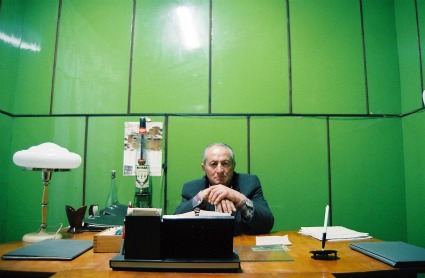
When you google Bahkmaro, Georgia, the top hit is a “gallery of gorgeous photographs.” The documentary Bahkmaro is strikingly beautiful, but not in a way that would be approved by the Georgia Chamber of Commerce.
A drab three-story brick building in the provincial town of Chokhatauri is the wizened host of this hour. Dogs bark, dilapidated interiors look through doorways into more dilapidated interiors, empty restaurant tables are surrounded by saturated green walls that belie the lack of customers — it’s like a Seinfeld episode filtered through Robert Bresson and the Romanian New Wave, where nothing ever happens. But instead of Upper East Side privilege, this is the banal life of a desperate people hungry for political change.
Salome Jashi’s film is bleak but also dryly humorous, as the restaurant owner orders his lone staffer to put out more plates than they will ever need to use. The diverse occupants of Bahkmaro deserve more time than the sixty minutes afforded to them here — one longs to be immersed more fully in their world. Two or three hours, peppered with the longeurs that make the current Romanian cinema glitter with fascinating boredom would make this as boring as it should be — and that’s a compliment.
View the trailer.
Premieres tomorrow at 7:30 p.m. in AFI Silver Theater 3.
—

Through the star power of numerous well-known chefs and advocates — including First Lady Michelle Obama, Chef Sam Kass, Alice Waters and Chef Jamie Oliver — many lines have been spent on improving school lunches. Obesity statistics aside, the National School Lunch Program is one of the largest assistance programs in the country, with approximately 50 percent of students receiving some form of aid, without which many would otherwise go hungry. However, most people know that while school lunches fulfill some basic needs, there are numerous issues that go beyond pleasing finicky eaters by serving processed foods with questionable nutritional value.
Richard Chisolm’s documentary Cafeteria Man provides snapshots of the numerous components of Baltimore City Public Schools’ reinvented school lunch program — the work of the visionary “Cafeteria Man” Tony Geraci. Geraci was hired in 2007 to be the school system’s director of food and nutrition, and has created a nearly self-sustaining ecosystem — developing supply relationships with local farmers, building small farms where students can learn more about agriculture, and instituting culinary job training programs that feed in to the schools’ cafeterias.
Viewers of Jamie Oliver’s Food Revolution might wonder if this documentary is just more of the same. While Oliver’s show seems to thrive on drama, uphill battles and tears, Cafeteria Man tends to steer clear of the theatrics. Chisholm doesn’t rely on money shots of sagging waistlines and out-of-breath children. Nor does he take the easy road of forming the narrative around Geraci’s dynamic personality or ranting against the system. Instead, he turns the camera on the bigger picture: smiling children excitedly snacking on unprocessed foods, visiting farms and cooking meals, parents actively engaged with the schools and the school council.
Even though the documentary makes it clear that some of the improvements to the school lunch program in Baltimore have been an uphill battle for Geraci, it isn’t what you will walk out of the theater remembering. As my Marketing 101 professor discussed in his lecture about nonprofits, the key to meeting your goals and getting people involved is not to focus only on the problems, but to do what Chisholm has done — show them the results.
View the trailer.
Premieres tomorrow at 12:30 p.m. in AFI Silver Theater 2, and screens again on Friday at 2:30 p.m. in AFI Silver Theater 1.