Martin Austermuhle
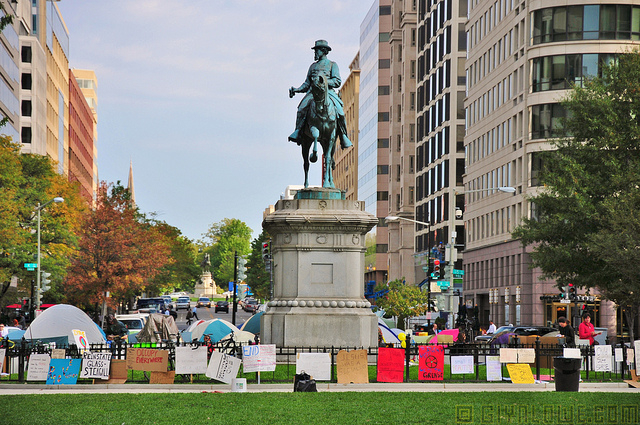 Photo by Glyn Lowe Photos
Despite a standing court order that forces the U.S. Park Police to give the Occupy D.C. encampment at McPherson Square 24 hours notice before moving to evict it, a lawyer representing the protesters is seeking to ban the government from acting against the occupiers altogether.
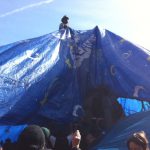
In a brief filed today, D.C. attorney Jeffrey Light has asked a judge to prohibit the Department of Interior — which runs the National Park Service and U.S. Park Police — from seizing tents or other personal property. In the 12-page brief, Light argues that unless the court grants his request for an injunction, it’ll only be a matter of time before the U.S. Park Police swoops in and dismantles the three-month-old tent city.
“[A]bsent judicial intervention, Defendant is likely to seize the tents of Plaintiffs without a warrant pursuant to an unconstitutional policy which it maintains which vests unfettered discretion in individual law enforcement officials to determine when to seize temporary structures and other nonvehicular personal property. Defendant maintains no reasonable, standard police procedures for determining when to seize temporary structures and other nonvehicular personal property,” he wrote.
Given that the Park Police and District at large have treated the occupiers with kid gloves so far, Light uses the eviction of encampments in other cities as proof that it’s only a matter of time before McPherson Square — one of the last large camps standing — is cleared and the protesters’ have their belongings seized. He also cites the seizure of “temporary” structures like the Occubarn and an art installation that was removed recently by police.
“Such a fear is reasonable based on the fact that government officials in numerous cities have seized and destroyed tents and other property belonging to Occupy protesters, despite public assurances that property would be safely stored,” he argued in the brief.
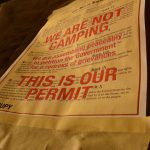
If Light’s request is granted, the McPherson Square occupation would become all but permanent, despite rules that prohibit camping in the federal park. But that’s the point, says Light, who writes that the act of occupying the park is intimately tied to the movement’s goals of shedding light on the issue of economic inequality and political corruption. The tents aren’t just for sleeping, he says, but rather part of the constitutionally protected expression the protesters are engaged in.
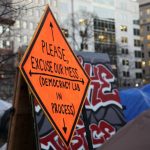
“Like the tent cities in other locations across the country, literal occupation of McPherson Square 24 hours-a-day is a core component of the Occupy DC movement and a key message the Occupy DC protesters seek to communicate to the government and the world. The tent city is not merely a symbol, but functions as a model community demonstrating the protesters’ vision of a more just and equal society. Physically occupying D.C. is the only effective manner in which Occupy DC members can express their message of taking back the city to create a more just, economically egalitarian society,” he wrote in the brief.
He also argued that there’s simply nowhere else in the District where the protest could effectively happen.
A hearing is set for late January to consider the request.