Martin Austermuhle
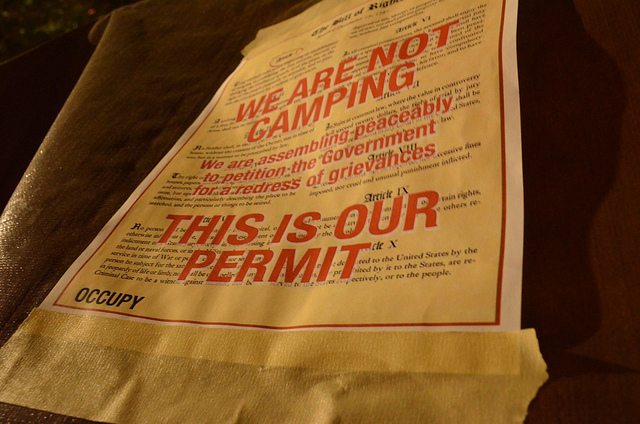 Photo by hortonmp3.
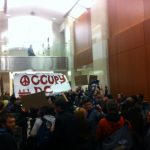
While Occupy Wall Street protesters were being evicted in the wee hours of the morning by New York City police officers, their counterparts in McPherson Square slept undisturbed.
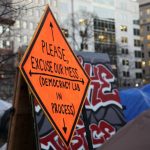
That’s pretty much been the norm for the District-based campers — as Occupy protesters around the country have been aggressively confronted by city officials and police that claim they’ve overstayed their welcome, two separate encampments in the city have largely been left to protest corporate greed as they wish.
All in all, that might seem pretty surprising. Protesters here don’t have to contend with a single police force, but rather a myriad of security agencies that have overlapping jurisdictions. McPherson Square is a federal park, so U.S. Park Police has jurisdiction; the many marches throughout the city, though, have been accompanied by Metropolitan Police Department officers. And for a town that regularly see “suspicious packages” close down entire city blocks, it’s nothing short of a miracle that security-minded bureaucrats aren’t warning of dirty bombs in every tent.
There have been moments of tension, of course. Two weeks ago, protesters and police clashed over who was responsible for a hit-and-run incident at the Convention Center in which three Occupy D.C. participants were injured. D.C. Police Chief Cathy Lanier and Mayor Vince Gray said that protesters were no longer peaceful, but tensions largely subsided in the following days. (Police even attended a General Assembly meeting.)
Beyond that, though, it’s hard to argue that D.C. police agencies haven’t been accommodating. The Park Service posted clarified rules governing everything from camping to how and when a generator could be used; D.C. police have consistently stopped traffic to allow marches to happen.
We could chalk it all up to experience, of course. The city’s many police agencies are used to protests. Johnny Barnes, executive director of the ACLU of the National Capital Region, told DCist that Washington is the “birthplace of protest,” and police agencies are simply used to handling crowds with grievances.
Moreover, D.C. police lawyers are probably all too aware of the lasting legacy of the 2002 Pershing Park arrests, where the illegal arrest of hundreds of protesters led to years-long lawsuits and millions of dollars in payouts — the city spent over $2 million on lawyers alone, not to mention the $22 million paid to those arrested.
There’s more to it, though. No one can accuse New York of not being used to its own protests, after all.
It might simply be a question of leadership. As the Post’s Tim Craig reports today, no one on the D.C. Council is pushing for police to crack down on either of the two encampments. Last Friday, Councilmember Phil Mendelson (D-At-Large), who chairs the D.C. Council’s Committee on Public Safety and the Judiciary, told WAMU’s Kojo Nnamdi that he saw no public threat from the protesters.
As for Mayor Vince Gray, he was himself arrested in April at a D.C. voting rights protest, and likely understands both the value of unencumbered protest and the symbolic backlash that could come from sending police in, Bloomberg-style. Councilmember Jim Graham (D-Ward 1) may have been on to something when he was quoted by Craig as saying, “We are not subject to Mayor Bloomberg, I’m happy to say. We make our own decisions, and it’s all dependent on the continued orderly nature of the protests.”
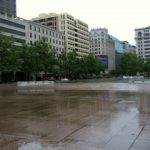
Finally, there’s the issue of the occupied lands. There’s no public clamor for protesters to be cleared out, because neither Freedom Plaza nor McPherson Square are beloved public lands for District residents or visitors. As both the City Paper and Post have argued, the encampments may actually have brought a little life to areas where it didn’t exist before. Neither encampment is on privately owned land, either, which certainly simplifies matters.
This tenuous peace may not hold forever, but it remains steady to date. In a way, it could prove vexing for Occupy D.C. protesters, who have called for a solidarity march at 5 p.m. today to register their anger with the events in New York and elsewhere. After all, how much can you rage against the machine when the machine is letting you rage away? Both police and protesters have pledged to change tactics as the movement evolves, but for now, the truce stays in place.