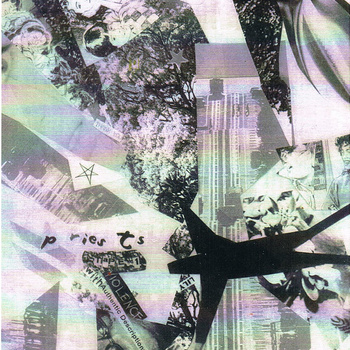
 Bands that are excited about what they’re doing are always more fun to watch. As such, when a band is so unabashedly in-your-face and energetic, its live set becomes instantly memorable. During Priests‘ show at the Black Cat last March, Katie Greer (also of Chain and the Gang), sneered, screamed and sang her way through a set of loud songs. Daniele Withonel pounded furiously behind her, with complex rhythms and occasional chirpy screeches of her own. Meanwhile, Gideon Jaguar seared through guitar riffs that while powerful, still sounded melodic and deliberate, as if fighting against the speed and dissonance of most hardcore. Every Priests performance since has been the sort of affair that has made us believe that D.C. hardcore is alive and kicking.
We talked to Priests about expressing their opinions, discovering interesting sister bands and avoiding turning their house into a concert venue.
Find them online: http://priests.bandcamp.com
See them next: Tuesday at the Black Cat with Foul Swoops and Fell Types.
When is your label, Sister Polygon, starting up?
Katie: I feel like the label is sort of like our club that we keep talking about, so it’s sort of been that for awhile—in name alone. But we’re recording.
Daniele: Then Cigarette went to New York to record some songs for a 7” and Bigmouth went to Inner Ear and recorded songs already, but I think there might be some new ones with us.
Do you suspect you’ll be doing more shows at your house?
Gideon: No.
Daniele: I don’t think so. We went to introduce ourselves to the neighbors and baked cookies and said, “Hi. We know that we’re musicians and we’re loud but we really try to be respectful and not to play late. We’re having this BBQ on the 24th with live bands.” And this woman was like, “Aren’t you so sweet! I’ll be out of town, I’m so sorry I can’t see you.” And since it was like, 7:30 p.m. we said, “Sorry, hope we didn’t interrupt dinner” and she said, “Dinner? No, it’s bedtime for us!”
Katie: I think Gideon doesn’t really want to live in a show house. This is the vibe I get from him.
Gideon: No. Because everybody seems to book shows out of lip service with the idea that “You booked a show for me, I’ll book a show for you.” But it really shouldn’t work that way. You should be passionate about the things that you’re doing. If we do happen to have shows at our place, it’d be really special. I think there needs to be more of the thoughtful effort towards that. Also, it’s not like we really planned on living in that neighborhood. That happened to be the cheapest place we could find.
How is that?
Gideon: I’m really good at the Internet.
Daniele: I used to live over on First and P and I used to pay more than I’m paying now and I have a larger room and practice space in the basement and a backyard and everything. It’s insane.
Gideon: I guess the main thing is finding a place where we can rehearse because that’s a problem in this city. I’d rather have a place where I can play music and it’s actually a pretty pleasant neighborhood and quiet.
Daniele: There’s not a lot to do. It’s kind of a bummer. There’s not a lot of bars or a bodega or restaurants. Over here it’s like, “Oh, I’m gonna go to Food For Thought and get some food.”
Katie: But you’re also surrounded by luxury condos.
Gideon: For me, it’s more important for me to have a place where I can be creative. Over here, it’s all bars anyway. I’m kind of broke. [editor’s note: this interview, like many Three Stars interviews, took place on U Street].
So, how did everybody meet each other?
Katie: We met at a show last summer. Well, actually, that’s not true because Gideon and I knew each other. It’s funny, Gideon and I started going to college together the year that Facebook kind of blew up. So everyone was friends with each other on Facebook before they knew each other face to face. It would make for really weird campus interactions where it’d be, “I recognize you from the internet but we’ve never been introduced” and we’re really awkward 18-year-olds so we’re not gonig to say hi to each other. But Gideon and I knew each other and saw that we had the same taste in music, kinda. I don’t think we ever really met, though.
Gideon: Not til last June, probably. We ran into each other.
Katie: We started running into each other at shows.
Daniele: And I used to drum for a band and one of the guys was like “You should meet Sasha [Lord] when you move down there. She’ll introduce you to people.” So, Sasha invited me to a show and she was there and Ian and Katie were there and a bunch of people that I later became friends with, I met. I had been in a band in New York and I really wanted to start my own band here in D.C. and I’m like, “I’m a drummer,” and Katie said, “Well, I make weird sounds on my guitar and write stuff and we have similar taste in music.” So, we went to another show together and that’s where we met Gideon.
Katie: And I was really not feeling confident in my guitar skills and I knew that Gideon before had been like, “We should play together sometime,” so I was like, “Oh, I have this friend, Gideon. He should jam with us, too.”
Daniele: Then we would jam in Gideon’s parents’ basement before we had a practice space.
Gideon, I know you’ve been in other local bands in the past, I just haven’t seen you active in awhile.
Gideon: Yeah, I kind of took a break from music. I was mainly playing jazz for awhile with a friend of mine, but I just kind of took a break from music. I was kind of disillusioned, but got back into it.
Daniele, how long have you been drumming? I’ve heard that you started recently.
Daniele: A little over two years. I started messing around two or three summers ago. Then I started dating a guy who ran rehearsal spaces. That was his business. Then, when he went on tour, I would manage them for him. I would collect the rent and that kind of stuff. That meant that I had keys to twenty-two rooms of unlimited instruments whenever I wanted. So, I learned how to hook the Casio into the bass amp and there were always drum kits around. I taught myself kind of. I don’t know how to read music or anything, so I sat down at the Casio and went, “Okay, here we go!” So, I did a lot by myself when he was on tour and I kind of started writing songs with him and then moved around here and met these guys.
That’s impressive then, that you can sing and play the drums simultaneously.
Daniele: It’s a new thing. So, we met and we’re like, “We’re going to have a show! Let’s have a show!” right off the bat. We had four songs and I love having a short set, I don’t want to change it but, I wanted to get us some more songs. So, when I was back home, me and my boyfriend at the time were hanging out and he started playing this really crazy, psycho keyboard riff and I was playing drums and I had an idea, so I said, “Give me the mic” and I started screaming and wrote this song. We were like, “This isn’t good for our band.” We were kind of a pop band. So, I brought it back to Priests, and I was like, “I kind of have this idea for a song, what do you guys think?” Gideon was like, “Hell yeah!” so I just did it. But I didn’t know until that moment that I could do it. It wasn’t a plan or anything.
Has that been difficult to do that?
Daniele: No, but I’ve found that I can’t do ornamental, syncopated drum beats. I have to do pretty steady beats so that I can kind of do it without thinking but it’s not bad.
Katie: It’s like playing any instrument and singing, though. I think I have a preference for bands with one person concentrating on vocals most of the time but the bands where you see people singing and playing an instrument, especially with guitar, I think sometimes those are the best guitarists because they’re not overplaying. They’re just putting it in where it needs to be there because they’re also working on singing.
And usually, you are singing without concentrating on an instrument.
Katie: Yeah. I like to do that. It’s ideal but at our last show, I played bass and I started writing songs with more bass parts. I actually really liked playing bass.
I was hoping you could expand on some commentary that you made mid-set when I saw you all play in March. It sounds like you had received some comparisons to Riot Grrrl bands.
Katie: A little bit. It’s happened before.
The commentary that I heard afterwards is that this is an archaic comparison.
Katie: Yeah.
Daniele: It’s kind of like being called a suffragette. Do I believe in women’s voting? Of course, but the suffragette movement was something that happened at a very specific time. So, I feel like Riot Grrrl is awesome and we all admired the work they did and love it. But we also feel like it was kind of its own time and place, kind of.
Katie: Riot Grrrl happened in 1991 and ’92.
Gideon: Also, people get into these really dangerous mindsets. We all love music from different eras and different points in time and those are different things we look to for inspiration but when I first hear a record and get really excited about it, it’s like, “Oh, this is from ’92” or “Oh, this is from ’81” and that’s great. But I feel like at this point in time, I really have a greater yearning to hear new music. I feel like right now is kind of an exciting time, ‘cause there’s an oversaturation with the Internet and everything like that. You’re just constantly blasted with information and everyone can hear it. Someone can be like, “I listened to this Italian disco band from the ‘70s” and that’s their point of reference but there is a lot of cool, interesting things going on right now and people that we’ve met and we’ve talked to or people that we’ve kind of observed are doing their own thing and saying, “We don’t really have to buy into all this. We’re just playing for ourselves and trying to get our own thing done.”
Katie: I think stylistically for me too it’s just bad taste to always be describing things in these terms. There was a music magazine from the Pacific Northwest in the ‘80s and the writers were all just young kids who were really excited about music but they were told by the guy who ran it said, “Cool. You can write reviews but the rule is don’t compare any bands to any other bands.” So, you got a lot of interesting, well articulated ideas about music that isn’t just, “They sound like the Smiths meet the Replacements” where it’s all very defined in terms of things that have already happened. That’s just not very interesting.
What are some of the cool things that you think are going on right now?
Gideon: Like our friends in Big Mouth, they’re really great. Mainly I think it’s just an idea of people being genuine and being real — like a new realness. I think there’s bands that are definitely doing their own thing and it sounds very unique. You can kind of hear hints of their influences but it’s definitely their own thing. Same goes for Cigarette. They like girl groups and they’re channeling it really hard but they’re a bunch of really shy guys. There’s bands from all over that we’ve heard that we think are pretty cool.
Daniele: I think for me, since I was so new to playing music and just got thrown into playing shows, I really like bands that you can deconstruct the songwriting process and as they build, you can see the parts more laid out. These bands like Downtown Boys, Cavegirls, Crazy Band where the components kind of stand alone. Some people might describe that as amateur and I guess it is but the vision of music you get from that a) doesn’t play by the rules which is really cool, because you listen to weird shit because they don’t know any better. That’s what I did. But also, you get to think about music because you see those bands in a really unique way. That kind of approach to me really gets me thinking and excited and wanting to create new stuff.
Katie: There’s a lot less spontanaeity in a lot of bands in recent years and I really think, I say this too much, but I really think it has to do with Internet culture where so much of your actions can be really premeditated. LIke, you’re going to sit at your computer and compose a really well-crafted email and you might really articulate your ideas well but there’s something that’s just missing.
Gideon: It’s not the same as writing a letter.
Daniele: Like this bedroom pop where people sit in their room with GarageBand and play every instrument and put it together for a whole month obsessively by themselves.
Katie: Yeah, we’re the opposite of bedroom pop.
Daniele: There’s nothing wrong with that but I really like it when there’s people thrown in a room and it’s like, “You don’t know what you’re doing but work it out.” That, for me, speaks to my own experience and life. Not just music, but how I experience everything. So, I find that approach more interesting.
Katie: It’s just a different way of thinking about it, too. I was talking to a friend of mine who was really involved in an up and coming band in Brooklyn right now. I don’t think she’s in the band anymore, but she was explaining to me her problems with the band. She was like, “We started out and we had barely gotten ourselves together and they wanted to play shows every weekend and I said to them, ‘But you’re cheapening our product! You’re making it less valuable because people can see us all the time.’” I was like, “We like to play all the time because it’s exciting and it’s new variables in different audiences.” It hadn’t occurred to me the market value of our music to be a contributing factor of when we should play. It’s funny. I didn’t know we were on the floor of the Stock Market Exchange.
Gideon: Also, I feel like people start bands really quickly to jump on a trend. At this point in time, “This blog says this is cool” but everything is a passing phase. So, it’s difficult. I think the people that are really doing something genuine really shine.
Daniele: I’m not saying that people who are playing less are making a mistake. You want every performance to be special. Playing a show is really f***ing fun and I want to do it all the time. But at the same time, you do need to practice and you do want it to be something cool and unique at the same time, so it’s hard.
Katie: I think she was also saying that her former bandmates were interested in being scenesters and they wanted to play every weekend because they wanted everyone to see them and think they were cool or something. So, it’s all in your motivation. Obviously, we’re not interested in playing all the time to be scenesters.
One of your first shows was at Occupy D.C. where you went into that Franklin School Building.
Katie: No. We played outside right before people people started marching into the Franklin School Building. It was happening concurrently which was really exciting.
Gideon: And then a woman yelled at us, saying that we were supporting the Iraq war because we were using a gas generator. It was an interesting experience.
Daniele: It was really good, though. We had a really fun time. Except I froze my feet off. It was winter and I wore little leather shoes. It was a mistake.
Gideon: It got real cold real quick.
Do you think that your opinions about different social subjects come through in your music? I only ask because listening to “Diet Coke,” I’m not sure if that’s an anti-consumerist opinion or just a punk “Go f*** yourself” sort of song.
Katie: That song is just about how everyone thinks everything should be free now. And it’s like, “Everything can be free…as long as you’re willing for everything to be a commercial spot. for something.” There’s lots of free stuff now and it’s sponsored by Target.
Gideon: Big Art Show! Sponsored by VitaminWater!
Daniele: I consider myself a steady Marxist and that’s something that’s pretty important to me and care about so it’s something I’m always thinking about. Not so much about the way the songs are written but when I think about what we’re doing…is someone trying to commoditize us? I was like, “I want to come out with just tape on my body with pricetags all over it and say, ‘You don’t think it’s okay to commodify my body, but you don’t question commodifying my art.’” I don’t think we’re trying to write diatribes in our art but our views about art and the world that we share probably does come out subconsciously.
Gideon: Also, everyone kind of takes themselves too seriously.
Daniele: Why does commentary have to be serious? Some of the best political commenters, in my opinion, are comedians. They understand that it should be entertaining. It should be something you get excited about. I hate so much when people are bludgeoning you with, “THIS IS THE TRUTH.”
When you played the show with your curlers still in, Katie, I actually thought that was intentional.
Katie: No. No, not really. I haven’t been doing it as much recently, but last summer I was always curling my hair because it was a really weird length. I hadn’t done it in awhile but if you take them out too fast then you’ve wasted all day with these stupid foam rollers in your hair and it’s just a limp, wet noodle. They weren’t dry yet so I couldn’t take them out.
Daniele: I just liked the way it looked, too. I thought it was awesome.
Katie: It’s an accidental fashion accessory.
Daniele: We’re deconstructing beauty the way our music deconstructs pop music.
I also found that during your live shows you appear to try to break down that fourth wall between audience and performer.
Katie: I think a lot of people have been interested in making music live where you could interact with the audience more. I think that began in this day and age with the Internet. I think it’s important to constantly make things where you’re reminding people, “This is not YouTube. You’re not just watching this at home. This is a live show and we’re talking to you right now.”