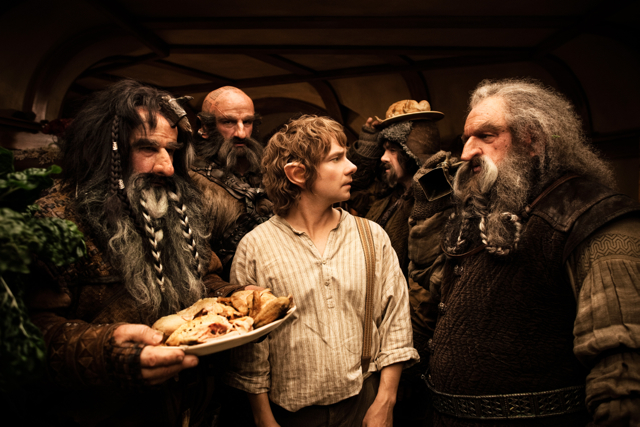
 Martin Freeman as Bilbo Baggins, center, and some dwarves. (Warner Bros. Pictures/James Fisher)
The world is changed. I feel it in the screen resolution, I feel it in the ticket prices, I smell it in the frame rate. Much that once was is lost, for none now make movies who remember it.
It began with the forging of three films, adapted from three books considered so unadaptable by their author, he sold the movie rights for less than a song. Peter Jackson’s The Lord of the Rings trilogy wasn’t just a gorgeous text-to-screen translation that managed to be both inventive yet remarkably faithful to J.R.R. Tolkien’s original tales of Middle-earth, it was a gift to the foes of bad fantasy films.
But now, it appears Jackson has fallen into shadow and ruin. Since 2003, after The Return of the King brought the Kiwi director’s trilogy to a beautifully epic close, a cinematic version of Tolkien’s other famous legend was inevitable. (Sorry, The Silmarillion. You’re great, but it’s not you.)
Studio bankruptcies and creative fits prevented The Hobbit from being made for several years. In the interim, Jackson, his partner Fran Walsh, and their writing partner Philippa Boyens cranked out two mediocre titles—the messy but gorgeous King Kong and the gorgeous but messy The Lovely Bones. As for the tale of Bilbo Baggins’ adventure with the exiled dwarves of Erebor, at first it was supposed to be Guillermo del Toro directing with Jackson as producer and creative majordomo.
Enough stalling convinced del Toro to step aside; he’s still credited as a writer. But, really, the director switch was never that surprising. Middle-earth on the big screen belongs to Peter Jackson. It came to him and he made it his. His own. His precious.
Too precious, in fact.
The Hobbit, which was first read to me when I was four or five, is a children’s novel that, including Tolkien’s usual appendices and maps, weighs in at about 300 pages or fewer. Jackson managed to make one movie out of each volume of The Lord of the Rings, which are longer, darker and even more engrossing.
Could The Hobbit have been turned into a single film? Of course it could have. Ralph Bakshi did it in a lovely animated version that clocks in at 132 minutes. But this adaptation started as two movies. Fine, whatever. All the kids (Harry Potter and the Deathly Hallows, The Twilight Saga: Breaking Dawn, the third volume of George R.R. Martin’s A Song of Ice and Fire) are doing it these days anyway.
But then, two movies became three, the first of which, The Hobbit: An Unexpected Journey opens today.
Although Jackson got his start in small-budget, blood-soaked, guts-caked horror flicks, he’s always been James Cameron’s brother from a New Zealand mother. His actors, while important, are also incidental, and whenever Jackson makes a movie, the real story is how much grandeur he can cram in to every frame. And Jackson didn’t have enough frames.
Instead of the usual 24 frames per second that movies have been shot at since the Years of the Lamps, or at least since cinema was invented, Jackson double the clip to 48 frames per second. The effect is constantly distracting, and this movie—one installment of a kids’ book—runs nearly three hours. Jackson opens his Hobbit moments before his The Fellowship of the Ring begins, with the wizened Bilbo, once again played by Ian Holm, writing down his life’s work to pass on to Frodo (Elijah Wood, another Rings alumnus returning for a cameo.)
Movies are supposed to look otherworldly. Colors are richer, shadows more powerful, movement is more graceful. At 48 fps, however, the verdant landscape of the Shire feels lit by supermarket halogens and the actors seem to move inhumanly quick. Perhaps the camera is sharper. But being more real than real is not always a good thing. The effect is multiplied by the 3-D presentation which, as usual, adds nothing.
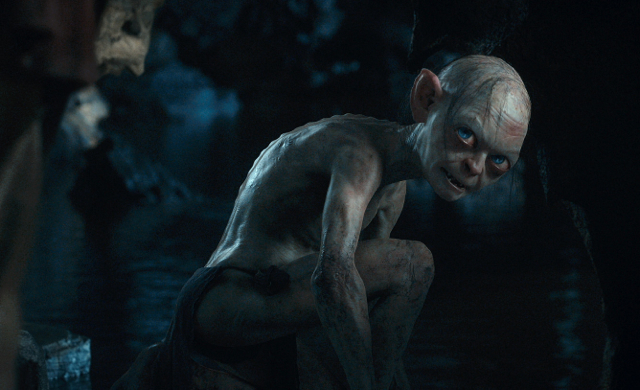 Andy Serkis as Gollum. (Warner Bros. Pictures/James Fisher)
Oh, and is there a story? Well, sort of. This Hobbit, once the action switches to the young Bilbo (Martin Freeman, who does his best with a bad script), begins appropriately enough—with a visit from Gandalf the Grey (welcome back, Ian McKellen). Soon the dwarves arrive—13 of them, in fact, led by Thorin Oakenshield. But Jackson, maximalist that he is, lingers on these meeting scenes. Sure, there is humor to be had in 13 lumpy, bearded dwarves and a kooky old wizard raiding Bilbo’s pantry, but by the time he’s out the door the next morning, the movie is already an hour old. The full title of Tolkien’s novel is The Hobbit, or, There and Back Again, but at some point you actually have to, you know, get there.
The actual quest—reclaiming the dwarves homeland from a giant dragon named Smaug, who luxuriates in mountains of gold like the Third Age’s Scrooge McDuck—is mentioned frequently, but seems secondary to Jackson’s set pieces. There are flashbacks, prologues, expositional asides and a most unwelcome appearance by Radagast the Brown, another wizard who while important to Tolkien’s legendarium, becomes Jackson’s very own Jar-Jar Binks.
Instead, in drumming out The Hobbit to what will presumably wind up as a nine-hour slog, Jackson appears to have mined the appendices at the back of The Lord of the Rings, as evidenced by appearances by Galadriel, a stately elf played Cate Blanchett, and Saruman, the eventually evil wizard played by Christopher Lee. (Neither character actually appears in The Hobbit; also, the 90-year-old Lee is finally showing his age.)
None of individual performers are bad—well, save the fellow who had to play Radagast—but it’s damn nigh impossible to enjoy any of them with such disastrous visuals. Computer-generated battle scenes between free folk and orcs, which seemed so believable in 2001, look like video game cutscenes a decade hence.
Only one scene—perhaps the most awaited of anything in these Hobbit movies—pays off. It is, of course, the appearance of Gollum, once again portrayed by Andy Serkis in a motion-capture suit. Freeman and Serkis pull off the fateful riddle game in a sublime moment that Jackson presents as the Misty Mountains version of My Dinner With Andre. (One guess as to what Bilbo has in his pocketses.)
If only Jackson could have stayed at that scale. Yes, Middle-earth is a big place that demands a big lens, but The Hobbit is just the prelude to the real epic. The road goes ever on, but if Jackson continues down this one, he’ll lead us to a place far worse than Mordor.
***
The Hobbit: An Unexpected Journey
Directed by Peter Jackson
Written by Jackson, Fran Walsh, Philippa Boyens and Guillermo del Toro; adapted from The Hobbit by J.R.R. Tolkien
With Martin Freeman, Ian McKellen, Andy Serkis, Hugo Weaving, Cate Blanchett, Christopher Lee, Richard Armitage and 12 more guys playing dwarves
Running time 169 minutes
Rated PG-13 for pointy swords and scary orcs
Opens today everywhere, and good on you if you can find it playing in two dimensions at 24 frames per second.