Photo via Warner Bros.
For a nearly three-hour film that covers roughly one-third of a 300-page book, The Hobbit: The Desolation of Smaug, tries its damndest to fill those 161 minutes with as much grandiose action as it can. But also with little substance in its narrative.
Unlike its predecessor, An Unexpected Journey, which wasted time on needless story building and Middle-earth navel-gazing, The Desolation of Smaug is far more thrilling, yet it can’t escape its completely tedious and overzealous trappings that comes with a moderately sized children’s novel adapted into three three-hour films. Indeed, no matter how good any of The Hobbit films may look on screen (An Unexpected Journey excluded, because the 48 fps gave the film a glossed-over soap operatic effect, that cause more headaches than jaw-drops), they’ll always be hindered by their needlessly bloated narrative, which wore thin by about the 45-minute mark of the first film.
To Jackson’s credit, however, he tries to pad out the story by inventing plot lines not found in J.R.R. Tolkien’s classic novel in order to tie in these new films to his masterpiece The Lord of the Rings trilogy. Unfortunately, the prequel plot-building—which gives Gandalf the Grey (Ian McKellen) more screen time and centers around the rise of a Necromancer—revealed to be Sauron—and his Orc army—comes of as clumsy and, well, boring; often detracting from the film’s central narrative of our titular hero, Bilbo Baggins, and the orphaned Dwarves of Erebor, who are on a quest to the Lonely Mountain to reclaim their rightful kingdom that was destroyed and overtaken by the nefarious dragon Smaug.
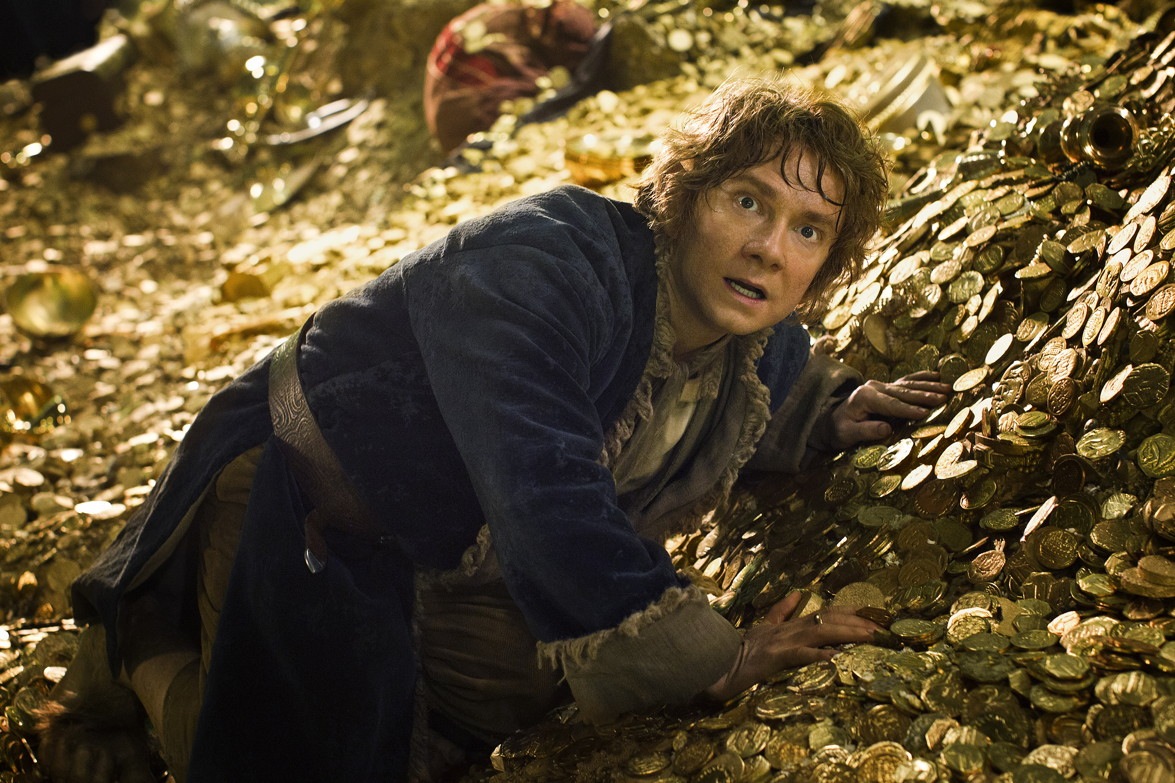 Photo via Warner Bros.
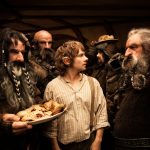
The Desolation of Smaug picks up right where An Unexpected Journey left off (oh, except there’s a needless fifteen-minute flashback scene between the first meeting of Gandalf the Grey and Thorin Oakenshield—the rightful Dwarf King of Erebor—because this movie isn’t long enough, Jackson decided), with Bilbo and the dwarves still on their quest to the Lonely Mountain. Though their quest has a deadline (they need to get to the Mountain before the Last Light of Durin’s Day, or else the keyhole to enter inside will be hidden forever), you wouldn’t guess it considering how much delay their journey has.
In the spooky, insidious forest dwelling of Mirkwood, the team gets attacked by a pack of giant spiders—a nice nod to Frodo’s arachnid encounter in The Two Towers—before they’re rescued by the Wood-elves. Of course, the elves and the dwarves have a history of not getting along very well, and they’re locked up. Bilbo, who’s harboring a secret, the “One Ring To Rule Them All,” that’s the focus of the original trilogy, manages to sneak around invisibly, thanks to the power of the ring, and rescues them.
Cue more extended fight scenes and superfluous subplots (including clumsily written romances and Middle-earth politics) not found in the original book, and the dwarves reach the Lonely Mountain. After about one three-quarters of a movie (or, about four hours). While the final 45 minutes of the film are thrilling—Bilbo, Thorin, and the rest of the dwarves encounter with Smaug are masterfully directed by Jackson—by that point we’ve become so exhausted by the bloated build-up, that the pay-off comes off as obligation, rather than relief.
I think Jackson would’ve been more successful dolling out The Hobbit as an epic, nine-hour saga, a la Béla Tarr’s 450-minute Sátántangó, or Claude Lanzmann’s punishing, but essential Holocaust doc, the 566-minute Shoah. At least then he’d be celebrated as a bold visionary, unafraid to dive deep into the Middle-earth realm in a way that would alienate anyone who’s not a hardcore Tolkien fanboy/girl. Instead, breaking up one book into three movies just plays like a money-grabbing scheme for Jackson to do three more victory laps from his uber-successful Lord of the Rings trilogy. But that’s Hollywood for you.
The Desolation of Smaug isn’t as grating and tedious as An Unexpected Journey, and that credit goes to director Jackson, rather than writer Jackson (along with co-writers Fran Walsh, Philippa Boyens, and Guillermo del Toro). Dropping the 48 frames per second effect gives the actions sequence far more coherence and gusto. While the 3D adds very little to the film, Jackson’s sense of camera movement and placement, which often sits still while the action brilliantly crafts around it, makes the film a far more exciting task than last time. Coupled with the unsurprising solid performances by the film’s acting ensemble, which is anchored by Marin Freeman, enduring The Desolation of Smaug isn’t as, well, desolating as it could have been.
Still, it is a damn long movie, and you’ll feel every minute of it.
The subtitle of Tolkien’s The Hobbit is There and Back Again. By the end of Jackson’s second movie, they finally—finally—get there. But with one three-hour movie left to go, one has to wonder if they’ll ever get back again.
***
The Hobbit: The Desolation of Smaug
Directed by Peter Jackson
Written by Jackson, Fran Walsh, Philippa Boyens and Guillermo del Toro; adapted from The Hobbit by J.R.R. Tolkien
With Martin Freeman, Ian McKellen, Orlando Bloom, Evangeline Lilly, and Richard Armitage and 12 more guys playing dwarves
Running time 161 minutes
Rated PG-13 for pointy swords, lots of beards, scary orcs, and a big-ass dragon.
Opens today everywhere, you should probably see it in plain ‘old 2D.