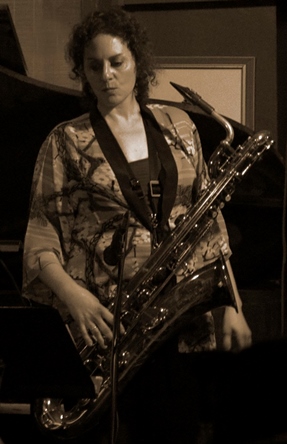
 Leigh Pilzer, photo by Carlyle V. Smith.
 The Washington Women in Jazz Festival is an annual highlight of the area’s arts calendar. Under the auspices of producer/pianist/composer Amy K. Bormet, the festival has grown from a series of dates at Twins Jazz to performances by world renowned artists at a number of local venues. The event had its unofficial start on Sunday with a jam session, but tonight is when things get into gear at the Atlas with the opening concert featuring the WWJF All-Stars, including Bormet on piano, bassist Karine Chapdelaine and alto saxophonist Sarah Hughes. The guest artist for the show will be drummer Kim Thompson, a phenomenal musician who has played with luminaries such as Beyonce, Kenny Barron, Jay-Z, and Mike Stern.
While the opening concert features a powerful lineup, we’d like to put the spotlight on aritone saxophonist Leigh Pilzer who will also be on the bandstand. Given this area native’s key role in the WWJF opening, as well as her growing stature within the local jazz community, this seems as good a time as any to feature this talented player and composer.
An area native, Pilzer came up through the Montgomery County Public School system, where she began playing cello in elementary school. In high school she met Bill Potts, a big band composer and arranger who had worked with Woody Herman and Buddy Rich. Potts introduced Pilzer to jazz, and rather than switch from cello to bass — which would have been the more likely thing to do — she picked the alto saxophone. She made the change to baritone while studying at Montgomery College. Pilzer then went on to study Jazz Composition and Arranging at the Berklee College of Music. Realizing that she needed to focus more on playing rather than composition, she returned to the area to earn two Master’s degrees from the University of Maryland, one in Jazz Studies and the other in Saxophone Performance. Pilzer then entered academia, teaching courses at UMD and Towson. Pilzer went so far as to begin a Ph.D. program at Catholic, but then left the program after the passing of her dissertation professor, Dr. Steve Strunk.
“I’ve gone from student to full-time — more or less — professional musician, professional musician to student, student to teacher, teacher to student, and now I’m back to focusing on writing and performing again,” Pilzer said.
And she has become quite prolific musician, at that. She co-directs the Jen Krupa-Leigh Pilzer Quintet, in addition to regular performances with several big bands, including the Bohemian Caverns Jazz Orchestra, Shannon Gunn & The Bullettes and Sherrie Maricle & The DIVA Jazz Orchestra. Pilzer also composes and arranges for all the ensembles with which she plays.
DCist interviewed Pilzer to get some thoughts about her career and D.C.’s jazz scene.
What are some notable gigs you have coming up?
Lots of good stuff in the next few weeks. I’ll be playing with the WWJF All-Stars at the Atlas Performing Arts Center for the opening night of the Washington Women in Jazz Festival. In April, I’ll be playing at the Iridium in New York with Sherrie Maricle & The DIVA Jazz Orchestra, celebrating DIVA’s 20th anniversary on the 3rd. On the 18th, I’m playing the music of Pepper Adams at the Smithsonian American Art Museum’s Take 5! program along with fellow baritone saxophonists, Frank Basile and Brad Linde. And on the 26th I’ll be at Baird Auditorium with the Smithsonian Jazz Masterworks Orchestra. John Clayton is coming to direct the band in a tribute to John Levy, and the next day we’ll head out to Wisconsin to play at Viterbo University.
Baritone saxophone is not often seen as a lead instrument. How did you settle on this horn? Have you faced any challenges getting your work out there because it is somewhat unusual?
I had been playing alto just a few months when I was recommended to sub for someone on bari and it was an immediate good fit. I have always liked the low end, and after ten years of cello it felt like the natural place to be. In big band, particularly, bari is a blast, because the role of the instrument is always changing. I’ll be playing along with the rest of the saxophones and all of a sudden I’m part of the trombone section. There’s a lot of independence in the bari part, and a lot of doubling with the bass. With those shifts I might want to make adjustments to my pitch, my vibrato, my tone, or where I’m placing the beat, so I really need to be alert.
Bari often gets short-changed as a solo voice in a big band, though. I think it’s partially out of habit — tenor and alto have traditionally been the solo voices in the saxophone section — partially because it’s just harder to hear. It doesn’t project like an alto or a tenor and it can get buried if there are backgrounds and/or there is no mic. I’ve never had anyone voice skepticism or resistance to the idea of it as a combo instrument, thanks in large part to Gerry Mulligan and Pepper Adams blazing the trail.
You play in a variety of settings as a freelancer, but also co-lead the Jen Krupa-Leigh Pilzer Quintet. How did that project come about and what was the goal behind forming it?
Trombonist Jen Krupa and I met while playing with Sherrie Maricle & The DIVA Jazz Orchestra. She was living in New York at the time. A couple of years later she won a spot in the U.S. Navy Commodores, the Navy’s premier jazz ensemble, and after she moved to this area we would carpool to DIVA jobs all over the East Coast. We had plenty of time to talk about music and what was important to us as performers and writers. We realized we had very similar outlooks and, since we were both ready to step up out of the side-woman role, decided to work together on a project.
You are not only an accomplished player, but also a well-versed composer. Is there any unifying thread in your writing style?
“Swing or I’ll kill you!” was one of Bill Potts’s favorite lines, and it stuck with me. I like writing music that swings and has some humor to it.
Do you have any plans to record your material with any of your groups? If so, when?
Jen and I have been batting around a couple of ideas. One is a project that would involve both of us arranging material for a slightly larger group, with some guest artists. Another is a quintet CD of our originals. It’s also not out of the question that I might record my own big band CD one day. Not sure when any of this might happen. I’ve only been officially out of the program at Catholic since January, and I’m still getting used to the idea that I now have the time and energy to devote to other projects.
How did you become involved with the WWJF? What other events will you be participating in with this year’s festival?
I first met Amy in 2008 when we played together at a concert at NoVa Annandale, and we crossed paths now and then after that with BCJO. The first year of the festival Amy invited me to play with her, Karine Chapdelaine, Jessica Boykin-Settles, and Lydia Lewis at Twins. Jessica and I each prepared a set of music and also performed on each other’s set.
This year, I’ll also be playing with Shannon Gunn and the Bullettes at Westminster Presbyterian on Friday the 22nd, and with BCJO featuring guest artist Sheryl Bailey on guitar on Monday the 25th. On the 26th, Amy, Karine and I will be giving a lecture-recital on some of the first female jazz instrumentalists, like Lil Hardin Armstrong, Mary Lou Williams, and the International Sweethearts of Rhythm, at the Hill Center.
What are your thoughts on D.C.’s jazz scene, and how do you think WWJF adds to it?
Let me start by saying that someone might argue the following with me, and I don’t disagree that another person’s perception of the scene might be very different than mine. My perspective is colored by the fact that I pretty much disappeared into academia for close to fifteen years and didn’t get out a lot, so I’ve got this “before and after” view of how things have evolved and how they stand now. I feel like the scene is more varied than it used to be. There are more people presenting original music, and there’s more experimentation. There are more younger players out there, and it’s more spread out geographically, what with venues like the Atlas, Strathmore, and Artisphere presenting jazz, and scenes like the Jazz Nights in Southwest at Westminster Presbyterian and the Mid-Atlantic Jazz Festival.
Back to the question, WWJF is in line with the idea of variety. In this year’s festival there are combos and big bands, instrumentalists and vocalists. There’s the lecture on our “foremothers,” and cellist Janel Leppin and saxophonist Sarah Hughes presenting a forward-looking program of new works. There’s the legendary Geri Allen on solo piano, and the next crop of young lionesses at the Young Artist Contest. And it’s spread across all four quadrants of the city, and Virginia as well. One aspect of the festival that I particularly appreciate is the chance to meet some musicians with whom I might not have crossed paths with otherwise, like Jessica Boykin-Settles and Karine Chapdelaine. I met them both when Amy put us together the first year of the festival, and boy, am I glad she did.
For more scheduling and ticket information on the Washington Women in Jazz Festival, visit its website.