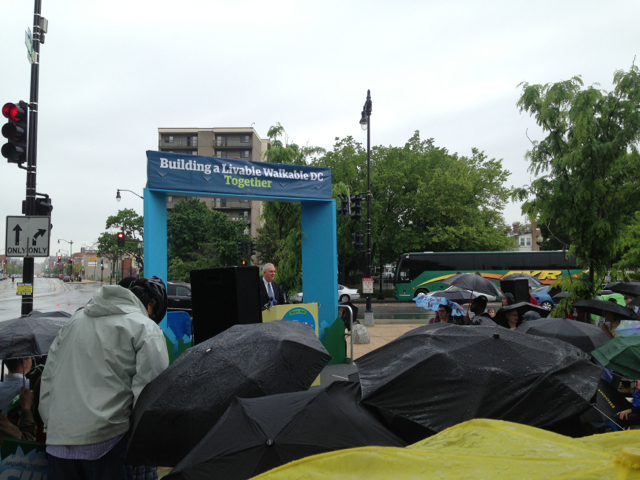
 Photo by Benjamin R. Freed
The District’s 2014 mayoral election officially became a race Saturday when Tommy Wells became the second candidate to enter the contest. Wells, the D.C. Councilmember representing Ward 6, enters the Democratic primary field against Ward 4 Councilmember Muriel Bowser, who kicked off her campaign last month.
A bit fewer than 100 supporters, some drenched, most toting umbrellas, trekked out on a rainy morning to Starburst Plaza—a six-way intersection of H Street, 15th Street, Benning Road, Bladensburg Road, Florida Avenue, and Maryland Avenue NE—to watch Wells begin a campaign that he said he is waging to bring public trust back to the Wilson Building.
“We have seen the greatest ethical crisis in our city since the beginning of home rule, and people want that changed,” Wells said.
Mayor Vince Gray, elected in 2010, has not yet said if he will be seeking a second term, but Wells’ focus on ethics plays in direct response to a mayoralty that has been hamstrung at times by campaign and staffing scandals. Gray’s 2010 campaign remains the subject of a federal investigation over a so-called “shadow campaign” in which the now-former Medicaid contractor Jeffrey Thompson allegedly funded a $600,000 off-the-books operation on Gray’s behalf. The mayor has not been accused of any wrongdoing, but several of his former political aides have pleaded guilty to campaign fraud charges.
The Democratic primary field could also expand with the entry of Ward 2 Councilmember Jack Evans, who has talked about running but has made no public steps toward doing do. Councilmember David Catania (I-At Large) has also been mentioned as a challenger in the general election following next April’s primary election.
Wells also laid out a vision for the city that harps on his longtime mantra of turning D.C. into a “livable, walkable” city. He pledged to halve the number of crimes committed by juveniles, put an elementary school within walking distance of every residential neighborhood, and expand public transportation.
“We’re going to build the next generation of a great public transit system,” said Wells, who arrived at Starburst Plaza on an X8 Metrobus. In the background of his podium was the streetcar track laid into H Street and Benning Road, and the plaza itself was lined with a Capital Bikeshare dock and several bicycle racks. “We’re gonna run the streetcar east before it goes west,” he added in an appeal to voters in the eastern part of D.C. where his base of support is weaker.
In choosing to launch his campaign at Starburst Plaza, Wells did so at the confluence of wards 5, 6, and 7. The speech came after a three-month exploratory period during which Wells held events in all eight wards. That Wells, 56, is running to be the first white mayor since home rule began was not lost on him in an interview a few days before Saturday’s announcement.
“I trust voters in the African-American community to give me a fair shake,” he told DCist on Thursday. “They want great neighborhood schools, safe neighborhoods to walk around. Everyone wants the same thing.”
But in his speech Wells harped most loudly on his ethical record, and his ambition to run a campaign in which all donations come in the form of personal checks. He said he will forgo contributions from corporations and lobbyists, a choice that could put him at a financial disadvantage against his competitors. Still, in three months of exploring a mayoral bid, The Washington Post reports, Wells raked in $150,000 from 500 donors.
He offered his backstory as someone who has seen D.C. move through several eras. Wells, an Austin, Texas native who attended the University of Alabama, moved to Washington in 1985 to take a job as a social worker in the city’s child protective services, later becoming the director of a consortium of family service agencies. After a stint as an advisory neighborhood commissioner, Wells was elected to represent wards 5 and 6 on the D.C. Board of Education. He was elected to represent Ward 6 on the D.C. Council in 2006, and re-elected in 2010.
“Everyone knows we’ve had a difficult journey,” Wells said during his speech, riffing on the crack cocaine epidemic of the 1980s, the District’s stint as the “murder capital of the world,” and transformation to a city with dropping crime rates and widespread gentrification.
“I apologize for the metaphor,” he said, noting the setting, “but today we stand at a crossroads.”