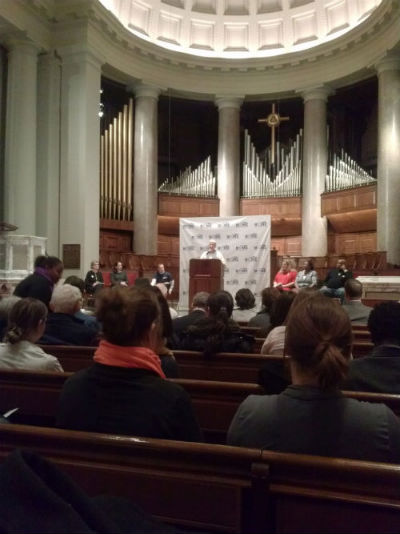
 The Way Home launch. Photo by Sarah Anne Hughes.
In front of a crowd of at least 250 people, local non-profit organizations and community leaders laid out how D.C. can end chronic homelessness by 2017.
Wednesday night’s event served as the launch for The Way Home campaign, an unprecedented effort in D.C. to rally community support behind ending chronic homelessness with the support of several organizations, including the DC Fiscal Policy Institute, Fair Budget Coalition, Friendship Place, Miriam’s Kitchen, the National Alliance to End Homelessness, Pathways to Housing DC, Thrive DC and the Washington Legal Clinic for the Homeless.
Kurt Runge, Advocacy Director at Miriam’s Kitchen, said there are approximately 7,000 homeless people in D.C., 1,800 of whom have been homeless for years. On average, homeless people in D.C. are in their 50s and don’t live past their 60s.
“We’ve lived with homelessness so long we’ve grown to accept it,” Runge said. “People do not have to be homeless for years. We can change.”
The campaign advocates for permanent supportive housing using the “housing first” model, meaning the longterm homeless are housed immediately and then treated for issues like alcoholism or mental illness. This, supporters says, provides needed stability and saves money. The Way Home also aims to end chronic homelessness among veterans in D.C. by 2015, saying an investment of $4.68 million from D.C. is needed to make this a reality.
Nan Roman, executive director of the National Alliance to End Homelessness, says the chronically homeless are at a much higher risk of physical and sexual violence, have untreated illnesses and are disproportionally involved in the criminal justice system. “Because they have to live out their lives in public,” she added.
“They can’t afford to wait around for us to decide we’re ready to do something,” Roman said. “We have a crisis. We have a solution. But we have to move much more quickly.”
Other cities like New Orleans and Portland, Roman said, have successfully tackled chronic homelessness by finding partners, setting a time frame and end date, agreeing on the way to track progress, and making a clear commitment on who will pay.
“Ending homelessness is an ambitious goal, but it’s a doable goal,” Roman said. “D.C. has the capacity.”
Christy Respress, Executive Director of Pathways to Housing DC — which uses the housing first model — told the crowd “it really wasn’t that complicated” to house their clients.
“Housing is the basic proponent,” she said. “We are close, close, close. We have the right factors … to get this done.”
The evening’s most compelling speeches came from two formerly homeless people who are housing first residents served by Friendship Place, one of the seven providers selected by then Mayor Adrian Fenty for the city’s housing first program.
Candi Darley, a nurse who graduated from George Washington University, said “things fell apart” for her after she became ill with fibromyalgia and depression, and her marriage ended. She said she ended up in a shelter then put her name on a city housing list — “I didn’t think it would take long. Maybe six months.” — and waited for seven years with no results. After filling out an application that ended up at Friendship Place, Darley was matched with a case manager and found housing.
“It was the quickness I couldn’t understand,” she said. “It was such a beautiful thing to be looking for a home, and the thought that I could have a key once again to be let into a place that was mine.”
Darley called housing first a “miracle,” adding that once housed people are able to get well. “I’m angry because it seems so simple. Why can’t this be a model for everyone?
“The person you see standing before you would not have been the person you saw five years ago because I was so sick, and it showed on me. Because of the ability to get rest and the correct doctors, I do so much better, feel so much better, look so much better.”
Alan Banks said he “never saw homelessness coming.” But, over several years, major depression consumed his life and he ended up on the streets. “[I was] eating out of the trash, because I was just that hungry,” he said. “Watching people going to and fro, and wishing I had somewhere to go.”
After living in a shelter, Banks found housing through Friendship Place within a week. “I will never forget the day that I realized I had walked from my bathroom to my bedroom without being fully dressed,” he said. “A lot of people take that for granted.”
“I found myself sitting in a park one day. I had not been in this park since I was homeless,” he continued. “I sat on a bench, the same bench I had sat on for hours, and came to the realization it was all the same except for one thing: When I got off that bench, I had a home to go to.”
Councilmember Mary Cheh (D-Ward 3) told those assembled she plans to introduce a resolution to the Council next Tuesday to end chronic homelessness in D.C. no later than 2020. To achieve this goal, the resolution states, “the District’s Interagency Council on Homelessness must coordinate the investment of sufficient resources to plan and create the 2,679 permanent supportive housing units needed to end chronic homelessness by no later than 2020.”
“The support you have is wider and deeper than you may appreciate,” Cheh said. “You certainly have my support 100 percent in this effort.”
According to Gray’s office, local funding for permanent supportive housing increased from $9.4 million in fiscal year 2010 to $21.4 million in fiscal year 2014. Between fiscal year 2011 and fiscal year 2013, the number of permanent supportive housing households increased by 178, despite a $10.5 million cut in federal funding after fiscal year 2011.
The Way Home campaign is asking supporters to contact Mayor Vince Gray and ask him to provide for the funding of the following in the 2015 budget:
While the non-profits involved in the campaign cannot endorse a mayoral candidate, The Way Home will provide training on how to speak to candidates about housing first.
Update: Here, from the mayor’s office, is the homeless services budget from the past few years.