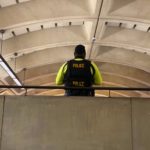
 Photo by Chris Rief aka Spodie Odie.
Here’s something you could be seeing in D.C. soon: Cops wearing body cameras.
The Police Complaints Board issued a report to Mayor Gray, the D.C. Council, and MPD Chief Cathy Lanier this week recommending that the city should implement an on-body camera program for police officers, to help deal with complaints of alleged misconduct.
One of the PCB’s primary functions is to field and investigate formal complaints from public citizens about alleged police misconduct. According to a statement from the PCB, the body cameras, which would be worn by all MPD officers, “can be used to resolve many of these types of citizen complaints and to train officers on proper police procedures.” The PCB also said that requiring officers to wear body cameras could even help prevent “negative police-citizen interactions.”
The program that the PCB is recommending would include an advisory panel, comprised of people from the Office of Police Complaints, MPD, the Fraternal Order of Police, the Office of the United States Attorney for the District of Columbia, the District’s Office of the Attorney General, representatives of the criminal defense bar, the American Civil Liberties Union, the Fair and Inclusive Policing Task Force, MPD’s Citizen Advisory Councils, and “representatives from groups who may be underreporting police misconduct, including
immigrants, non-English speakers, crime victims, and the LGBTQ
population.” The panel would help develop and finalize the program’s policies, while assessing a pilot program for body-worn cameras.
In Laurel, Md., a similar program was implemented last year. Laurel police officers are required to wear “lipstick cameras,” attached to their sunglasses or a headband. According to the Post, while reports say the program has caused complaints against officers as well as the use of police force to decrease, it’s still controversial, as it raises concerns about breaches of privacy.
If the pilot program to implement similar cameras in D.C. proves successful, the PCB recommends that the city should pay for the body-worn cameras.
“Police wearing on-body cameras should produce a number of advantages,” Philip K. Eure, OPC’s executive director, said in a statement. “With the public’s involvement in developing the program, the use of body-worn cameras can lead to better police-community relations, improve officer training, and ultimately enhance public safety.”