 Photo by Matt Cohen.
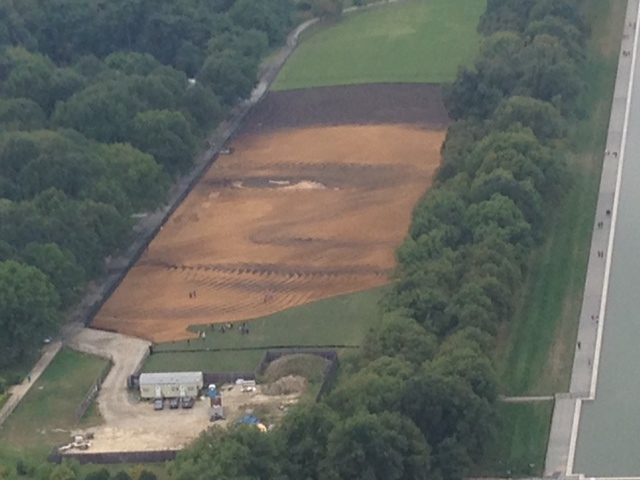
Right now, there’s a giant six-acre portrait of a boy’s face on the National Mall. But you wouldn’t be able to make it out even if you’re standing in the middle of it. You can only see it from the top of the Washington Monument. Or from an airplane. Or from your computer.
The giant landscape portrait, called “Out of Many, One,” was created by artist Jorge Rodríguez-Gerada as part of a collaboration between The Smithsonian’s National Portrait Gallery and the National Park Service. If the name of the piece sounds vaguely familiar—it should—it’s the english translation of “E pluribus unum,” which can be found on the U.S. Seal.
Standing atop the Washington Monument looking at it, it’s an impressively detailed portrait of an anonymous boy’s face. The face, Rodríguez-Gerada tells DCist, isn’t of one person, but rather “a composite of different people from all over the world.” As the title of the piece suggests, it’s meant to represent the diversity of U.S. culture.
For Rodríguez-Gerada, the inspiration for the piece is deeply personal. “I moved from Cuba when I was four years old and grew up in New Jersey with a bunch of Italian, Polish, and Irish friends,” he says. “What this means is that my upbringing—how I was a formed as a person—was really based all these different people who I called friends, who came from all different parts of the world. This diversity that makes America so incredible.”
The mural, which took Rodríguez-Gerada and his team six months to complete—from design to construction—uses 10,000 wooden pegs to create points of reference for the contours of the face. To fill in the shading and facial contrast of the image, 800 tons of topsoil, 2,000 tons of sand, and eight miles of string were used. The funding for the entire project, National Portrait Gallery director Kim Sajet says, was all donated by private donors
It’s all incredibly impressive to hear what went in to making the project, but it leaves one big question: how?
First, Rodríguez-Gerada had to create the image, which he did from combining several drawings and designing them into Photoshop. He then used a high-precision satellite navigation receiver that linked to at least five different orbiting satellites in order to create what he calls his “giant canvas.”
From there, his crew used the data from the satellite navigation receiver to create 10,000 points of reference in order to determine what needs to be filled in and where. The satellite navigation receiver was essentially like his “paintbrush,” Rodríguez-Gerada says.
The piece will be available to the public from October 4 to October 31, at which point NPS will begin to fill the area back in with grass. For those who can’t make it up the Monument, or aren’t flying over the mural, it’s viewable online via EarthCam’s new live streaming webcam, which was embedded into the Washington Monument looking over the mural, which you can view right now.
According to a release, the EarthCam camera engineers designed is a “small, yet powerful, HD camera enclosed in a cylindrically formed aerospace polymer material that has zero impact on the 130-year-old stone structure,” which will allow clear views of the mural to stream online.
Rodríguez-Gerada has created hundreds of murals in neighborhoods around the world, but this is his biggest and grandest piece yet. With an October 30 expiration date, though, its existence is fleeting. Still, that doesn’t bother him.
“A lot of my work is ephemeral because I want to talk about living in the moment,” he says. “I want to talk about not waiting until tomorrow on things, which is something a lot of people do. We’re here now, and the people we love are here now.”