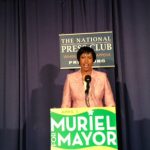
The mayoral candidate that wins the Democratic primary historically has the general election in the bag. At least, that’s been the typical narrative in the historically Democratic District of Columbia for decades. But the city is rapidly changing, and with a proliferation of candidates in different races running as independents, the general election isn’t so predictable anymore.
After a crowded primary election, in which Ward 4 Councilmember Muriel Bowser defeated incumbent Vince Gray in one of the lowest turnouts for an election in years, Councilmember David Catania (I-At Large) announced his mayoral candidacy, with former Councilmember Carol Schwartz announcing her candidacy shortly thereafter. Though the polls continually show Bowser with a respectable lead (the latest poll has her leading by 12 percent over Catania), compare this to the last general election where Gray took in nearly 75 percent of votes, with write-ins accounting for nearly 20 percent, and it’s clear that there’s a real race this time around.
Shortly after the Post published their endorsement for Bowser, DCist caught up with her to discuss some of the bigger issues in this election, like D.C. General, education, transportation, child sex trafficking laws, and more.
Our interview, which has been condensed and edited for length and clarity, is transcribed below. You can read our first interview with Bowser here, and our interview with Carol Schwartz here.
DCist: In their endorsement for you, the Post’s editoral board wrote “those critical or jealous of Ms. Bowser have painted a caricature of a lightweight. That is not the tough politician we have come to know and admire in her seven years on the council. She strikes us as smart, capable and confident without being arrogant.” What kind of temperament do you think it takes to lead this city?
Muriel Bowser: I think it’s important that we elect a leader, first of all, and the kind of leader that brings people together, across the aisle, across the park, across the river, across interest from transportation to housing issues. That has been my hallmark as a Ward Councilmember, which I think is the best training to be mayor of the District of Columbia. I do think it separates me from my competition.
DCist: Speaking of ways to bring the city together, the 11th Street Bridge Park is one private-public way that will attempt to unify all eight Wards in D.C. What are some other ways you would try to unify the city?
MB: I’m glad you pointed out that project because I think it’s an excellent example of how we can use infrastructure and unify the city in non-obvious ways. But it is when you have easy transportation links; it does help people go back and forth for arts, school, and work in a way that’s beautiful and creative. I’m really excited about what’s there. We’ve got to get the money for it, though. My brother attended for me the announcement of the [design] firm selected [for the project]; it was a Dutch firm.
DCist: A partnership between a Dutch firm and a Philadelphia firm, I believe.
MB: I think that’s interesting. I’m really looking forward to projects like that moving forward. But there are a lot of ways to connect the city—and I talked to a lot of people about how to close these gaps, and there are a few that are huge; they are gaping. I intend to appoint a Deputy Mayor that’s going to work directly with me to close those gaps: in school investments; in jobs; creation in matching; and economic development.
DCist: Continuing the discussion of public-private partnerships, what are your thoughts on the current bid to get D.C. to host the 2024 Summer Olympics? Is it a good or bad idea? Is there way to do it that would be economically feasible?
MB: First, I would step back and say that we’re at a time in our city where we can step up. We’re a small town, but we’re the capital city of the world. So, how can we be more like world capitals? We know that world capitals do a lot of things. They take care of the basics: city services; schools; and all that. They also have vibrant arts scenes and restaurants, great parks and public spaces. They have sports and entertainment, as well. We would want to make sure we’re playing on that level and I think that the Olympics is that opportunity.
But here’s where we are now: there’s a privately funded exploration, and that’s exactly where it should be — with the private sector looking into it. But we want them asking the smart questions right now. First of all, how much is it going to cost? What’s our share as D.C.? And we want the whole region paying their shares. We can’t carry the whole ball. What are the other jurisdictions going to do? How can we have these investments that will outlive the games: transportation; affordable housing; and—one of my big goals—connecting both sides of the river. I think we can do all of those things with the right, smart investments.
DCist: A recent investigation by WAMU and the Investigative Reporting Workshop at American University revealed campaign donations with timing that heavily imply a “pay-to-play” culture in the Council. Do you think there’s still a pay-to-play culture in the D.C. Council and, if so, how would you, as mayor, address the problem?
MB: I’ve been proud to go down to the Council for the last seven years and make decisions that are in the best interest for the residents of the District of Columbia, and even more proud that nobody can say otherwise. My record speaks for itself. I do think that there’s room to change our procurement policies, and the P3 bill [public-private partnerships bill] suggests one way to do it. For public-private partnerships, it says that the Council would not actually approve the selected contracts, it would approve the projects. It says that “we want to have a public-private partnership for X, Y, and Z bridge, Council, do you agree or not?” And once the Council agrees to that project, then the professional procurement team in the executive side goes through the procurement process and it never goes back to the Council. So I think that’s one way.
I think that we have developed in our city and in our charter that the Council approves contracts, that there’s a check on the executive, and I don’t know that everybody will be willing to get rid of that check on the executive. But it’s probably too much—it is too much—to do it on every contract for a million dollars. I think we can reserve it for really large contracts, or have some way to approve the contracts—or approve the work—at the beginning instead of at the end. That also saves D.C. residents money because the more businesses that have confidence in coming here to bid on work usually means the work is cheaper, and that’s important.
The other thing that’s important is our procurement process: it helps us achieve other social goals. Not just the bottom line, “How much does this cost?” goal. It is important that the executive agrees with this. If i’m the executive, i’m definitely going to agree with this: that our contractors should hire D.C. residents. We pay, we want our people working, and I think that the government can play a bigger role in making sure we’re matching qualified residents with that work. That’s also important to me.
DCist: A recent White House report said that 95 percent of D.C.’s roads are in poor condition. While the D.C. Department of Transportation disagreed with the report’s findings, it raised an interesting question: the city’s population is rapidly growing, which means it’s going to take a lot to ensure our roadways are reliable. What sort of things would you do to help improve the condition of D.C.’s roads?
MB: That demonstrates the challenge of making sure we have a DDOT that can do a lot of things well. I think it’s important that we have leadership in DDOT that focuses on public transit. I can’t emphasize that enough. But the organizations have to also get the basics right, with street repair, with bridge replacement, alleys, sidewalks, lights, and trees. All responsibilities of DDOT. I don’t know that it’s a resource issue, but I think that we can use our resources more strategically and better and we have to do that.
I also think that public-private partnerships play a role in how we live up to our promises. We’re exploring that now with legislation at the Council that will allow a more streamlined approach to procuring public-private partnerships, especially with infrastructure.
DCist: Many customers are unhappy with Metro, and as a board member, some vocal online critics, like Fix It Metro and WUSA9’s Russ Ptacek, who camped outside your office, think you should answer for this. What do you say to these critics?
MB: I’m really proud to have been on the Metro board at a time when the Metro really needed to regain its footing and restore safety culture, and we’ve seen that. I’ve been a part of the board that called for and shepherded through the Momentum plan. We didn’t really know what Metro needed just a few years ago, and now we not only know what it’s going to cost to achieve a state of good repair, which is what we all are entitled to—that’s the $6 billion—but the growth plan to get us to be able to accommodate the 150,000 people that will move to D.C., and the six million that will move to this region in the next 25 years. And that’s the $26 billion price tag. D.C. is going to be willing to step up to the plate for our share, and now we have to rely on our Maryland folks to step up to their share and our Virginia folks to step up to their share.
I think I’m encouraged by the Democratic leadership in those states who put more of a premium on public transit and also the Metropolitan Washington region as being big drivers of the economy as well. I think we’ll get there. I think we’ll explore all kinds of ways to make sure we get the dedicated funding to do it.
DCist: D.C. has one of the worst child sex trafficking problems in the country, according to advocates, but it’s an issue that doesn’t get a lot of attention. At the moment, D.C. only has four emergency beds available through Fair Girls for child sex trafficking victims. Should the city offer safe harbor to minors found accepting money for sexual acts, as a bill to protect child victims of sex trafficking calls for? Should more resources be directed toward addressing this problem?
MB: This is a terrible problem and I think protecting children should be our first priority in government. I do think that it’s not just us, but a lot of cities have gotten behind the eight-ball on this issue. We didn’t really see it as—we’re treating it as child abuse, or we’re treating it as a crime, and not treating it as a kind of human services problem that it is. I think that we have to look at it a lot differently.
Housing for abused children is high on a list of things we have to do. Even a lot of the children that we see as runaways are homeless. They probably have some history of abuse or trafficking—however we name it, they have some kind of history like that. That’s why they’re living out on the street and finding all kinds of ways to survive. I think there’s a whole lot more we can do to protect children. We support a number of nonprofits that are pretty effective in this space. I would look to work with our whole human services team and with the police to help identify the kids who need help the fastest and find the resources necessary to get it there. We have a pending bill at the Council—we haven’t voted on it yet, I don’t think—but we’ll make sure the law is as robust as possible to deter and punish offenders.
DCist: Recently, a few Councilmembers held a hearing at Howard University to discuss police procedures and policies in D.C. with the community. The testimonies from public witnesses were unified: there’s deep-seated racism in the MPD and a lot of their policies and procedures—stop-and-frisk, jump-outs, and the liberal use of SWAT-like teams—has many District residents fearful of their safety. How do you view the effectiveness of the MPD? As mayor, what would you do to initiate police reform in D.C.?
MB: I grew up in D.C. at a very different time. I have three brothers who grew up in D.C. at a very different time, where vast parts of our city were unsafe. Where crack had taken over our neighborhoods, where we were the murder capital of the world, people fled our city, and our schools were out of control largely because of the violence in D.C. We don’t live in a D.C. like that today and we have a lot of people to thank for it. And more than that, 20 years ago we had a police department that people really didn’t trust. We had hired a lot of cops that were doing the wrong thing, and I know that people were very scared of them. My parents would tell my brothers that there is no reason for them to be out after midnight because nothing good could come of it. A lot of families had that kind of discussions with their sons. Families still have that kind of discussions with their sons. I won’t lead a government where there’s a police department that’s racist, or any institution that’s racist.
At the same time, I have great confidence in our leaders and I think Cathy Lanier is a premiere police chief, and she has done a good job in also making sure that we have good cops on our force and supporting them. Is there more to do? Absolutely. I think one thing that helps is making sure we attract and retain police officers that live right here in the District of Columbia. They know our neighborhoods, they know our people, and they can work in neighborhoods to regain the trust that may be lost when police are trying to keep neighborhoods safe. That’s important.
I’ll tell you a little story: I was at Mayfair Mansions a couple of weeks ago when a child was shot. The police saved the child’s life by not waiting for an ambulance and taking him to the hospital. What I saw there was a community that really trusts the people that are there to protect them. I will work very diligently to make sure we have a police force and leadership that is respectful of everybody’s rights, while keeping neighborhoods safe.
DCist: At the WAMU debate, you said that the school boundary plan approved by Mayor Gray isn’t ready, and that the city and DCPS need to spend more time on it to get it right. But a student assignment member from Ward 7 told us that it’s a “thoughtful plan” that addresses immediate needs, like feeder schools lining up with boundaries and under-enrolled schools. What specific parts of the plan do you think need work and what would be your timeline for retooling the plan and implementing it?
MB: First, all of the numbers of things that the advisory board did was a Yeoman’s job. I know that they were thoughtful; they’re very smart about the needs of schools and neighborhoods across the District of Columbia, and I am thankful for the work that they did. I think there’s some very good parts of the plan: the investments and thoughts around early childhood seats; middle schools, which I’ve been talking about for the last 19 months straight; and recommendations about forming middle schools is a good idea.
My reservations are with the boundaries themselves. I think that we don’t want to have boundaries that exacerbate inequalities in our city. And that’s what I would turn to immediately. In my first budget, we’ll make the commitment to middle schools across the District and I think that we could finalize boundaries in short order too.
DCist: Mayor Gray recently released a plan to close D.C. General by the fall of 2015 at the earliest, replacing it with several smaller, community-based shelters. Meanwhile, The Community Partnership’s contract was passively renewed recently. Last winter was absolutely devastating for the city’s homeless families. What, if any, short term solutions can the city implement to ensure this winter doesn’t have a repeat of last winter? Do you think the plan to close D.C. General is a good one, and do you think the timeline for it is realistic?
MB: The next mayor is going to walk in [to office] in the middle of hypothermia season. One thing that the government can do is to figure out how to keep families in the places that they were in, as long as they’re safe. Some people may be facing eviction. How can we stop that? Some people may be with a family member in a safe environment, and if that family member had a little assistance, they would be happy to house that family as long as needed. Some people were out of work, and they’re working again and now they just need first month’s rent and a security deposit. Those are questions the government has to be focused on right now; how to keep families in the safe places that they’re in.
I think that New York City has been successful in that—they have different names for it, but it’s credentials—we put $2 million in the last budget to work on those types of programs to keep families in the housing that they’re in. Then we know that we’re going to have some emergencies; people who are not in safe places that are going to seek the city’s help. Where are those hotel rooms right now? We need to know them and we need to be able to pay for them. The Gray administration did budget for it—the estimate is that it could cost $10 million. The Council has to be working with the mayor right now to make sure that that happens. Making sure D.C. General is safe and up to code for this winter has to be a priority as well.
DCist: Should The Community Partnerships contract be reviewed more than once a year?
MB: I think that there has to be regular oversight and that happens. Every contract that we have allows for aggressive contract management. I know a lot of people want to say “let’s end that contract and let’s do it right now!” But then the question is, who’s going to provide the services? As I understand it, there’s not a lot of people waiting in line to run D.C. General. And there haven’t been. And that’s our fault, that we haven’t generated the kind of interest in D.C. General to operate it.
DCist: Well then, what can we do to make running out homeless services more attractive to organizations?
MB: Shelters like D.C. General are never going to be attractive to run because they’re not conducive to success. Not successful for the people who are seeking shelter or for the operator. We need to reject the notion that we have a homeless shelter for families of that size.