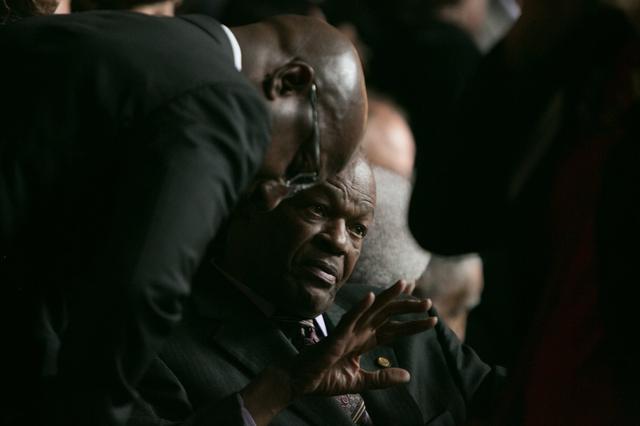
 Getty Images.
Andrea Majanik Bowen, the executive director of Garden State Equality, lived in D.C. from August 2009 to May 2014. Here, she remembers mayor-for-life Marion Barry, who will be laid to rest this weekend, and her time advocating for the rights of transgender D.C. residents.
When I was nineteen years old and interning at a lefty think tank in D.C., I took a day off to see Bill Clinton speak. It was the summer of 2005, and Clinton had by then passed from ignominy in the opinions of pundits and into that beloved bipartisan player that, also in the opinions of pundits, swaths of America seem happy with today. Anyway, I saw Clinton speak, and the day after the event, one of my older colleagues said, mostly sincerely, I think, “Did he make you believe?”
Somewhere in there is a viable comparison to Marion Barry, who will be buried at the end of this week. With Barry, as with Clinton, you have that person of amazing virtue and ideal-killing reversals, of civil rights leadership and love-of-welfare-reform, of economic populism and embrace of economic royalists, of legendary rhetoric and wheeler-dealer blandness, of, well, the stuff of epic 20th century liberal politicians. I had the weird fortune to live in D.C. during the end of Marion Barry’s life. I had the weird fortune to see the contradictions in the man’s character that are probably mandatory for a writer to mention. I had the weird fortune to be an organized-labor-and-then-transgender activist who ran into Barry and, upon hearing him speak up for my causes, believed.
When I say I believed, I don’t mean that I forgot about Barry’s more sinister tendencies, like his opposition to marriage equality and embrace of Bishop Harry Jackson (Jackson, who was about as hateful toward the LGBT community as a person can get without, say, actually killing an LGBT person). What I mean is that in these moments I’m about to tell you about, I understood—through the things I saw and heard from Barry himself—why people loved the guy, why he inspired people, why he had a greatness. What I mean is that for these moments, I felt inspired by him, and even with his history, I thought he was on my side.
My entrance into D.C. politics came from my job at the Iron Workers union. I was a researcher for the Organizing Department, which meant I researched the dark sides of various companies and gathered documentary evidence of the cruel things that bosses did to workers. I also occasionally helped plan and put on events where D.C. Councilmembers would talk about their solidarity with workers. On one occasion, my colleagues and I organized a press conference in the John A. Wilson Building (the building where D.C. Council does its business), replete with Councilmembers. Workers talked about the evils of a company that occasionally worked as a subcontractor on D.C. government projects. At a podium in a Wilson Building conference room, one ex-employee of this company talked about an incident where poor safety standards resulted in rebar cages falling seven stories onto workers below. In another, a D.C. resident and third-year apprentice talked about being underpaid some $11,000 by the company.
Councilmember Tommy Wells stood at the podium as workers told their stories. I sat off to the side, embarrassed by the lack of news coverage. A friend of mine worked for one of the Councilmembers and texted me in the midst of the event: It wasn’t likely that press would show up, because Marion Barry had just pulled up to the Wilson Building with the bumper falling off of his car. That seemed like a reasonable analysis—but then Barry slinked into our press conference, looking around a bit, and sidling up to the podium.
A Barry speech hadn’t been part of the agenda, but no matter. “And now a man who needs no introduction,” announced the emcee, “former Mayor and Councilmember Marion Barry!” Barry stepped to the mic. People shuffled. What he said is from my memory—I don’t know of a recording—but it left a mark. Here’s what I recall Barry saying.
“When I was mayor of this city for sixteen years,” Barry said, as he almost always said, “I stood with the working people of this District. And a company like this has no place getting government contracts.” Tommy Wells stood behind Barry. “Tommy,” Barry said, “don’t you think we should debar this company?”
“Well, Marion,” Wells said, “I’m a New Testament man, and I believe in forgiveness.”
Barry threw his fist down on the podium, and yelled, “THROW THE MONEYCHANGERS OUT OF THE TEMPLE!”
And it was then that I got the Barry sensation.
One of the things happening while I was in that job was that I was transitioning, going from working as a dude in a tie to living my entire life as the woman that I am. I mean to say that I’m a transgender woman, and I was closeted while I worked at the Iron Workers. But I was taking hormones—testosterone blockers and estrogen—in secret during my last year. I went to work looking like a dude (albeit one who was slowly growing breasts), and then went home, dressed like a lady, and occasionally volunteered with DC Trans Coalition, a grassroots transgender advocacy organization. A more established member drafted me, on the basis of the things I had done with the District government, to get a bill passed in the Council that would help transgender people change their birth certificates more easily.
Before the bill passed, a transgender person in D.C. needed to get surgery before getting the “M” or “F” changed to the correct marker. Most transgender people don’t get any of the many surgeries that are available for transition-purposes; medical treatments for transgender people, until very recently in DC, weren’t covered by insurance and cost many thousands of dollars. So the ability to get one’s gender marker changed wasn’t available to most transgender people born in D.C. The bill I helped get passed changed that. It was called the Deoni Jones Birth Certificate Equality Amendment Act of 2013, named for Deoni Jones, a transgender woman who was murdered in February 2012.
I left the Iron Workers in July 2012, started living as a woman full-time and spent August—as I waited to start graduate school the next month—lobbying for the bill. By the time the bill was introduced in February 2013, I had been given guarantees from every Council office that their respective member would support the bill. The bill was introduced at a Committee of the Whole meeting, and every member was present except for Barry. Every member co-introduced or co-sponsored except for Barry. After the bill had been introduced, I checked in with Barry’s staff. “You said Councilmember Barry would support the Deoni Jones Act,” I politely reminded a staffer or two, “but Councilmember Barry wasn’t at the Committee of the Whole meeting where it was introduced, and the Council website doesn’t say whether he’s a co-sponsor or co-introducer. He still supports it, right?” The staffers said yes. Time passed; the website still didn’t list Barry as showing support. I bugged the staff again. They told me it was weird that the website hadn’t been updated to show his support, but he supported it, and the site would be fixed.
Good God, I wanted Barry’s love. Yvette Alexander, the other member of Council who opposed marriage equality, the other Councilmember of a Ward east of the Anacostia River (the standard geographic race and class dividing line of the city) supported the Deoni Jones Act, and her staff helped get it passed quickly. I wanted the bill to be a coming-together of the government for my community; a symbol that LGBT justice wasn’t another battle between parts of the city east and west of the Anacostia River. But winter became spring became summer, and Barry still wasn’t on the record supporting the bill.
In D.C., all bills are passed twice by Council, by law in sessions at least two weeks apart from each other. The Deoni Jones Act’s first passage would be June 26, 2013. I showed up early and walked to the dais over and over again, thanking Councilmembers for their support of the bill as they appeared or finished chatting with various and sundry other people. I kept eyeing Barry, who talked with a seemingly endless succession of people during the immediate lead-up to the Legislative Session. The session was about ready to start. Barry was finally free. I walked up to him. He was looking at his cell phone.
“Councilmember Barry?” I said. He didn’t look up. “Councilmember Barry?” I said again. He still didn’t look up.
Councilmember Wells, who sat next to Barry, nudged his neighbor and pointed to me. Barry leaned over. I extended my hand. “Hi, Councilmember Barry,” I said. “I’m Andrea Bowen? From DC Trans Coalition? I’ve talked to your staff about the Deoni Jones Birth Certificate Equality Amendment Act, and they said you support it. But I wanted to make sure I have your vote.”
“What’s this about again?” he asked.
“Transgender people and birth certificates,” I clarified.
He sat back, then pointed at me. “Transgender. We got this.”
I shook his hand again. “Thank you, Councilmember.”
Transgender. We got this. That wasn’t actually an absolute affirmation, but it was wonderful all the same. The session started, and I sat down. The Deoni Jones Act was first on the agenda. Yvette Alexander, whose committee had jurisdiction over it, spoke first. David Catania, who introduced it, spoke next. Then: Barry asked for his turn to speak. This exchange was actually caught by video, so that we can all actually see and hear Barry saying this.
“Chairman,” he started, “let me thank Mr. Catania and Ms. Alexander for this great leap forward. The District has been a place where we welcome all persons: race, creed, sexual preference, religion—and unreligion. We got to keep that pace going. And I know some people are a little surprised I support this, but I’ve been a long-time supporter of the gay—lesbian, gay, and transgender community. Since 1971, when we had a gay teacher at McKinley Tech High School, about to be fired. I was President of the Board of Education. I said ‘No, it won’t happen,’ and introduced a policy that no one would be fired because of their sexual preference or their orientation or et cetera. I supported domestic partnerships, I supported everything—except one. And so Mr. Chairman, this just is right to do.”
I grew up in suburban Central Maryland, where the more morbid version of the Barry story was the one I grew up with. I always liked sending my parents word about the real adventures in D.C. local politics that I was having, and it felt like some blessed historical corrective to let them know this thing I had just experienced. I texted what had just happened. Since that day, I mention Barry to my parents and they say, “Transgender. We got this.” The Bowen Family came to believe.
I live further up the East Coast now, and am executive director of New Jersey’s LGBT civil rights organization, Garden State Equality. I may never live within the bounds of D.C. again. But I got to live in a D.C. personified by the bizarre greatness of Barry: this guy who was a civil rights leader, albeit an inconsistent one, who came to office as a veteran on the good side of the Second Reconstruction. The tone was set. D.C. became a civil rights leader, at least in statutes. There are horrors: the murder rate during the crack boom; the HIV infection rates; the brutal decrease in affordable housing stock; Barry’s own problems with drugs and alliances with horrible people, like Rev. Jackson. But still, there’s a sort of spirit of the District, which sprouted somewhere from Barry’s tenure, that has made the place a leader in civil rights and in providing for economic justice measures (like attaining nearly universal health insurance before the Affordable Care Act; like ensuring that transgender people have their transition-related health care needs covered by insurance; like being one of the last states to end old-school cash assistance).
Some of these things were in the spirit of the old Barry and against the actions of his late self. But all of them happened because of a certain vision of D.C. that he brought into solidity. I believe in that D.C., even if I don’t live there anymore. Let’s hope that that D.C. lives beyond Barry’s funeral.