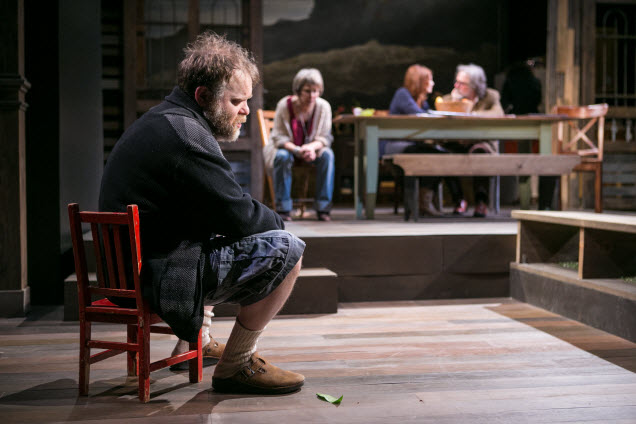
 I think we’re good to just sit here for a while and just talk about our feelings. Sasha Olinick, Naomi Jacobson, Monica West and John Lescault. Photo: C. Stanley Photography
Though the play currently running at Theater J is a world premiere, it feels undeniably familiar. That’s partly because writer/director Aaron Posner’s Life Sucks (or the Present Ridiculous) is an adaptation of Chekhov’s oft-produced Uncle Vanya, and partly because the play hews so closely to the winning formula that brought Posner’s other Chekhov adaptation, Stupid Fucking Bird, such wild success. But in large part, the sense of warm familiarity at the heart of the play emanates from Posner’s meticulously crafted, lovable characters. The old Russian bones of the play are really just an excuse to bring the most charming characters this side of Whedon to life.
Life Sucks borrows a generic horror movie set up: A group of attractive and angst-y people convene in a cabin in the woods, passions and tempers quickly run hot, and someone winds up brandishing a gun. Much of the play’s drama— and I suppose I mean that in both the theatrical and the “teenage girl” senses of the word— is sparked by the arrival of a blowhard professor (John Lecault) and his much younger wife Ella (Monica West), a winter-skinned, auburn-haired beauty whom I am compelled to describe here as a weirdly, stunningly hot version of Judy Greer. Everyone at the cabin more or less falls in love with her, much to her dismay.
Aside from a pulse-pounding moment late in act three, not much actually happens on stage, like a sitcom bottle episode or (maybe more accurately) like a season of In Treatment. What unfolds in a little over two hours on set designer Meghan Raham’s eminently comfortable/impossible looking stage (a cozy, warmly lit, theatrically deconstructed/exploded cabin) is a whole lot of talking. The topic under consideration: whether or not Life does indeed Suck.
I know how this sounds. The characters do, too: The play opens with a prologue where the actors warn you that it’s not too late to leave and go see a play that’s not about love and longing (you could call this breaking the fourth wall, but in typical Posner fashion, that wall isn’t so much broken as non-existent). And indeed, the source text Uncle Vanya really does contain several hours of wealthy people complaining about first world problems.
But Life Sucks is electrified with such hilarious, thought-provoking, and heartfelt dialogue that, against all odds, its two hours seem like a scant and meager amount of time to spend with the deeply-but-likeably flawed characters. For instance: Pickles (the inimitable Kimberly Gilbert) is socially awkward, a “conversation annihilator” who wears nerdy sweaters and plays the ukulele; she’s also blessed with some of the best punchlines of the night (she responds to the complaint that every non-sequitur she spouts leads conversations nowhere with “well… I am the Walrus”), as well as some serious pathos. Her lament about still feeling love for everyone she’s ever loved before— even those who have long since “moved on”— is particularly touching.
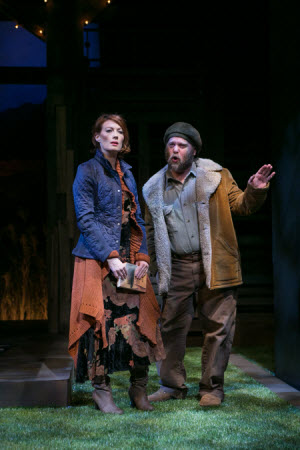 Monica West and Sasha Olinick. Photo: C. Stanley Photography
The rest of the characters are similarly complex, well-rounded, and full of, as one character puts it, beautiful contradictions— a particularly impressive writing feat for a cast of seven. The disheveled, depressed Uncle Vanya (Sasha Olinick) is a “nice guy” who wants Ella to see past his exterior and into his genuinely warm and well meaning core. His handsome friend Doctor Astor (Eric Hissom), meanwhile, winds up winning Ella over without doing much of anything, much to Vanya’s and Pickles’ (whose wooing attempts involve sock puppets, of course) chagrin.
Unsurprisingly, the characters have a lot to complain about. Sonia (Judith Ingber) feels that no one will ever take a romantic interest in her (a situation not helped by everyone falling all over themselves for her stepmother, Ella). But moping is never tolerated: Vanya’s insistance that life, well, sucks, is slapped down with emphatic denial (Pickles: “life does not suck“), or a kindly but stern rebuttal, which is Babs’ (Naomi Jacobson) specialty: “I don’t think it has to be as hard as we make it, I really don’t.”
The fights that the characters pick generally arise because of how much they care for each other— and with the demolished fourth wall, they tend to exude that same sort of care for the audience. Even a private conversation between two characters will see one turn to the audience to roll their eyes or make an appeal that the other is being unreasonable; the effect if not of being a fly on the wall, but of being a (mostly) silent old friend that has joined the gang for a weekend in the woods.
This leaves the audience, collectively, as an awkward third wheel, or a helpless bystander, or, in the case of one monologue from Ella, someone kind of being hit on. Posner runs a seriously strong risk of coming across shmaltzy— a gamble any play that acknowledges the audience takes— but as he proved in Bird, Posner has a unique skill in fostering a (weirdly) intimate connection between the audience and the characters.
But Life isn’t perfect. In so closely replicating the success of his last play, Posner is effectively shooting fish in a barrel— but he’s having a damn fun time doing it. Bird‘s flippant genre-bending, fourth-wall breaking exploration/explosion of theater made more thematic sense in updating The Seagull’s similar exploration of theater. The many appeals and sly, knowing winks (“your life isn’t some stupid fucking play,” Astor gripes to Vanya) to the audience are thrilling, fun, but less earned in a play that focuses more on love and longing than on the state of modern theater.
That doesn’t mean you should turn your brain off to enjoy the play— on the contrary, it’s laden with so many Arrested Developement-like references and in-jokes that it seriously rewards its contemplative viewers. However you decide to view it, though, the play is worth watching. Posner has reconfirmed his writerly chops with another thoroughly enjoyable play. No, Life doesn’t suck.
Life Sucks (or, The Present Ridiculous) plays at Theater J through February 15. Tickets, $10-65, available here.