By DCist Contributor Arielle Milkman
In six to eight weeks, the Arts Coalition for the Dupont Underground will open the eastern side of Dupont’s infamous (and currently abandoned) tunnels to the public for small events. From there, they’ll make the case—and raise $450,000—to use the west side for large performances and art openings.
But first the group has to get rid of the remainders of the space’s long-gone days as a disgraced food court. Namely, the food stalls that were designed to look like trolleys.
On Saturday, a volunteer demolition crew started to do just that, breaking ground for the first time. I was part of the group that tore the space apart with sledgehammers, crowbars, and drills.
We met at 9 Dupont Circle, in a resource center on the west side of the traffic circle, where we were greeted by Patrick Smith, Dupont Underground’s director of real estate, and Braulio Agnese, the group’s managing director.
Smith directed us to take a flashlight, earplugs, safety glasses, a hardhat, neon vests, and crowbars and hammers, and then gave a small safety speech: “If it’s metal it is trying to kill you. Assume metal will cut you. Gloves will help, but they won’t’ prevent slicing through the gloves and your pristine flesh.”
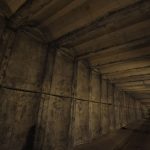
With those comforting words, we were off. Agnese led us through a manhole covered loosely with a piece of plywood, down concrete steps. We passed a small, faded sign that says ‘Dupont Down Under,’ the name of the failed food court, and we were in the tunnels.
Lit by small lamps, the food stalls contained most of their lettering and paint—but inside they were filled with rubble. Some of it was unrecognizable trash, some of it relics of the time when the food court was designed: chunky ‘90s-era computer keyboards laced the floor of Taste of the Orient.
For those unfamiliar with the Dupont Underground’s history, the tunnel served as a streetcar station between 1949 and 1962. It was briefly used as a fallout shelter, but mostly sat vacant until developer Geary Simon made a deal to establish an underground food court. Poorly designed and underused, Dupont Down Under opened in 1995 and closed the next year.
Today, the Arts Coalition for the Dupont Underground has a five-year lease on the property, and is free to demolish the place as it pleases.
So when Smith gave the word, we let loose. I swung a sledgehammer into the side of the Deli and Bakery, “Home of the Original Sandwich.” Only after I hit myself in the ribs with the heavy implement did I ask the guy next to me for a usage tip.
Inside the Deli and Bakery, a volunteer named Alan was ripping up tiles. “Let’s tear this whole wall down,” he said to me, and we did, swinging sledgehammers and levering with crowbars.
We stopped to catch our breath and marvel at the sheer weight of the destruction we were sowing—drywall seeping down in sheets, porcelain tile cracking as it crashed to the floor. “This is so fun,” Alan said to me.
Saturday’s objective was to begin demolishing the food court. From there, Dupont Underground can measure the space and find out exactly how to transform it into a 1,000 person multi-use event space.
“The only things that will work down there are rare things, such as a theater event. Maybe a restaurant if it’s special because it has a lot of live acts going through,” Smith said.
Smith also has ideas for an art gallery, artist studios, shooting space for music and television, growing plants with hydroponics, and maybe even a micro hotel.
The only thing the group won’t be doing in the underground, with certainty: growing weed.
“Everyone was like, ‘You can grow pot down here!’” Smith says. “You can’t, because in order to move the pot out of the space you have to walk across, under, or over federal land … Connecticut Avenue Northwest is a federal highway.”
Architect Julian Hunt assessed the space as we worked. During demolition, a volunteer found the original designs for the food court under a pile of rubble, which will facilitate Hunt’s work. Having the original designs in hand will give the group a much better sense of how to engineer its transformation.
By the time we took lunch, we had demolished walls on two food courts. Agnese was happy with the progress.
“We’re way ahead of where we thought we’d be,” he says.
Dupont Underground will hold several more volunteer demolition events in the coming weeks, which they’ll announce in the coming days via Twitter.