Photos by Pablo Maurer. Words by Matt Cohen.
It’s a rainy, chilly March night and the air underneath McMillan Park is dense and thick. Pockets of the moon’s illuminating glow peek through the holes of the manhole covers that populate the ceiling of the catacomb-esque chamber. It gives off an eerie but nonetheless gorgeous glow of what’s one of the most unique pieces of land in D.C. right now.
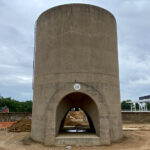
The McMillan Sand Filtration Site—a 25-acre piece of land situated in Northwest, right across from Children’s National Medical Center—was once a fully functional water treatment plant, but it was decommissioned in the mid-’80s. The D.C. government purchased the land from the federal government in the late ’80s with plans to develop it. It’s 2015 and the filtration site remains as is.
It won’t be that way for long, though. The impending development of McMillan Park is perhaps the most contentious debate among D.C. residents right now—especially among the neighbors of the park, where “Build It At McMillan!” or “Save McMillan!” signs frequent front yards.
This is all nothing new, of course. The debate over the proposed development of McMillan has been ongoing for years now. And pictures of the serene underground water cells are nothing new either—the city actually hosted public tours of McMillan’s underground chambers up until 2012. But recently, DCist’s Pablo Maurer and I started visiting the underground chambers in a series of, uh, legally ambiguous trips.
As you might recall, Pablo wrote a series for DCist called “Abandoned D.C.,” in which he’d photograph and write about abandoned places of interest around the D.C. region (or within a few hours drive). The one place Pablo never shot, which happens to actually be in D.C., was McMillan. So we recently made a couple of field trips to check it out.
Why now? Why did it take us so long to finally visit McMillan’s underground chambers? Well, it stems back to the evening of February 25th. That date, as you may recall, is the day before marijuana became legal in D.C. Earlier in the day I’d gotten an email from the D.C. Cannabis Campaign—the group responsible for getting the marijuana legalization initiative on the ballot. Cannabis Campaign chairman Adam Eidinger invited me to their secret “legalization” party, which—for better or worse— was taking place underneath McMillan Park.
They had found a way of getting in (don’t even bother asking how) and had brought a car battery inside, which they used to power trippy lights and equipment for a DJ, who was playing chilled-out ambient noises. Later, I told Pablo about my experience and we decided we needed to check out the space.
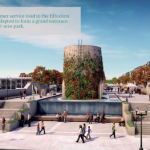
The development team selected to redevelop the property, Vision McMillan Partners, has a massive $720 million plan to turn it into a combination of housing, shopping, and office space, while promising to keep some of the property a park and preserve at least one of the underground cells. Many want it to remain as is or have it fully converted into a park. Others have different ideas for what should be done with it—including turning the underground aqueducts into an urban aquaponic farm or a performance/art space, much like what’s happening with Dupont Underground.
Whatever happens to the space, we do know that it won’t stay like it is now. The gorgeous, cavernous underground cells are truly one of the most fascinating and distinct places in D.C. and it’s remarkable that, in 2015, with all that’s changing in the District, it remains pretty much untouched.