 Rachel Sadon
 (Courtesy of WMATA)
One surge down, 14 to go. And the next one is going to be rough.
Standing in front of the elevated tracks near RFK stadium this morning, Metro General Manager Paul Wiedefeld pointed to the structure and noted that it is both one of the most difficult portions of the line to work on and also one of the system’s busiest.
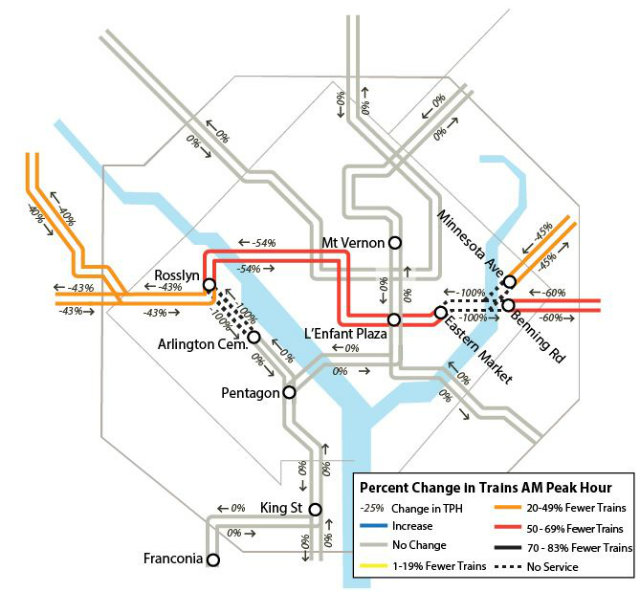
For 16 days, starting on Saturday, the Potomac Avenue and and Stadium Armory stations will be closed entirely, bifurcating the Orange, Blue, and Silver lines.
“This is not like what we went through in surge one. This is greater,” Wiedefeld said. “There will be no trains in any direction, at any time” between Eastern Market and Minnesota Ave/Benning Road. There also will be no Blue line service between Rosslyn and Arlington Cemetery or in the District of Columbia.
It will place “tremendous stress on people coming into the city,” said Prince George’s County Executive Rushern Baker, urging commuters to telecommute, bike, or come in at off-peak times, if possible. The county has increased capacity and waived fares on the 15X bus route, which travels between Greenbelt and New Carrollton, so that riders can hop on the Green Line instead. MARC will also add capacity to its Camden line and the state will step up enforcement of HOV lanes.
WMATA is providing bus shuttle services to bridge the gap at Eastern Market and Minnesota Avenue. But they won’t be able to handle the capacity that Metro normally carries. “The experiences on the bus will be tough,” Wiedefeld said. “You need to come up with a game plan and you need to come up with it now.”
Meanwhile, those who generally come into the city from the southern portion of the Blue line will have to transfer to the Yellow line, as there won’t be bus shuttles making the connection.
The first surge, which ends today and has seen trains largely at capacity on the affected Orange line, has gone well, according to Metro. Enough people diverted their commutes to make the situation workable, and Metro even came out ahead of schedule in a number of track work categories.
But while the first surge entailed continuous single tracking, the second is “a lot more difficult,” Wiedefeld said, “because we are really closing down portions of the line.” More than 60,000 trips are likely to be affected.
“We have 13 more to go after this,” said Metro board member Jack Evans. “Is this the beginning of the end? No, but it could be the end of the beginning.”