Rachel Kurzius
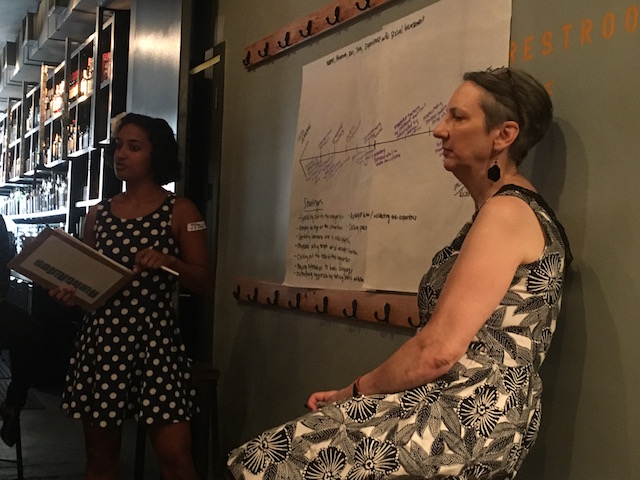 Jessica Raven and Lauren Taylor at the most recent Safe Bars training. (Photo by Rachel Kurzius)
Once seen as harmless or even complimentary, behavior like a never ending barrage of pick-up lines and excessive touchy-feely-ness is getting recast in a new light: unwanted actions on the spectrum of sexual misconduct.
This idea becomes visually apparent at a training for Safe Bars, a collaboration between Defend Yourself and Collective Action for Safe Spaces that trains bar staffers to identify and intervene in instances of sexual harassment and assault. Establishments who’ve received the training get a decal, a la Zagat, so patrons can use that as a factor in choosing a watering hole.
To begin the most recent training, which occurred Monday afternoon at Eat the Rich, Jessica Raven, of CASS, and Lauren Taylor, of Defend Yourself, stood in front of the group with a large sheet of paper that had a line across the center of it. On the left of the line, it said “less severe,” and to the right, “more severe.”
Participants went around the room and gave their names and experiences with sexual harassment. Raven asked where on the spectrum their experience fell and filled it in along the line.
“There’s severe and there’s not severe, but they’re all important,” says Jay Bowman, a host and security guard at Columbia Room. “They all mean something.”
Nearly 20 employees of Drink Company, Derek Brown and Angie Fetherston’s group of bars that, in addition to Eat the Rich, includes Southern Efficiency, Columbia Room, and the currently-under-renovation Mockingbird Hill participated—Safe Bars’ biggest training yet. It took the better part of an hour for folks to share their stories, and you could hear the sighs of recognition as some people spoke.
The otherwise blank line became populated with the employees’ experiences, ranging from things like persistent conversation on the left to attempted abduction on the right. Despite the differences in degree, a pattern emerged: the less severe behaviors displayed the same lack of respect for boundaries and the potential to escalate into something worse.
It shouldn’t come as a surprise that the folks in the room had a ton of experience dealing with harassment. The people who work in bars and nightlife establishments are on the front lines—right where alcohol and the hopes of getting laid meet. Most people can navigate this juncture just fine, but there are those who cross the line.
That’s not to blame alcohol itself for people’s behavior. Studies show that aggressors target those who’ve been drinking. “Alcohol is a weapon or an excuse,” says Raven. “The only thing that causes assault is the decision of the aggressor.”
Safe Bars is designed to help bar staffers stymie the aggressor, using bystander intervention techniques to stop things from going too far. The idea is to design the trainings around ways people can help, rather than frame them as potential aggressors. Raven says people are more receptive that way.
The program received a $20,000 grant from Raliance, an initiative from the National Football League “dedicated to ending sexual violence in one generation” by funding different preventative initiatives.
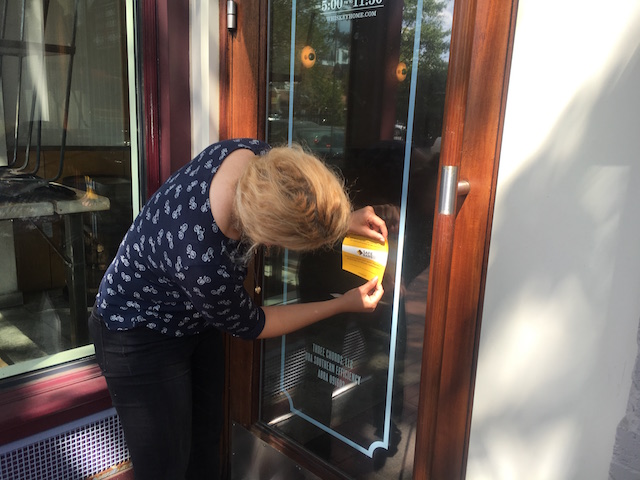 Angie Fetherston, CEO of Drink Company, puts up the newly earned Safe Bars decal. (Photo by Rachel Kurzius)
Along with the Drinking Company establishments, ChurchKey, Birch & Barley, Sudhouse, and Peregrine Espresso have earned their Safe Bar decal, with Mackey’s, The Partisan, and El Chucho all scheduled for upcoming trainings. The Heights and Hank’s Oyster Bar participated in the pilot program, and are due for another training (the Safe Bars designation expires without retraining, because of industry turnover). All of the bars trained so far have been in Northwest, and Raven is looking for participants in other quadrants.
Participants in the Drinking Company training already had tons of techniques for dealing with wayward customers, even if they hadn’t envisioned them as “strategies” before. In discussions, they talked about how to identify a situation of potential harassment—staying alert, watching for body language.
People don’t want to be the spoilsport getting in the way of everyone’s good time. That’s why most of the interventions don’t involve riding in on some white horse and making a grand proclamation. They’re smaller things—distracting an aggressor, helping a patron get to a car home alone—that can prevent an annoyance from becoming something worse. Trainees practiced with a series of roleplaying exercises.
I remember one time I passed out on a table at the McDonalds in Dupont. (Hey! It was late and I was wasted, but my housemates wanted to stop for chicken nuggets!) A woman asked me if I was okay. I was fine—among people I trusted, though perhaps I should have been in bed. But she wanted to make sure that was the case. No harm done, and it made me feel like people had my back.
As city-dwellers, we’re faced with these kinds of conundrums all the time. Something feels a little off, but who are we to intervene? The training sought to emphasize that there are low-risk ways we can help, whereas the cost of inaction can be high.
In addition to a moral imperative, Safe Bars is hoping that bars will want to get involved with the program because it could ultimately help their business. If people feel comfortable in an establishment, they’ll return.
One question, especially among men at the training, was whether someone could perceive an intervention as another skeevy dude trying his luck. There’s no one solution that works for everyone, or for every situation. But Raven and Taylor emphasized being aware, and openly communicating with other staffers, as well as having bars figure out and explain their policies.
“This is our house,” said JP Fetherston, the head bartender at the Columbia Room. “People are guests in our house, but there are rules here.”
If it wasn’t already clear by their participation in Safe Bars, Brown made Drinking Company’s stance crystal to the participants. “We support you 100 percent,” he said. “If you feel like you need to intervene, we will never punish you.” Angie Fetherston, who spearheaded their involvement, agreed.
“It’s important to train people as they come in the door and ensure that they are thinking about this,” Lauren Paylor, the head bartender at Eat the Rich, Southern Efficiency, and Mockingbird Hill told DCist. “It’s easy to take for granted that people know this stuff.”
Bystander intervention training isn’t limited to bars. CASS trained Department of Parks and Recreation staffers at Banneker Pool after a misgendering incident.
Restaurants and organizations looking to participate in Safe Bars should go to the project’s website.