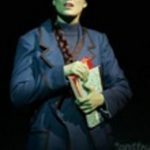
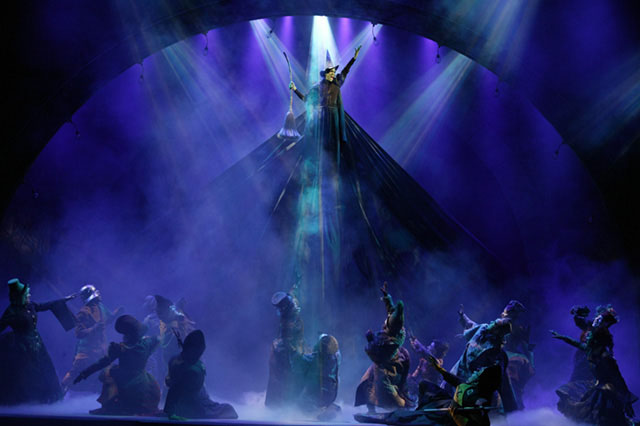
 From the Broadway production of WICKED
A charlatan with a fondness for glitz and glam blows into the capital city. Promising change, pointing fingers, and peddling lies, he gets himself elected to office. Sound familiar?
This guy didn’t make his grand entrance on an escalator, though, but on a hot air balloon. The comparisons between the Wizard of Oz and the victor of the 2016 presidential election are easy enough to make, but pay no mind to that man behind the curtain. Wicked mostly focuses on Elphaba (Jessica Vosk), the Wicked Witch of the West and Glinda (Amanda Jane Cooper), the Good Witch of the North, though it is about much more.
Written by Winnie Holzman, based on the novel by Gregory Maguire, and featuring music and lyrics by Stephen Schwartz, the touring musical is currently making a stop in D.C. It’s a good time for it too, as Americans face outward displays of prejudice and distrust of anyone who might be perceived as “other.”
If that doesn’t sound like the story you’re used to, strap in. As marketing materials will tell you, so much happened before Dorothy dropped in. Wicked begins immediately after that, though it soon takes us back in time to provide some unique context to the beloved story. In the aftermath of the Kansas farm girl’s surprise visit to Oz, word in Munchkinland is that the Wicked Witch is dead. Rumor also has it that Glinda had been her friend.
“Why does wickedness happen? That’s a good question, one that many find confusifying,” the perky blonde enchantress says from her giant floating bubble. She explains to the assembled citizens that the Wicked Witch once had a family and “a mother, as so many do.”
It’s not all black and white. People come in shades of grey—or green in this case. If you’re accustomed to the 1939 film The Wizard of Oz, the Wicked Witch is just that—pure evil. Glinda is purely good. But things are rarely that simple, and people are complex creatures with their own backgrounds, hang-ups, successes, and disappointments.
Elphaba’s story unfolds from its unfortunate beginning. Born the color of pond scum, she enters the world to gasps and disgust, which follow her all the way to Shiz University. She enrolls at the same time as her paraplegic sister Nessarose, played by the honey-voiced actress Kristen Martin.
Wheelchairs are not a strange sight, however, unlike Elphaba’s skin. To cope with the stares, taunts, and relentless questions, “Elphie” takes the aggressive approach. She chooses to openly confront the things others say and feel about her. “I don’t cause commotions. I am one,” she says at one point.
But it’s clear that Elphaba yearns to belong as much as anyone else.
Audience members witness bullying and sweet schoolyard crushes, cruelty and kindness, acceptance and exclusion, censorship, and bigotry. These are themes that resonate with teenagers and older generations alike. Magic, talking animals, and green skin aside, Wicked is a surprisingly relatable play.
“Defying Gravity” is an arresting scene that brings Act I to a close and audience members to their feet. As Elphaba rises above the stage, her cape extends to the floor, making her larger than life. Vosk’s vocal gymnastics in the musical’s most well-known song are as powerful as the message. Its theme of refusing to be held down is inspirational for anyone looking to conquer a personal mountain or battle haters in 2016.
Wicked is on stage at The Kennedy Center through January 8th. Tickets ($99-$359) are available here.