 Photo courtesy of Marshall Moya Design
There’s a new outdoor art exhibit on the U Street Corridor designed to raise awareness about public harassment in order to encourage safer interactions on D.C. streets, but critics say it’s contributing to the problem.
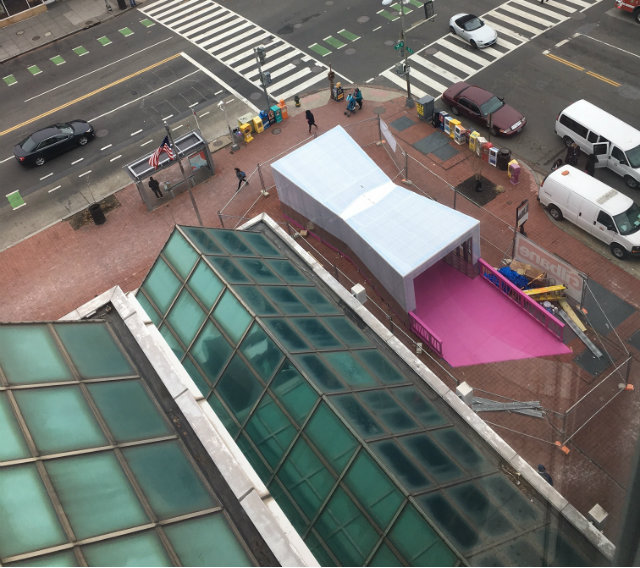
The Walkway, which opened yesterday next to the Reeves Center, is a collaboration between the D.C. Commission on the Arts and Humanities, the District Department of Transportation, and Age-Friendly DC, which commissioned the exhibit as part of D.C.’s Vision Zero plan to eliminate traffic fatalities in the District by 2024, introduced by Mayor Muriel Bowser in December 2015.
One of Vision Zero’s strategies is to establish an initiative to enhance safety through placemaking and public art, which birthed The Walkway. The action plan also mentions establishing a street harassment task force.
The exhibit is intended to “inspire understanding and respect to make the streets of D.C. safe for residents and visitors,” according to a release from Marshall Moya Design—the company responsible for the concept, design, research, and project management of the exhibit.
The Walkway is comprised of panels that include stock images of diverse people and written reflections from actual District residents who’ve experienced unfavorable encounters with strangers in public.
One of the anonymous quotes reads:
“There’s a big difference between being polite and friendly and being harassing and intimidating. But it can be subtle at first and that’s the scariest part—you never know so you always have to be defensive. I feel like if I get harmed or sexually assaulted, I’ll be blamed.”
The Walkway also includes an audio portion with general street and traffic noises as well as catcalling, whistling, and other sounds meant to simulate what a person might hear on a city block.
The center of the exhibit is designed to feel claustrophobic, evoking feelings of discomfort to “create a connection with how street harassment makes an individual feel,” according to the project’s FAQ sheet.
“We hope that through storytelling and observation, we can continue to push the nation’s movement towards ending all forms of harassment and disrespect,” says Zarela Mosquera, design strategist at Marshall Moya Design, in the release.
But not everyone believes that the exhibit accomplishes this goal.
Jessica Raven, executive director of Collective Action for Safe Spaces, told DCist that one of her concerns is that the piece is a trigger for people who experience street harassment on an almost daily basis in D.C. with “unwanted, demeaning comments that often escalate to following, grabbing, groping, assault, or even murder.” A tunnel that “shouts harassing comments at people” can be harmful, she says.
Jonathan Rogers, a transportation management specialist at DDOT, says that the agency isn’t “trying to subject anyone to street harassment, but we do think it’s part of a culture change and there are definitely people who think this is just a fact of life and it happens.”
He says the agency wants the exhibit to be an educational experience for people “who don’t think [street harassment is] a problem.”
Still, Raven says, she’s heard reports from passersby who say “they can hear the honking and comments” from outside of the exhibit. Cecilia Dos Santos, a CASS volunteer, says the noises from the automated machine prompted her to stop walking down the street to investigate. “It almost feels like you don’t have a choice of whether or not to participate in this piece,” she says.
In response, Mosquera tells DCist that the design firm can turn down the audio if DDOT and the other partnering agencies believe it’s necessary. “At the moment, they are totally fine with it,” she says.
But even if people engage with the exhibit on their own, Santos says she’s worried that it doesn’t provide enough context around the issue. While it shows people what it feels like to be harassed and provides reflections, it doesn’t give any statistical data around just how much of a threat it can be.
Instead of contextualizing it as a potentially violent occurrence, it’s leaving the subject of street harassment “neutral and open-ended.”
Mosquera says that the exhibit’s initial concept did include data, but they moved away from that model because they felt that “stories and the human element” would have a greater impact.
In collecting feedback, she says people have thanked them for bringing awareness to the subject and adding the diversity of people to the exhibit. She says that women said they saw themselves in some of the stories “and they can really relate.”
Mosquera says that she’s “really open to feedback” whether it’s negative or positive. “The more we get, the better we can improve,” she says, adding that Marshall Moya hopes to evolve the project if it has enough support. She also says that the company will soon put street harassment data on the project’s website.
Rogers of DDOT adds that feedback about the project will also be used to enhance Vision Zero initiatives. Although DDOT doesn’t have hard data on the subject, the Vision Zero team has heard anecdotal stories in which pedestrians have made unsafe decisions in order to avoid areas where they’ve previously experienced street harassment.
He says that responses from The Walkway can be used to better examine the correlation between street harassment and traffic fatalities.
The exhibit runs through March.
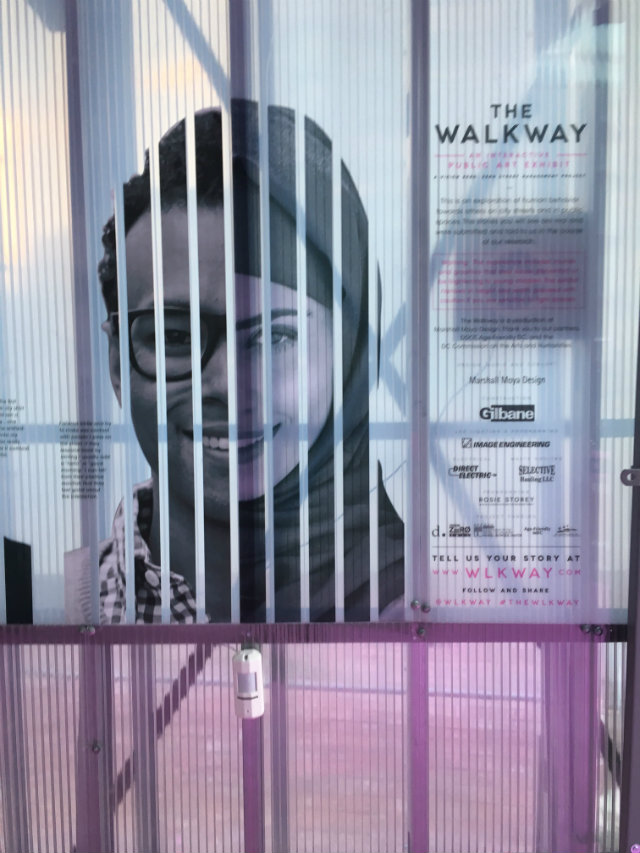 Photo courtesy of Marshall Moya Design