 Rachel Sadon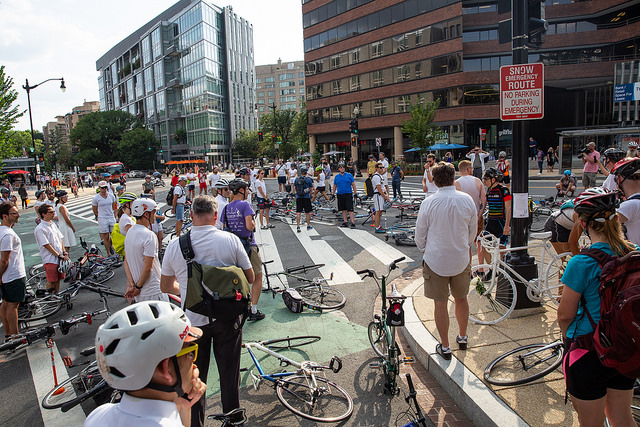
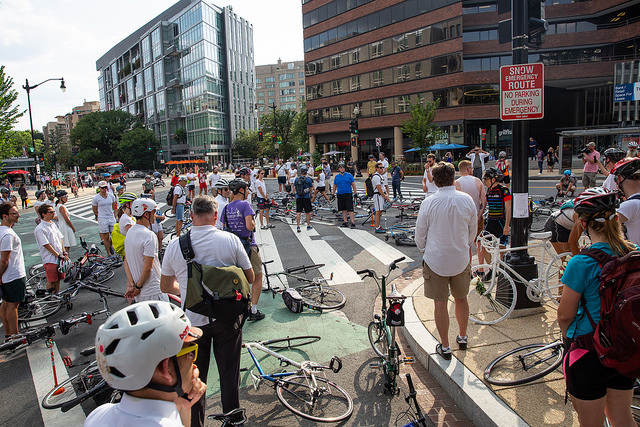 Cyclists hold a memorial at the intersection of M Street and New Hampshire Avenue NW, where Jeffrey Long was killed while riding a bicycle. (Photo by Aimee Custis)
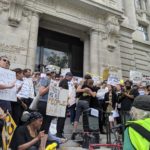
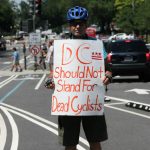
In the wake of two cyclist deaths in a span of two recent weeks, the Washington Area Bicycle Association is leading a protest at the John A. Wilson Building on Thursday to demand the city do more to eliminate traffic fatalities.
“The numbers are just going up, and we think this is fundamentally a priorities problem and a leadership problem,” says Colin Browne, WABA’s communications director.
Mayor Muriel Bowser announced in December of 2015 that the city would undertake an ambitious effort called Vision Zero, modeled after a Swedish policy, to eliminate all traffic fatalities by 2024. But the numbers have risen the last two years in a row, and are on pace to do so again, according to data from the Metropolitan Police Department. There have been 20 such fatalities this year, in comparison to 19 at the same time in 2017.
Two of them are cyclists: 19-year-old Malik Habib and 39-year-old Jeffrey Long.
Habib was killed after his bike tire got stuck in the H Street streetcar rail and he fell into the path of a charter bus on June 23. Exactly two weeks later, Long was struck by a truck making a righthand turn from M Street NW onto New Hampshire Avenue. He died the following day.
On H Street NE, the Department of Transportation has long put out educational materials about riding safely in the corridor and encourages cyclists to stick with bike lanes on parallel streets. And in the wake of Long’s death, the agency removed some parking and added signage to make the bike lane more visible to drivers.
But despite a steady investment in bike infrastructure that earned the city “Gold Bicycle Friendly Community” status earlier this year by the League of the American Bicyclists and a pledged commitment to Vision Zero, some advocates believe that the city isn’t doing nearly enough.
“We have this gold status—the D.C. government is bragging about that, is bragging about Vision Zero. But where are we? Two cyclists got killed in two weeks,” said Rachel Maisler, who serves as the Ward 4 representative on D.C.’s Bicycle Advisory Council, after Long was killed. “That’s not acceptable.”
Browne says the two cyclist’s deaths prompted WABA to think about why things haven’t changed, despite D.C.’s pledge to reduce traffic fatalities.
He believes that Vision Zero’s emphasis on data and technology makes it easier for city officials to sidestep difficult choices for “technocratic and bureaucratic reasons,” and that ultimately Mayor Muriel Bowser hasn’t pushed hard enough.
“Her government is trying to accomplish a lot of different things. People not dying on the road needs to be at the top of that list,” Browne says. “The mayor needs to be out there saying ‘bureaucracy is not an impediment. You have my buy-in to go fix this and make it work.'”
WABA is also calling on the Bowser administration to complete the Vision Zero action plan released in 2015. The mayor put out a progress report in 2016, but hasn’t released updated information since. Browne says he has also unsuccessfully sought answers as to whether an interagency workgroup, with leaders from a relevant city agencies, has been holding regular meetings.
“Ensuring the safety and well-being of all residents and visitors is Mayor Bowser’s top priority. Any loss of life is tragic and we will continue working diligently to prevent fatal crashes,” DDOT director Jeff Marootian said in an emailed statement on Wednesday.
He points out that Vision Zero has resulted in “increased transparency in our safety data, new bike lanes, intersection bicycle improvements, new trails, new traffic signals, and better signage and markings,” along with a task force to review major crash incidents.
Marootian added that a progress report will be released this summer, but did not address the question of an interagency working group.
“We will continue to work with internal and external stakeholders to address safety concerns and look forward to ongoing dialogue around this issue,” he said.
But Jacob Mason, the president of pedestrian advocacy group All Walks DC, which is joining the protest, echoes the claim that the political will isn’t there.
“All too often when tough choices are faced between safety and other considerations, the safest choice is not chosen,” he says.
Even when the government has good regulations in place, Mason argues, they often get sidestepped for convenience and other reasons. He points to a 2013 city law that requires “safe accomodations” for cyclists and pedestrians when a sidewalk or bike lane must be closed for construction. All too often, he says developers get an official waiver or simply flout the rule without consequence.
“The policies are only as good as the support politically for them to be actually implemented,” Mason says. “We know how to make our streets much safer, we’ve known for decades. The problem is they’re not choosing to do so.”
Browne acknowledges that difficulties implementing Vision Zero aren’t unique to D.C. Several other cities, Toronto among them, have seen increases or only slim decreases in traffic fatalities since making similar pledges to eliminate traffic fatalities.
“It’s a very easy thing to promise and a very hard thing to implement,” Browne says. “The top-level goal is very popular. But when you get to the level of implementation, it affects people’s lives in ways that they didn’t expect and all of a sudden, they are less excited about it. The way you lead about that is you make the case as an elected official that ‘this is more important and here’s why,’ and we haven’t really seen that from the mayor.”
About 100 people have indicated that they plan to attend the rally, which will begin at noon.